Get Full Government Meeting Transcripts, Videos, & Alerts Forever!
Get email alerts on the Foster Care And Guaranteed Income topic
No spam. Unsubscribe anytime.
Lawmakers press agencies on foster‑care coordination, mandated‑reporting training and guaranteed‑income pilot expansion
Summary
Committee members reviewed multi‑agency foster‑care coordination efforts, asked for scoring updates on AB 2083‑related work, and discussed mandated‑reporter training costs and a guaranteed‑income pilot for former foster youth and pregnant people; agencies requested more time and offered implementation options.
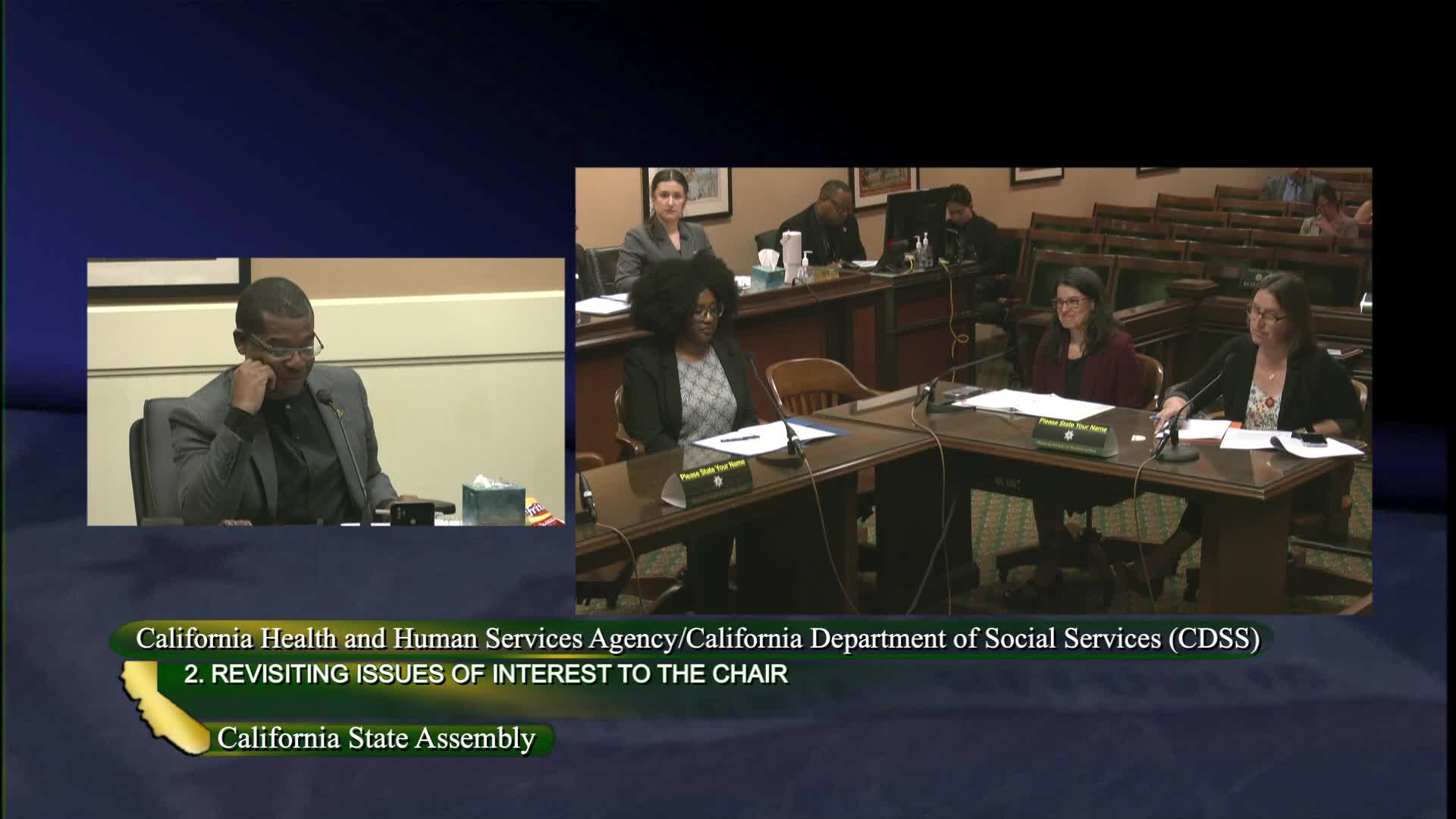
Officials told the California State Assembly Budget Subcommittee 2 on Human Services that coordination across state and local actors remains the priority for foster‑care system reforms, and they provided technical notes on mandated‑reporter training and the state’s guaranteed‑income pilot for former foster youth and pregnant people.
Jennifer Troyer of the Department of Social Services summarized existing multi‑agency efforts, including Assembly Bill 2,083, the complex care steering committee, the Child Welfare Council and memoranda of understanding at local levels. Troyer said the state is “building on the strengths of these multi‑agency collaborative efforts” and that the department had no additional technical assistance to offer beyond prior briefings, while offering to provide a fiscal scoring update when requested.
On mandated‑reporter training, CDSS said updates are underway and that implementing a statutory requirement to use the updated training would carry costs. The department estimated one‑time costs in the “low millions” for delivery and ongoing costs in the “hundreds of thousands” for staff time, and said it would provide a more specific fiscal estimate to the committee.
On guaranteed income, CDSS said the state currently oversees pilots that target former foster youth and pregnant people. The department referenced a Department of Finance estimate that closing a tax exemption would generate roughly $119,000,000 in state revenue and said that planning assumptions for a permanent program should be based on that revenue universe. CDSS advised drafting new statutory language if the Legislature wants a permanent program and suggested distributing funds to counties via allocations rather than repeatedly running competitive grants to reduce administrative overhead.
Committee members asked for follow‑up: verifying scoring for the foster‑care multi‑agency office item; more precise fiscal estimates for mandated‑reporter training; and further analysis comparing state‑run versus county‑administered guaranteed‑income models ahead of May revise discussions. Public commenters from advocacy organizations and county associations voiced support for automatic enrollment, community‑supporting mandated‑reporting reforms and AB 661 (guaranteed‑income research and expansion legislation) and asked the Legislature to fully fund related research and expansions.
No votes were taken on these items during the hearing.