Get Full Government Meeting Transcripts, Videos, & Alerts Forever!
Get email alerts on the Conservation Districts Funding topic
No spam. Unsubscribe anytime.
Conservation districts ask lawmakers for increased operational funding, warn MEEP trust fund faces shortfalls
Summary
The Michigan Association of Conservation Districts told lawmakers that 75 locally led conservation districts deliver voluntary technical assistance and outreach across the state and asked for a $10 million boost to state operational funding to expand staffing and capacity.
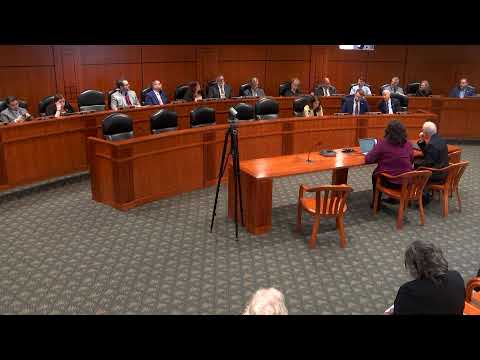
Representatives of the Michigan Association of Conservation Districts (MACD) told the committee that Michigan's 75 conservation districts deliver voluntary, nonregulatory conservation services on private land and that current state operational funding limits their capacity to serve every county.
Jerry Miller, president of MACD and chair of the Kent Conservation District, introduced the panel and said the association and local districts partner with the U.S. Department of Agriculture Natural Resources Conservation Service (NRCS). He introduced Rivkah Hutchinson (executive director of MACD) to present the association's materials; Diane Gray, the NRCS state conservationist, attended as a partner.
What MACD told lawmakers
Hutchinson said conservation districts are "locally organized special purpose units of state government" that provide technical assistance, education and voluntary conservation practice implementation. She listed core programs conservation districts participate in, including the Michigan Agricultural Environmental Assurance Program (MEEP), the Conservation Stewardship Program (CSP), EQIP (Environmental Quality Incentives Program), a produce safety program unique to Michigan, Regional Conservation Partnership Program (RCPP) activities, cooperative invasive species management areas (CISMAs), and reforestation/tree sales.
Hutchinson provided program and participation figures: conservation districts carried out 1,791 outreach events in fiscal year 2022, reaching more than 129,000 people and attending 1,146 local government meetings. She said state operational grants total $3,000,000 annually (about $40,000 per district) and argued that each $1 of state operational funding leverages $5.10 from other sources; when federal funds are included MACD estimated a return of roughly $43 for every $1 invested.
Funding request and consequences
MACD asked lawmakers to increase state operational funding; Hutchinson said an additional $10,000,000 would allow each district to hire a full-time district manager and a full-time conservation planner to expand capacity and better leverage federal Farm Bill funds.
Committee members also spent substantial time on the Michigan Agricultural Environmental Assurance Program (MEEP). MACD said the MEEP trust fund is supported by a per-ton fertilizer fee and a per-pesticide-registration fee; they told the committee inflation has eroded the fund and MDARD eliminated two positions in FY25 because of revenue shortfalls. Hutchinson said the association is "working very closely with the department" and with state senators to seek increases to the trust fund fees.
Why it matters
MACD emphasized that 72% of Michigan land is privately owned and that conservation districts serve as the primary delivery mechanism for technical assistance and locally tailored conservation, helping reduce long-term costs such as flood mitigation. Hutchinson cited an annual flood-mitigation benefit figure for Michigan wetlands of about $4,770,000,000 as an example of larger economic benefits of conservation work.
Committee Q&A and follow-up
Members asked how landowners find conservation districts (Hutchinson said online searches, annual tree sales and USDA NRCS co-location are common entry points), about reforestation programs and tree sales (districts choose species suited to local conditions and sell seedlings with planting guidance), and about how districts respond to recent storm damage and wildfire risks in the Upper Peninsula (MACD representatives described a replanting cost-share grant starting that year and said staff were active on the ground).
Ending
MACD's presentation concluded with a formal request for increased state operational funding and support for MDARD's Freshwater Protection Fund request. Committee members thanked presenters and moved to other agenda items; no immediate funding decision was recorded in the transcript.