Get Full Government Meeting Transcripts, Videos, & Alerts Forever!
Get email alerts on the Interdepartmental Grants topic
No spam. Unsubscribe anytime.
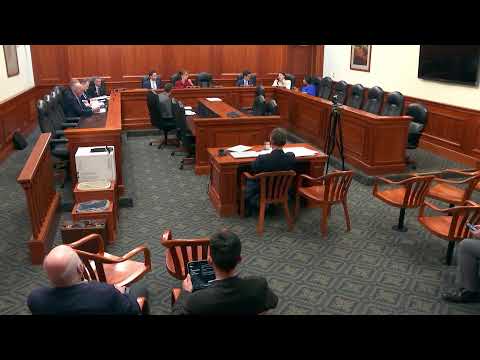
House subcommittee hears how MDOT uses interdepartmental grants to reimburse other state agencies
Summary
William Hamilton, fiscal agent with the Michigan House Fiscal Agency, told the Appropriations Subcommittee on State and Local Transportation that interdepartmental grants in the Department of Transportation budget reimburse other state departments for services that advance the transportation program.
William Hamilton, fiscal agent with the Michigan House Fiscal Agency, told the Appropriations Subcommittee on State and Local Transportation that interdepartmental grants in the Department of Transportation budget reimburse other state departments for services that advance the transportation program.
Hamilton told the committee that the enacted transportation budget includes separate line items for IDGs and that the current-year gross appropriation for those grants and contracts totals $50,700,000. “Interdepartmental grants are simply a budgetary tool that allow for one State Department to effectively reimburse another State Department for services performed,” he said.
Hamilton said the IDG line items cover work performed by the Civil Service Commission, the Attorney General, the Department of Technology, Management and Budget, the Michigan Department of Treasury, the Auditor General, Environment, Great Lakes, and Energy, and the Secretary of State. He highlighted that the Michigan Transportation Fund (MTF) includes a $20 million statutory cap for IDG payments to the Secretary of State to partially reimburse that office for vehicle registration and title collection costs, while the total cost of branch operations tied to registration collection is closer to $90 million.
Hamilton explained the budget accounting practice: the same $20 million appears both in the Secretary of State’s branch operations appropriation and as an IDG in the transportation budget so the appropriation can be tracked in both places; statewide budget reporting uses an adjusted gross appropriation figure to avoid double counting.
Committee members asked how the actual costs are validated. Hamilton said the Auditor General audits IDG costs and noted there is an external cost allocation study that analyzes branch operations and the portion attributable to vehicle registration. He said those audits or studies appear on a biannual schedule and that departments submit letters each year comparing costs to appropriation amounts.
Hamilton also described contractual and audit practices used when MDOT contracts with other agencies or local units, saying agreements typically set a “not to exceed” amount and are subject to periodic audit.
The subcommittee did not take further formal action on IDGs during the meeting and Hamilton said he was available for follow-up questions.
Ending: Committee members requested follow-up material, including more granular cost figures and audit reports; Hamilton offered to provide additional documentation on request.