Get Full Government Meeting Transcripts, Videos, & Alerts Forever!
Get email alerts on the Utilities Water Sewer Rates topic
No spam. Unsubscribe anytime.
San Luis Obispo council authorizes Prop 218 notice to consider 2025–27 water, sewer rate increases
Summary
The San Luis Obispo City Council voted 5-0 to authorize mailing Proposition 218 notices to begin the public protest process on proposed 5.5% annual water rate increases and 6.5% annual sewer rate increases for fiscal years 2025–26 and 2026–27.
The San Luis Obispo City Council voted 5-0 to authorize staff to mail Proposition 218 notices that begin the public protest process for proposed water and sewer rate adjustments for fiscal years 2025–26 and 2026–27.
Julie Ridgeway, utilities business manager, introduced the proposal and said, “So for water, our proposed rate adjustments are 5.5% annual increases over the next 2 fiscal years.” She said the sewer proposal would be higher in the near term — 6.5% for the next two fiscal years — largely because Cal Poly will begin treating most of its campus wastewater on site, which the city estimates will reduce sewer fund revenues by more than $900,000 a year starting in fiscal 2026.
The council’s action authorizes the release and mailing of Proposition 218 notices and sets public hearings for June 17, 2025. Ridgeway said the city will mail 28,565 notices to parcel owners and account holders; she told council that there are 17,161 parcels in the city and that a majority protest would require 8,580 valid parcel protests plus one.
Why it matters: Utilities staff said the proposed increases are intended to keep enterprise funds self‑sustaining while paying for planned capital improvements, repairs from winter 2023 storm damage (including the Nacimiento pipeline and road repairs), regulatory compliance costs and inflation. Ridgeway said the city has pursued grants and alternative funding to reduce rate pressure and that over the past seven years the utilities team has secured more than $22 million and applied for about $7.5 million in additional funding.
What staff told the council - Drivers: staff cited increased capital project costs, added projects after the 2023 storms, higher regulatory compliance costs, inflation and decreased sewer revenue from Cal Poly’s new treatment facility. - Customer impact: Ridgeway provided a sample residential bill for a median single‑family home with a 3/4‑inch meter using five units (about 2,992 gallons), saying the example customer’s bill would rise by roughly $8.50 per month under the proposal. - Consumer protections and outreach: staff said they plan community outreach, an informational session on June 4 at the Ludwig Community Center, translated materials in Spanish on the city website and expanded notice distribution. They also said protest forms must include the service address and an original signature and that only one valid protest per parcel counts toward a majority protest. - Affordability measures: staff proposed increasing the percentage discount for qualifying customers in the City’s customer assistance program from 15% to 20%; they said details and a draft resolution will be on the June 17 agenda.
Cal Poly, drainage and revenue interaction During consideration of the consent agenda and public comments, Cal Poly representatives and city staff addressed a neighborhood drainage concern near Hay/Slack Street. Timmy Tway, community development director, noted the Vista Meadows project is outside city jurisdiction but said Cal Poly must comply with stormwater regulations. Mike McCormack, Cal Poly vice president for facilities management and development, said, “all of the drainage contained on the site that we're redeveloping will be dealt with as part of the project,” and offered to assist with off‑site runoff that originates off Cal Poly property.
Council questions and follow up Council members asked how much of the rate increases were attributable to Cal Poly’s change in wastewater treatment. Staff said roughly half of the sewer fund’s rate revenue requirement for the first year of the adjustment — expressed by staff as about 48% of the first‑year rate revenue requirement and about 21% of the second‑year additional requirement — was associated with the projected Cal Poly reduction, and that translated to roughly 3 percentage points of the overall increase. Staff also said if Cal Poly delays bringing its treatment plant online, the city could return at midyear with adjustments; adopted rates can be reduced later if revenues are higher than projected.
Planned projects and resilience work Staff noted major near‑term work that the rates are intended to support: advanced metering infrastructure (AMI) rollout, groundwater well construction and delivery, maintenance at the water treatment plant (ozone system, filter media and underdrains), evaluation and possible replacement of a major storage tank, replacement of large distribution mains, sewer collection system renewal and lift station upgrades. AMI will allow customers to view near‑real‑time water use and set leak alerts; staff reported about 313 customer radios are currently active on an existing opt‑in system.
Public hearing and protest process If council does not find a majority protest at the June 17 hearings, they may adopt rates up to the proposed amounts. Staff said protests must be submitted before the hearing close, must include original signatures, the service address and indicate protest. Notices and related materials will be posted on the city's website and made available in the city clerk's office; staff also said they will continue direct outreach with local community groups and student services at Cuesta and Cal Poly.
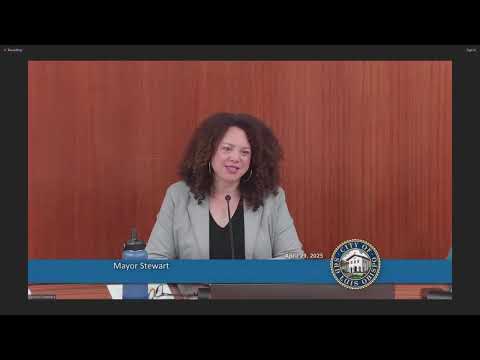
The council took the action by roll call: Mayor Erica A. Stewart — yes; Council Member Boswell — yes; Council Member Francis — yes; Council Member Marx — yes; Vice Mayor Schorzmann — yes. The motion passed 5-0.
Ending: Staff said they will return June 17 for the Prop 218 public hearings and that, if adopted, the first of the two annual increases would take effect July 1, 2025. The council and staff emphasized continued outreach and additional briefings before final adoption.