Get Full Government Meeting Transcripts, Videos, & Alerts Forever!
Get email alerts on the Community Services Block Grant topic
No spam. Unsubscribe anytime.
Council committee reviews CSBG oversight as UPO leaders and DHS testify on program reach and controls
Summary
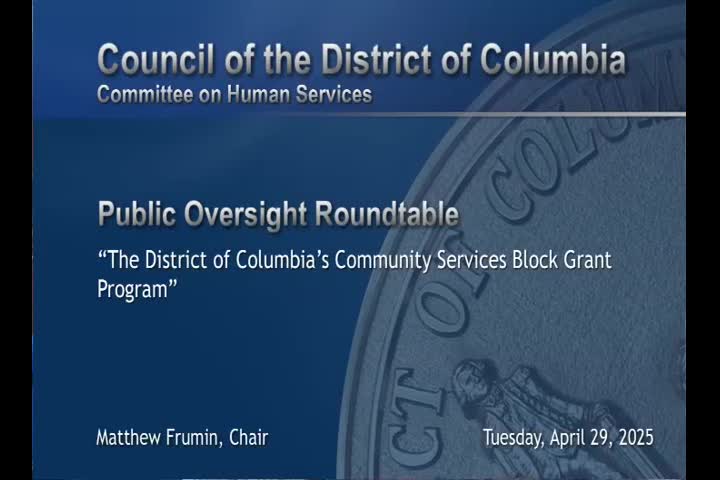
The District of Columbia Council Committee on Human Services held a performance oversight roundtable April 29 to review administration and local impacts of the Community Services Block Grant (CSBG). Committee Chair Matt Frumin called the session to hear testimony from residents, UPO leaders and the District’s CSBG administrator.
The District of Columbia Council Committee on Human Services held a performance oversight roundtable April 29 to review administration and local impacts of the Community Services Block Grant (CSBG). Committee Chair Councilmember Matt Frumin called the session to hear testimony from community members who receive services, leaders from the United Planning Organization (UPO), and the District’s CSBG administrator at the Department of Human Services (DHS).
Why it matters: CSBG is a federal anti-poverty block grant that state and local governments pass through to local community action agencies. Committee members pressed DHS and UPO on how grant dollars are distributed, monitored and measured, and heard multiple accounts from residents and volunteers describing direct benefits — from job training and child care to volunteer tutoring and foster-grandparent programs.
UPO leaders described the network of programs CSBG helps support and provided program-level figures and examples. Andrea Thomas, president and CEO of UPO, said UPO has served as the District’s community action agency for more than six decades and described services across early childhood education, workforce training and community supports. Thomas said UPO’s Workforce Institute has invested roughly $3.5 million in vocational skills training over the last four years and estimated that residents trained or placed through those programs will earn an estimated $81 million in total earnings. Lafayette Barnes, UPO’s board chair, told the committee UPO’s network served more than 55,000 District residents in fiscal 2024 and outlined UPO’s Early Head Start and workforce figures.
Residents and volunteers who testified described individual outcomes. A participant who completed a UPO career program said he earned three industry certifications in 12 weeks and now earns $29 an hour; a high school student from Friendship Collegiate Academy described Saturday construction-trades instruction, NCCER certifications and a trip that included building a school in Jamaica. A Ward 8 parent described how UPO adjusted childcare tuition after a job loss, enabling the family to keep their child enrolled. Foster-grandparent volunteers and other long-term UPO volunteers described tutoring, computer-literacy classes and in-class support for students with special needs.
DHS administers CSBG in the District and oversees the required pass-through to the community action agency. Tunde Aboda, the District’s CSBG administrator at DHS, told the committee the federal allotment for fiscal 2025 to the District was $12,675,977. He said federal statute requires a minimum 90% pass-through to the local community action agency (UPO) and caps administrative spending at 5%; applying those percentages to the FY2025 allotment implies a statutory pass-through of roughly $11.41 million and an administrative cap of about $633,799. Aboda also described monitoring practices: DHS conducts monthly desk reviews of UPO financial and program reports, holds quarterly meetings with UPO leadership, and performs a comprehensive on-site monitoring review at least once every three years (the most recent comprehensive review took place in February 2023).
Committee members raised questions about program tracking and long-term outcomes. UPO executives said the agency follows an outcome-oriented framework (ROMA — Results Oriented Management and Accountability) and conducts follow-ups at 30, 60, 90 and 180 days and attempts one-year follow-ups, but both UPO and DHS witnesses acknowledged that long-term tracking is difficult because many participants are highly mobile. Andrea Thomas and Lafayette Barnes said UPO uses a performance scorecard with dozens of indicators to monitor organizational performance and results; the agency offered to provide the committee additional scorecard detail and placement metrics.
On program specifics and partnerships, UPO leaders described a range of training and placement activities: the Building Careers Academy (trades tracks including plumbing, cabling, electrical and professional building maintenance), culinary arts with ServSafe and more advanced culinary training, CDL instruction at the Anacostia site, and Help Desk/IT training when an instructor is available. UPO said it partners with DC agencies and community organizations including the DC Office of Employment Services, DC Students’ Construction Trades Foundation, DC Central Kitchen and local union apprenticeship programs to place graduates and to build pipelines into higher-wage jobs.
Committee members also asked about how CSBG funds are budgeted and dispersed. DHS said the fiscal practice is to obligate funds and make periodic drawdowns: UPO submits monthly invoices that reflect the agreed grant activities and DHS performs monthly desk reviews before disbursing funds. Aboda explained that unspent funds may be carried into the next fiscal year and that some expenditures are accounted for in general ledger categories such as "contractual services" while remaining intended for direct service in a later expenditure period.
No formal votes or motions occurred during the roundtable. Chair Frumin closed the session by inviting follow-up written materials and by accepting UPO’s offer to arrange site visits to several program locations.
Resident and volunteer voices at the hearing highlighted the local services CSBG supports: workforce certificates and placement, youth construction-trades exposure, early childhood classrooms co-located at public and charter schools, volunteer-run computer and literacy instruction, and foster-grandparent support in classrooms. UPO and DHS both emphasized monitoring and outcome frameworks but acknowledged limitations in long-term tracking of participant outcomes; both agencies offered follow-up materials to the committee for additional detail.
The committee requested written materials and additional program metrics from UPO and DHS. Chair Frumin adjourned the hearing at 3:24 p.m.