Get Full Government Meeting Transcripts, Videos, & Alerts Forever!
Get email alerts on the Personnel Discipline topic
No spam. Unsubscribe anytime.
Milwaukee commission upholds discharge of DPW equipment operator after time-sheet dispute
Summary
The City of Milwaukee Board of City Service Commissioners found cause to discipline and sustained the December 2024 discharge of Department of Public Works equipment operator Jesse Tatum after testimony and a department analysis comparing scan-in logs to submitted time sheets.
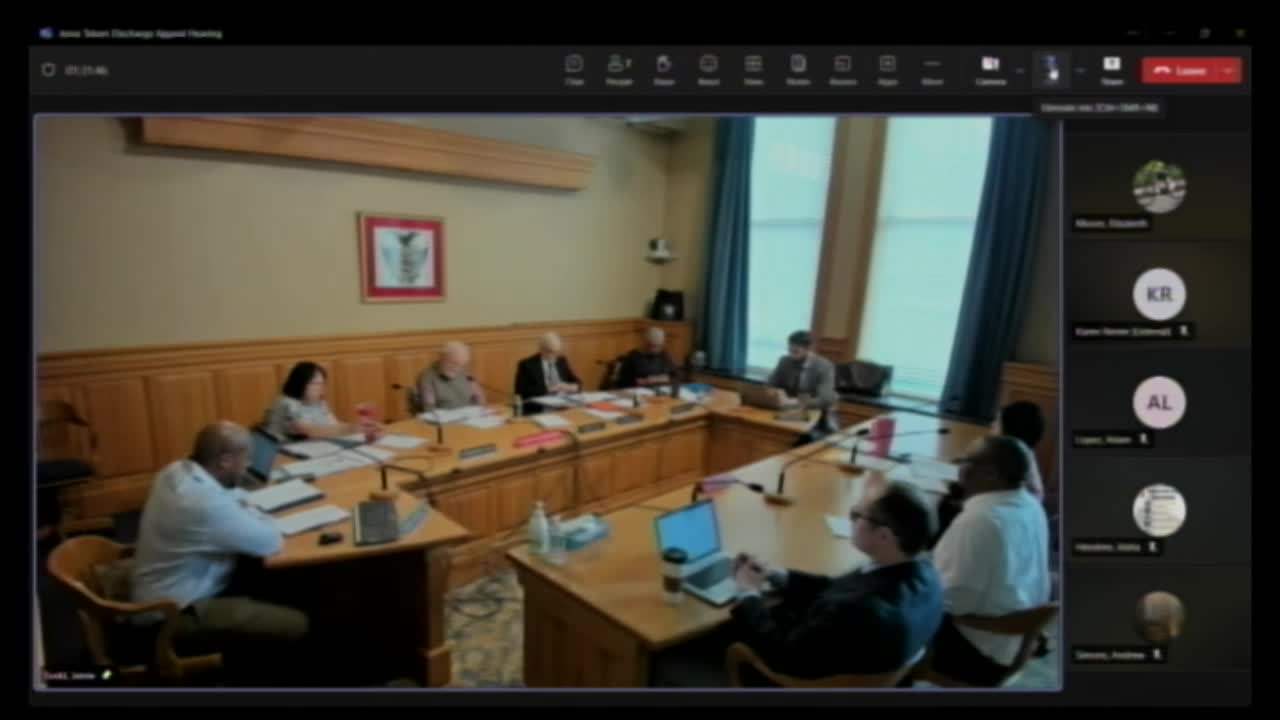
The Board of City Service Commissioners on April 28 upheld the City of Milwaukee's December 2024 discharge of Department of Public Works equipment operator Jesse Tatum, voting that the department had cause to discipline him and then voting to sustain the department's decision.
The commission sustained the department's case after hearing testimony and reviewing exhibits in a formal appeal hearing. The department presented an analysis it said showed multiple incidents in which Tatum's submitted time sheets did not match electronic scan-in/scan-out logs. Adam Lopez, lead operations supervisor for fleet operations, testified he prepared an analysis comparing electronic scan reports to Tatum's time sheets and concluded there were repeated discrepancies between August 2 and Sept. 30, 2024. "That's what it revealed, that Mister Tatum, on 08/02 worked 8.2 hours, but he claimed 9 hours of work," Lopez testified. He estimated the number of discrepant days at about "28 times," later noting the spreadsheet indicated about 32.
The department said the discrepancies amounted to falsified city records and time theft. Dan Thomas, DPW administrative services director, testified he presided over a pre-discharge hearing on Dec. 10, 2024, and that the department's view — based on the scan reports, time sheets and Tatum's disciplinary history — supported termination. "It is the expectation that you need to scan in and scan out each and every day without exception," Thomas told the commission.
Tatum and his representatives disputed the department's interpretation. Tatum, an eight‑year city employee who recently worked as a special‑equipment (street sweeper) operator, said he performed the shifts he claimed on his time sheets and that supervisors signed his operator daily time sheets. Two coworkers, Eric Humphrey and Damon Young, testified they worked with Tatum on dates the department singled out and said he worked the full shifts. Tatum also told the commission he had at least one instance of a misplaced badge and that his routine historically was to perform vehicle pre‑trip inspections before scanning in; he said he was not told previously to "scan in first, then pre‑trip." He told commissioners he provided written statements and other evidence to managers before the hearing but that those materials were not considered.
Commissioners spent part of the hearing discussing what documents had been provided to Tatum before the pre‑discharge meeting and whether the department's pre‑discharge notice fully reflected the allegations later relied on in the termination decision. The commission admitted into the record the department's spreadsheet analysis (admitted as D23) and a one‑page document Tatum had supplied earlier and that the parties debated (admitted as AU1). Commissioners also questioned whether every discrepant scan necessarily proved an employee had not worked: both sides acknowledged operational complexities, such as employees picking up equipment at a different location than their assigned reporting point and some work locations lacking scan pads.
After deliberation in closed session, the commission returned to public session and first voted that "the Department did have cause to discipline the appellant" by a recorded 4–0 vote. The panel then voted 4–0 to sustain the discharge. The chair announced the appeal was denied and the discharge stands.
The commission's decision will stand unless overturned in later appeal or review. The hearing record contains the exhibits and witness testimony the commission cited in reaching its decision, including the department's scan/time‑card analysis and multiple time‑sheet documents with supervisor signatures. The commission did not further modify the penalty announced by the department.
The meeting also included routine business prior to the hearing and scheduling of future commission dates.