Get Full Government Meeting Transcripts, Videos, & Alerts Forever!
Get email alerts on the Childcare Rate Reform Transition topic
No spam. Unsubscribe anytime.
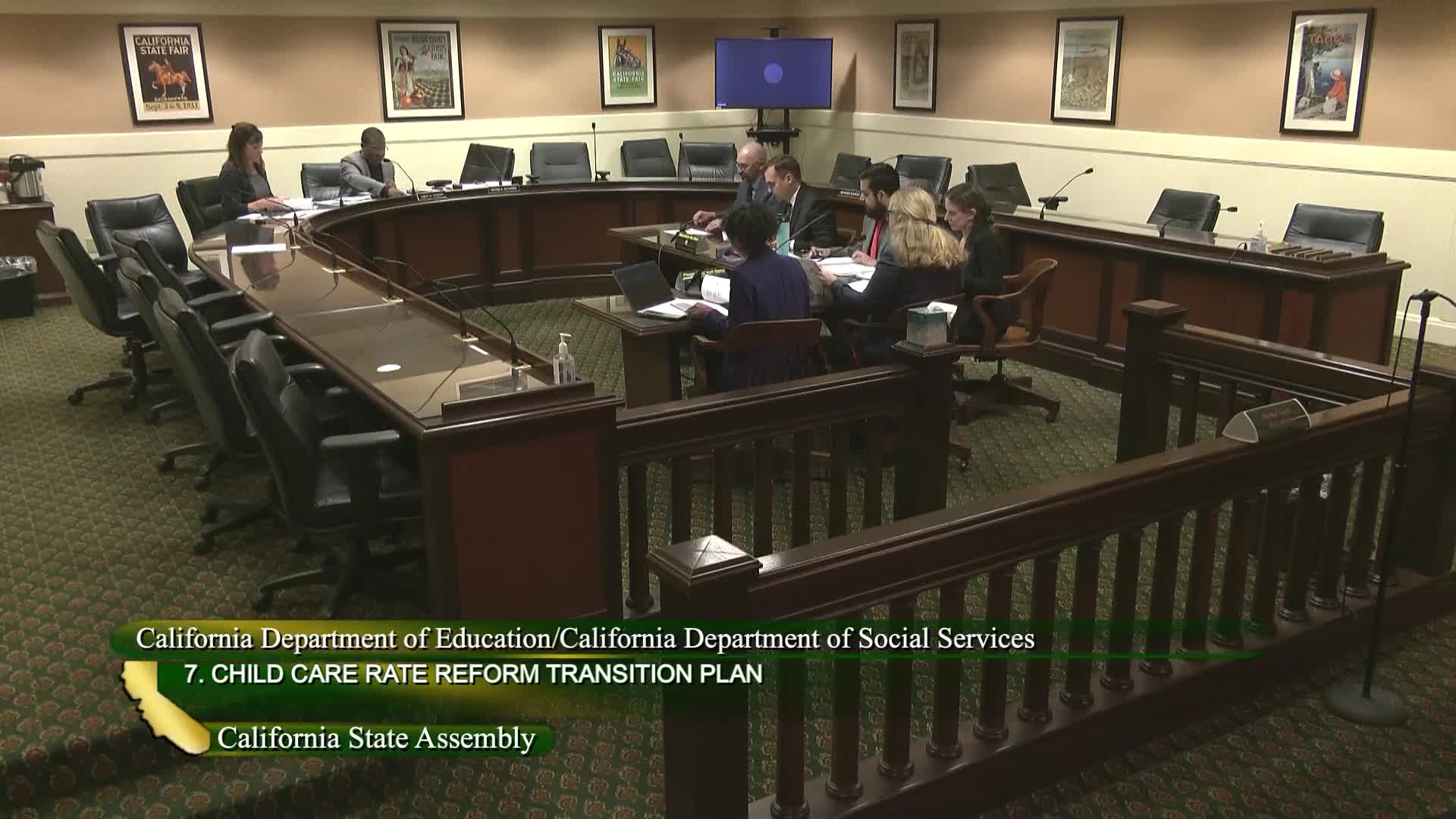
Assembly panel reviews childcare rate-reform transition plan; advocates urge interim payments and equity for rural counties
Summary
Legislative Analyst Office presented an eight-part interim transition plan for California’s childcare rate reform. Stakeholders at the hearing urged interim increases, enrollment-based funding, use of cost-based wage benchmarks and inclusion of 20 currently excluded counties in an Inclusive Early Education Expansion Program.
The Legislative Analyst’s Office outlined an eight-part transition plan for childcare rate reform and stakeholders urged interim funding and equity measures during a California State Assembly hearing on the topic.
Dylan Oksalitza, Legislative Analyst with the Legislative Analyst’s Office, told the panel that the transition plan “consists of 8 parts” and described measures intended to provide interim increases to existing reimbursement rates, maintain the single higher rate between the regional market rate (RMR) and the standard reimbursement rate (SRR), annualize cost-of-care supplements, update the statutory hold-harmless language to reflect any interim increases, eliminate the private market cap in the RMR statute, authorize one-time funding for data and systems transitions at CDSS and CDE, and require collection of parent copay data beginning January 1, 2026.
The plan as presented would: provide percentage increases to the regional market rates table and the SRR beginning January 1 of the budget year; preserve the rule that the applicable single rate is whichever is higher (SRR or RMR); annualize cost-of-care supplements; expand the statutory hold-harmless floor to include any interim rate increases; remove the private market cap on state reimbursement in RMR statute; authorize with Joint Legislative Budget Committee approval one-time funds for California Department of Social Services (CDSS) and California Department of Education (CDE) systems and contract transition costs and a 2026 cost-study contract; and require CDSS and CDE to report annually on parent copays by county, program type and rate type starting 2026-01-01.
Assembly members and administration staff discussed timing. An administration representative said the state is “working towards meeting that 07/01/2025 date,” noting the state must provide a detailed report to federal partners and that rate updates are periodically required as part of the state plan process.
Public commenters strongly urged interim supports while the alternative methodology is finalized. Dave Gordon, County Superintendent of Schools for Sacramento County, urged the committee not to redirect existing Inclusive Early Education Expansion Program (IEEP) funds only to current grantees, arguing that the recommendation to continue funding current grantees would “risk leaving behind our most vulnerable communities, largely our rural communities.” Julie Montale, Executive Director for Early Learning at the Sacramento County Office of Education, described a statewide proposal to extend targeted support to underserved counties, including Amador and Del Norte, and said the plan would provide professional learning, workforce supports and coordination rather than simply reallocating funds to existing grantees.
Several providers and advocacy organizations urged that interim reimbursement be based on the true cost of care and that providers be paid on authorized enrollment rather than attendance, citing federal requirements and stability concerns for programs that faced funding shortfalls this year. Speakers asked the legislature to adopt enrollment-based funding for early learning, to extend encumbrance dates for several grants (UPK Mixed Delivery Grant, UPK Planning and Implementation Grant, and EETD), and to maintain statewide systems-level funding for the Inclusive Early Education Grant. Multiple speakers — including representatives from Catalyst Family, Child Care Resource Center, Child Action, Early Edge California, Thriving Families California, and the California School Boards Association — urged prompt action on rate reform and workforce supports, including cost-of-living adjustments in the 2025–26 budget.
Stakeholders also pressed for use of cost-based wage benchmarks such as the MIT Living Wage over Bureau of Labor Statistics figures when setting reimbursement levels, and sought a transition plan that prevents provider reimbursement from falling when the new methodology is implemented. Several commenters described operational strain: Catalyst Family and other agencies said they relied on voluntary temporary transfers this year to avoid disenrolling families; Child Care Resource Center said it serves over 65,000 children and has “over 19,000 children waiting for care;” Catalyst Family and Child Action provided counts of children and providers they serve in specific counties.
Committee staff and public commenters highlighted facilities and mixed-delivery issues: some community-based centers have lost four-year-old classrooms to transitional kindergarten (TK) and face dark or unused rooms, while other commenters said community-based providers have existing age-appropriate facilities that could support TK if policies permit mixed-delivery participation.
No formal vote or binding action on the LAO plan was recorded in the transcript. Committee members said they would hold the item open for revision and further feedback from providers and advocates while the administration and legislature work toward agreement.
The hearing record shows broad, cross-sector support for implementing an alternative rate methodology but frequent requests for interim financial supports, equity for rural and underserved counties, enrollment-based reimbursement, and systems funding for the CDSS and CDE to implement data and payment changes.
Looking ahead, the LAO and administration reiterated the target implementation date for the alternative methodology reporting and cost model as July 1, 2025, and the plan would require annual reporting on parent copays beginning January 1, 2026. The committee said it would continue to accept feedback and monitor the transition plan’s development.