Get Full Government Meeting Transcripts, Videos, & Alerts Forever!
Get email alerts on the Zoning Ordinance Rewrite topic
No spam. Unsubscribe anytime.
Rockville staff seeks Planning Commission feedback on FAST 2 zoning-review streamlining; commissioners ask for benchmarks and safeguards
Summary
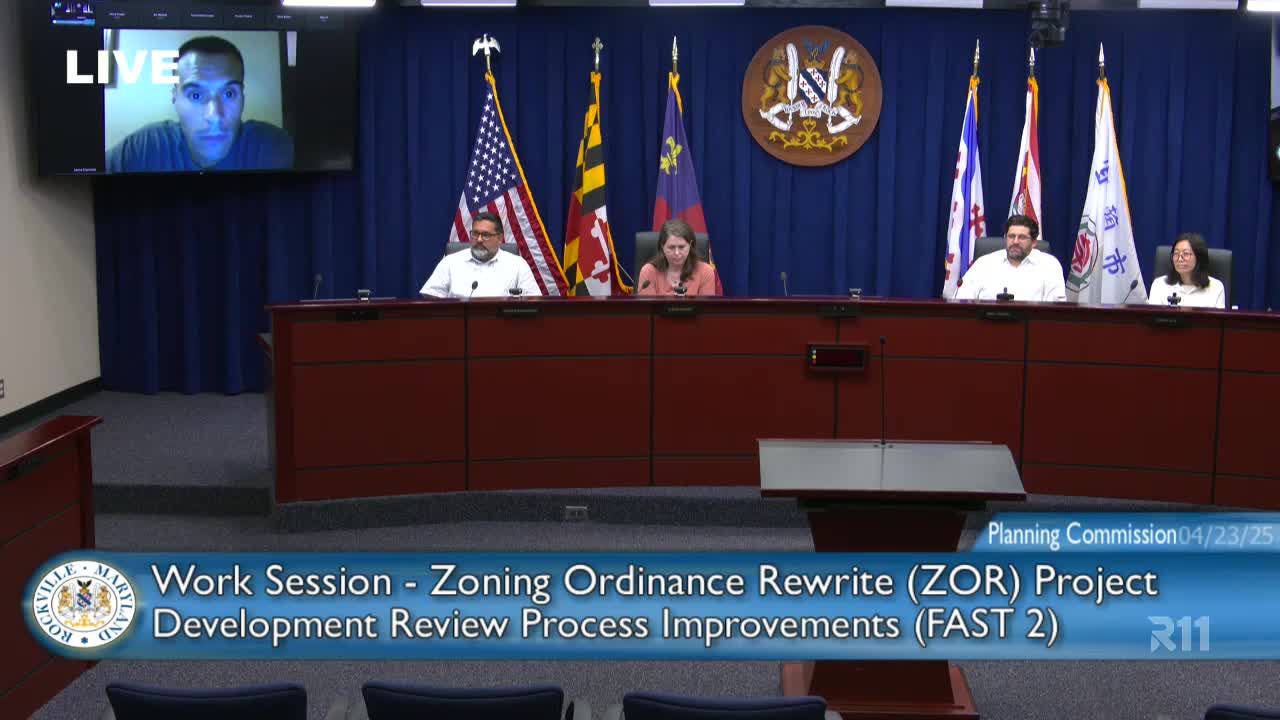
Rockville staff presented FAST 2 process improvements on April 23 proposing combined area meetings, reduced briefings and expanded administrative approvals to speed development review; commissioners backed streamlining but asked for benchmarks and clearer criteria for administrative approval of site plans.
City staff presented a multi-part work session to the Rockville Planning Commission on April 23 explaining the FAST 2 recommendations to the Zoning Ordinance Rewrite (ZOIR), seeking feedback on streamlining the project-plan and planned-development amendment processes and on expanding administrative approvals for certain site plans.
John Foreman, the City’s Development Services Manager, led staff’s presentation and said Rockville’s average project-plan review from pre-application to approval is “18” months and that site-plan reviews average roughly seven months. Foreman and other staff framed the FAST 2 work as a follow-up to earlier process improvements (FAST 1) and as part of the broader ZOIR intended to implement the Comprehensive Plan’s land-use goals and to increase housing supply by providing predictability and administrative options for low-impact projects.
Staff proposed four primary changes: (1) streamline the project-plan process by combining two area meetings into one and eliminating briefings while keeping Mayor and Council as the deciding body; (2) shorten plan-development amendment timelines with a similar approach; (3) allow administrative approval of site plans in selected mixed-use districts not within 300 feet of residential zones and, optionally, limit administrative approval to partial redevelopments (for example, up to a 50% threshold); and (4) permit administrative approval for select project types, including research-and-development (R&D) in the MXE zone and smaller housing projects (for example, small-site projects under 20 units), and conversions such as office-to-residential in limited circumstances.
Foreman emphasized that staff propose to retain public notification and a post-application area meeting and to publicly post any administrative decisions for transparency. He said the recommendations are intended to preserve technical reviews and life-safety checks while improving speed and predictability. "We see the greatest opportunity to get to a building permit, not through the permit process itself, but through the development review process," Foreman told the commission.
Commissioners broadly endorsed the goals of speed and predictability but expressed caution about expanding administrative approvals for certain housing types and projects near residential areas. Commissioner Susan Pittman said the annexation item earlier in the meeting was a reminder that some land-use decisions have multi-generational impacts, calling the long-term nature of land acquisition “a generational acquisition.” Several commissioners said they supported staff’s recommendations (items 1 and 2) to combine area meetings and eliminate briefings. On items 3 and 4—additional administrative approvals—commissioners asked staff to return with more specifics: concrete thresholds (the staff proposal used a 50% redevelop/expansion threshold as an example), a clearer metric for what qualifies as a Level 1 administrative site plan versus a Level 2 planning-commission review, benchmarking that compares Rockville’s average timelines to peer jurisdictions (Gaithersburg and Montgomery County were mentioned), and evidence of developer community feedback already gathered.
Commissioners repeatedly noted the distinction between technical life-safety reviews (which staff said would remain unchanged) and planning-level considerations where the Planning Commission’s broader judgment about neighborhood impacts and design has been valuable. Commissioner Eric Fulton said he values retaining opportunities for the Commission to weigh in on quality-of-life issues even as the body seeks faster approvals; Commissioner Cheyenne Salahuddin and others said they would support many of the streamlining proposals but wanted guardrails for vulnerable populations and neighborhood impacts.
Staff said Mayor and Council had generally supported recommendations 1 and 2 but were not yet comfortable with 3 and 4. Planning staff offered to return with more detailed criteria, examples, benchmarking data, and proposals for public-notification improvements. The commission conducted a straw poll: unanimous or near-unanimous support for recommendations 1 and 2; mixed support for recommendations 3 and 4 with several commissioners requesting additional detail before endorsing broader administrative approvals. Staff said it will bring follow-up material and a deeper discussion to a future meeting.
The Zoning Ordinance Rewrite and FAST 2 work will continue through multiple work sessions; staff expects a public release of draft zoning text and map by December and a target adoption schedule in spring 2026, subject to further review and Mayor and Council actions.