Get Full Government Meeting Transcripts, Videos, & Alerts Forever!
Get email alerts on the State Budget topic
No spam. Unsubscribe anytime.
Minnesota legislative leaders say federal uncertainty makes passing a stable state budget urgent
Summary
Minnesota majority and legislative leaders, responding to Gov. Tim Walz’s State of the State, said federal budget moves and possible Medicaid cuts make it urgent to pass a balanced state budget this session; they flagged potential sticking points and signaled bipartisan talks.
Minnesota legislative leaders said Thursday that uncertainty at the federal level — including potential cuts to Medicaid — makes it critical for the Legislature to approve a stable, balanced state budget before the July 1 funding deadline.
The majority leader, speaking after Gov. Tim Walz’s State of the State address, said lawmakers “have to enact a budget not knowing what the federal government is going to do,” and urged colleagues to move quickly to give Minnesotans a reliable spending plan.
The comments came as leaders described a legislative agenda shaped by concerns raised at recent community visits and town halls and by what they called clear signals from Washington. “You can’t talk about the state of the state right now without talking about the impact that the federal chaos is having in the state,” Jamie Long said, noting that federal actions on Medicaid, tariffs and other areas are already affecting Minnesota institutions and households.
Why it matters: Minnesota state government faces a statutory funding deadline of July 1; leaders said failing to pass budgets would risk a shutdown and leave families and state programs without promised supports amid possible federal cuts. Lawmakers described a session shortened by schedule and by the practical need to resolve policy and funding conflicts quickly.
Leaders’ votes and planning: The majority leader said the House must pass a full budget and the Senate must pass its own budget “to get to the starting blocks” for negotiations. He and other leaders described efforts to find bipartisan solutions — including regular, informal meetings — but said several issue areas could prove contentious.
Medicaid and health funding: Medicaid cuts from federal action were repeatedly cited as a major uncertainty. The majority leader said there are “a lot of outstanding issues in the health [budget]” and that some elements of Minnesota’s medical assistance policy — including care for undocumented people, which has been a flashpoint in prior negotiations — remain unresolved. He said those topics were appropriate for negotiation on the floor and in committee but declined to negotiate specifics during the press remarks.
Housing and veterans funding: Leaders noted possible interplay between separate bills. The majority leader said the House veterans bill contained a $10 million reduction in veterans homelessness prevention funding while a House housing bill had a $75 million allocation; leaders said reconciling such cross-cutting funding decisions is part of the budget work ahead.
Public engagement and concerns: Speakers said they have been meeting Minnesotans across the state — one leader said he spent the prior week on “10 community visits, 5 town halls” where audiences raised concerns about cuts to Medicaid, housing, job losses and tariffs. He said rural communities attended in “strong and powerful numbers” and emphasized the importance of protecting rural hospitals and reducing uncompensated care.
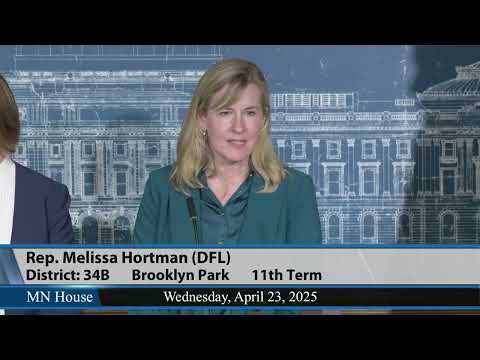
Partisan dynamics and cooperation: Melissa Hortman, identified as Speaker Emerita, said the governor’s framing of themes such as security, opportunity and freedom provided a platform for cross-party negotiations. The majority leader described “cordial” meetings so far, including biweekly walks with Leader Johnson, and said lawmakers were beginning to identify “win‑win solutions” that have been possible under divided government.
Next steps: Leaders said they expect the coming weeks to produce the House and Senate budget bills that will form the basis for negotiations before the July 1 deadline. They cautioned that federal actions could force revisions but stressed the local need for a predictable, enacted budget.
No formal actions or votes were recorded in these remarks.