Get Full Government Meeting Transcripts, Videos, & Alerts Forever!
Get email alerts on the State Budget topic
No spam. Unsubscribe anytime.
Gov. Tim Walz proposes sales-tax cut, insurer surcharge and fraud crackdown in 2025 State of the State
Summary
Members of a joint convention of the Minnesota House and Senate on Wednesday heard Governor Tim Walz outline a budget that he said would protect prior investments in education, health care and public safety while addressing long-term cost growth in human services programs.
Members of a joint convention of the Minnesota House and Senate on Wednesday heard Governor Tim Walz outline a budget that he said would protect prior investments in education, health care and public safety while addressing long-term cost growth in human services programs.
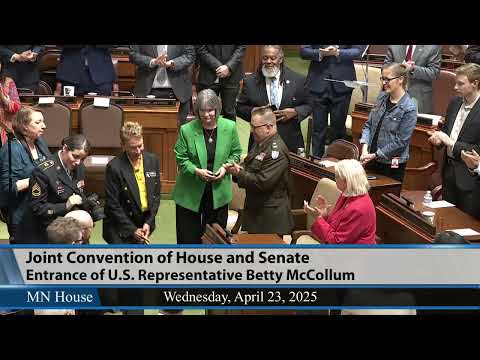
Walz presented his plan on April 23, 2025, at the Minnesota State Capitol in St. Paul. The governor said the proposal would cut what he called a structural imbalance in state finances by about half over the next two years and would include what he described as the state's first-ever reduction in the statewide sales tax, funded by closing tax loopholes.
The speech — delivered before the full Legislature, the Minnesota Supreme Court, constitutional officers and invited guests — led with a defense of Minnesota’s approach to governing and a critique of federal policy moves. "Under this administration, the federal government exists to help the corporations as they screw the American people over," Walz said, adding that his administration would act to protect Minnesotans from federal cuts he predicted would hit programs such as Medicaid.
Why it matters: Walz framed the budget as a bid to sustain large recent investments while placing state finances on a more stable footing so future leaders "don't have to make impossible choices." The proposals, if approved by the Legislature, would change tax and health-insurance policy and rely on administrative as well as statutory action to reduce misuse of public funds.
Major budget and tax proposals
Walz said his budget protects prior commitments to schools, health care, green energy and public safety while addressing unsustainable growth in certain human services spending. He said the package would include an "unprecedented tax cut for working people," a reduction in the statewide sales tax that he said has never been done in the state's history. He added the cut would be fully paid for by closing tax loopholes, but he did not specify the proposed sales-tax rate or the precise loopholes targeted in the speech.
Health-care funding and insurer surcharge
Walz proposed a measurable increase in an existing surcharge on health maintenance organizations, saying insurers should "start paying their fair share" as federal Medicaid cuts threaten to shift costs to the state. He did not specify the amount of the surcharge increase.
Family and medical leave, child tax credit and education
Walz reiterated that Minnesota will soon have "one of the nation's most generous family and medical leave policies," saying implementation would occur in a matter of months. He credited a child tax credit enacted earlier with an expectation that it would "cut childhood poverty by half." The governor also highlighted recent and proposed investments in public education and literacy programs.
Fraud prevention and criminal penalties
The governor emphasized fraud prevention as a budget priority. He referenced an executive order issued earlier in the year that established a centralized fraud and financial crimes unit at the Bureau of Criminal Apprehension (BCA) and proposed using artificial intelligence to "sniff out and catch the bad actors before they get their hands on the money," a phrase he used in the address. Walz also proposed increasing criminal penalties for theft of public funds by 20 percent.
Human services cost growth and fiscal outlook
Walz described long-term growth in human services spending as the state's most significant fiscal challenge, saying those programs could consume "one in every eight dollars" if not addressed. He framed his budget as both protecting existing services and reducing the structural imbalance over the next two years.
Labor, jobs and energy
The governor touted bipartisan labor wins and the state's economic growth, highlighting investments in green energy and innovation-led job creation. He pointed to major employers and health systems investing in Minnesota as evidence of a strong business climate.
Remarks on federal policy and tone of governance
Walz used the speech to sharply criticize recent federal actions and their anticipated impacts on Medicaid, rural hospitals and other programs, and to contrast his state's approach to governance. He called for bipartisanship in the narrowly divided Legislature to enact his proposals.
Attendance, procedure and next steps
The joint convention included formal introductions of the chief justice of the Minnesota Supreme Court, the chief judge of the Court of Appeals, constitutional officers and members of Congress from Minnesota. Walz concluded, "Let's get to work." The joint convention then adjourned. Legislative leaders scheduled post-speech reactions and further committee and floor action as the budget moves through the House and Senate; the address itself included no formal legislative votes.
Ending note: The governor framed the proposed package as balanced and consequential while noting it would produce debate across the political spectrum; specifics on tax rates, the size of the insurer surcharge and exact legislative language were not specified in the address and will be subject to negotiation in the coming weeks.