Get Full Government Meeting Transcripts, Videos, & Alerts Forever!
Get email alerts on the School Finance topic
No spam. Unsubscribe anytime.
Judge hears arguments over whether Detroit schools can keep levying operating millage after $150 million emergency loan is repaid
Summary
Presiding Judge (unnamed) heard oral argument on a plaintiffs' request for a preliminary injunction to preserve Detroit Public Schools' ability to collect an existing operating millage after it repays a $150,000,000 emergency loan.
Presiding Judge (unnamed) heard oral argument on a request by Detroit Public Schools (DPS) plaintiffs for a preliminary injunction to preserve the district
(Note: the court transcript identifies this hearing but does not provide the judge's name.)
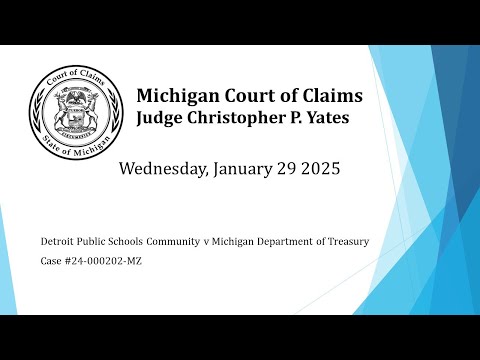
The case, filed as a verified complaint for declaratory and injunctive relief and styled Case No. 2024-0002-MZ, asks whether the Detroit Public Schools Community District and the School District of the City of Detroit may continue to collect an existing voter-approved operating millage once DPS has repaid a $150,000,000 emergency loan. The plaintiffs asked the court to grant a preliminary injunction preserving DPS's ability to levy the operating tax while the underlying legal dispute is resolved; the defendants (the Michigan Department of Treasury and Rachel Eubanks in her official capacity as State Treasurer) opposed that request and have filed a motion for summary disposition under MCR 2.116(C)(8).
Why it matters: The parties and the judge framed the dispute around who may collect a continuing operating millage after the emergency loan is paid and whether that revenue can be applied to other legacy obligations. Plaintiffs told the court that using the operating millage to continue paying debt now would avoid "hundreds of millions of dollars in unnecessary interest payments"; defendants say the statutory definitions and structure require treating operating levies and debt-service millages separately and that existing state programs and payment schedules mitigate immediate harm.
Arguments and legal focus
Plaintiffs. Scott Eldridge, attorney for the plaintiffs, argued that section 12b of the Revised School Code (cited in the hearing as MCL 380.12b) requires the old district to "perform the functions . . . relating to the payment of debt," and that the statute defines "debt" broadly (incorporating the Municipal Finance Act definition, MCL 141.2103). Eldridge said that the language in 12b mandates that DPS continue levying the operating millage to repay outstanding obligations (including the revolving fund debt and outstanding bonds) and that if the operating millage ends when the $150 million emergency loan is paid, Detroit taxpayers would face an estimated additional $320 million in interest costs over time. Eldridge also relied on a prior administrative practice he described as exemplified by an Inkster matter, saying Treasury previously allowed a district in a similar posture to continue levying an operating millage.
Defendants. David Thompson, assistant attorney general representing Treasury, disputed that Inkster governs this case and emphasized differences in statutory text and context. Thompson argued that "operating obligations" (a separate defined term in MCL 380.12b) triggers only a notice duty by the treasurer and that the statutory scheme treats operating levies and capital/debt millages as distinct votes and streams. Thompson also pointed to (1) a revised debt-service schedule that allows interest-only payments through 2026, (2) the State's School Loan Revolving Fund (SLURF) program and state guarantees that affect debt-service risk, and (3) the indenture agreement language addressing surplus disposition. He contended the plaintiffs' alleged harm is not "irreparable" for preliminary-injunction purposes because the state and statutory mechanisms reduce the risk that the district would suffer unrecoverable operational losses.
Key factual points the court and lawyers discussed
- Parties and case: Detroit Public Schools Community District and School District of the City of Detroit v. Michigan Department of Treasury and Rachel Eubanks (in her official capacity); case referenced as 2024-0002-MZ. - Central disputed amounts (as described in argument): roughly $150,000,000 (emergency loan); approximately $1,300,000,000 in outstanding bonds; about $350,000,000 in revolving fund debt. Plaintiffs used these figures in arguing possible interest savings; Treasury disputed the characterization and emphasized other state mechanisms. - Operating millage: counsel said the existing operating tax was approved by Detroit voters and (per plaintiffs) the authorization extends through 2033. Plaintiffs argued that if the operating millage ends when the emergency loan is repaid, the new district could seek its own operating millage only by going to voters, creating a revenue gap during the ballot process. - Procedural posture: plaintiffs moved for a temporary restraining order and preliminary injunction (the TRO portion was described as no longer appropriate); defendants filed a motion for summary disposition under MCR 2.116(C)(8). The judge said he would decide the preliminary-injunction request first and defer decision on the summary-disposition motion.
Court directions and next steps
The Presiding Judge directed counsel to focus argument on the four standard preliminary-injunction factors: (1) likelihood of success on the merits, (2) irreparable harm, (3) balance of harms, and (4) public interest. The judge told counsel he would issue a written decision within a week and noted a February 10 filing deadline tied to timelines for placing proposals on a May ballot. No ruling was announced at the hearing.
Representative quotes
"A decision must be rendered before February 10 . . . and I'm gonna explain why that date's significant," the Presiding Judge said at the hearing.
"We're not asking for money damages," Scott Eldridge said. "We are asking for declaratory and injunctive relief," and he argued that without an injunction Detroit taxpayers could face hundreds of millions in additional interest costs.
David Thompson said Treasury views the statutory scheme differently: "The operating millage is used for operating obligations. . . . The new district is the operating district. The ones actually teaching and learning. The DPS does nothing today except service the legacy debt."
Ending
The court heard extensive argument from both sides and took note of competing statutory readings, prior administrative practice (the Inkster matter), and contract/indenture language about how surplus funds would be handled. The judge did not rule at the hearing but told counsel a decision would follow within a week. That decision will determine whether DPS can continue levying the voter-approved operating millage after repaying the $150 million emergency loan and could affect the timing and scale of repayment of the district's remaining legacy debt.