Get Full Government Meeting Transcripts, Videos, & Alerts Forever!
Get email alerts on the Criminal Law Mens Rea topic
No spam. Unsubscribe anytime.
State Supreme Court Hears Challenge to Mens Rea in Prisoner-possessed-contraband Statute
Summary
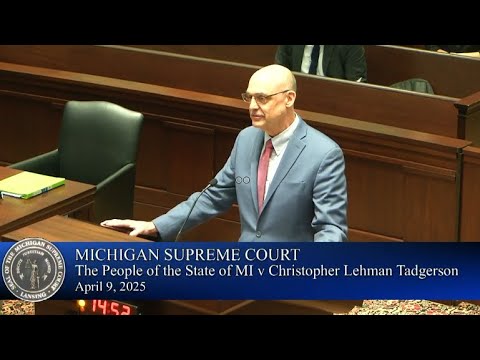
The state high court heard oral argument in People v. Christopher Tadgersen over whether MCL 8.9’s “plainly imposes” language allows the prison possession statute, MCL 800.281(4), to be enforced as a strict-liability offense or whether proof of a defendant’s mental state is required.
The State Supreme Court heard oral argument in People v. Christopher Tadgersen on whether MCL 8.9 requires proof of a defendant’s mental state for the crime of prisoner possession of contraband under MCL 800.281(4).
The question presented to the justices was whether the statute that penalizes possession of contraband by a prisoner “plainly imposes” strict criminal liability under MCL 8.9, or whether the court must read a mens rea (intent, knowledge or recklessness) into the offense. The outcome could affect how prison contraband cases are prosecuted and the defenses available to detained persons.
Mike Mittelstad, representing Christopher Tadgersen and identified as appearing from the State Public Defender’s Office, argued that MCL 8.9 embodies a presumption against strict-liability crimes and requires that any strict liability be plainly imposed within the four corners of the statute defining the offense. Mittelstad told the court that subsection 4 of MCL 800.281 “does not contain any of the clear and unobstructed language imposing strict liability,” and said the phrase plainly imposes should be applied only to language actually present in the offense’s statutory text.
Jordan Miller, chief assistant prosecutor for N. C. County, urged the court to find that MCL 800.281(4) plainly imposes strict liability and therefore falls outside the mens rea requirement in MCL 8.9. Miller pointed to Court of Appeals precedent and statutory context, saying the legislature intended 8.9 to address prior ambiguities and that the prisoner-possession statute’s wording and surrounding statutory framework support a strict-liability reading. “8.9 says, this is what we meant,” Miller told the court when arguing that the statute should be applied as written.
Eric Pistucia of the Attorney General’s Office, appearing as amicus for the Department of Corrections, emphasized corrections’ safety concerns and argued the prisoner-possession statute functions as a strict-liability tool to prevent drugs and other contraband inside facilities. Pistucia said the common-law defense of involuntariness remains available where a defendant’s possession was truly beyond control and described the statute as “an essential tool for maintaining the security and safety of prisoners themselves and also for the corrections employees.”
Justices asked multiple questions about how to apply the mens rea provisions set out in MCL 8.9, including whether the statutory list of “intent, knowledge, or recklessness” means the prosecutor may choose among them, and whether recklessness could serve as the floor for culpability. Counsel debated whether knowledge is the appropriate mens rea for possessory offenses, whether the rule of lenity and other canons of construction require reading a mens rea into the statute, and whether involuntariness can operate as an affirmative defense where appropriate.
No opinion was issued from the bench. At the close of argument the court announced the case would be submitted for decision.
The court’s forthcoming ruling will address whether prosecutors must prove a defendant’s mental state for prisoner-possession charges under MCL 800.281(4) or whether the statute operates as a strict-liability offense under MCL 8.9; the decision could affect prosecution strategy, available defenses such as involuntariness, and corrections policy concerning contraband control.