Get Full Government Meeting Transcripts, Videos, & Alerts Forever!
Get email alerts on the Charter Interpretation topic
No spam. Unsubscribe anytime.
Michigan Supreme Court hears dispute over Macomb County commissioners' request for real‑time access to finance system
Summary
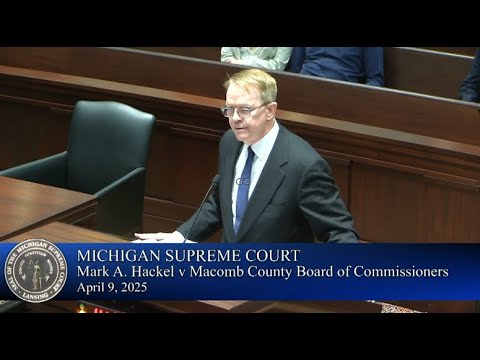
The Michigan Supreme Court heard oral argument in Hackle v. Macomb County Board of Commissioners over whether the county commission may require read‑only, real‑time access to the executive’s financial software and whether the charter phrase “by law” includes locally enacted ordinances.
The Michigan Supreme Court heard oral argument in Hackle v. Macomb County Board of Commissioners over whether the county commission may require the county executive and the finance department to provide commissioners with read‑only, real‑time access to the county’s financial software.
The question before the court was whether the charter phrase “by law” includes locally enacted ordinances — a construction that would permit the commission to adopt an ordinance requiring system access — or whether “by law” instead refers to state or other higher law that cannot be supplied merely by majority vote of the commission.
Counsel for the Macomb County Board of Commissioners, Peter Webster, told the court the ordinance at issue requires the executive and finance staff to “furnish and share with [the board] public financial information” so the board can perform its budgeting and appropriation duties. Webster said the ordinance does not grant the commission control over finance operations but instead ensures commissioners can view “current, meaning accurate, and real time information regarding the financial status of the county” and that the charter itself contains multiple provisions authorizing the board to require information (citing sections the board relies on as 3.7(d) and provisions tied to the budgeting process). Webster said the need is ongoing, not merely seasonal, noting the county averages about 90 budget amendments a year and that departments currently see rolled‑up rather than line‑level data (for example, capital outlay totals without vehicle counts).
On behalf of the Macomb County Executive, David Porter argued the case is not about furnishing information but about access to the executive’s systems. “This case is not about furnishing information. It's about access,” Porter told the court, saying the executive has repeatedly provided requested information and that no record shows a refusal to furnish data. Porter urged the court to read the charter’s phrase “by law” as a reference to state law or other external legal authority rather than enabling local ordinance to reallocate executive functions. He warned that if “by law” were read to include ordinances in this context, the commission could use ordinances to intrude on executive powers across many charter provisions.
Both sides disputed whether granting read‑only, real‑time access would meaningfully differ from requiring the executive to furnish the same information in a usable format. Porter emphasized a textual distinction between “furnish/transmit” and “access,” and argued that allowing commissioners direct access to the executive’s financial system could expose confidential information and permit escalations (for example, additional users or write access) beyond what an ordinance purportedly grants. Webster responded that departments currently use successive iterations of financial software (he referenced the initial software in 2017 through subsequent systems to Workday) and that many departments — including the sheriff’s office — already have read‑only, real‑time views of their own line items; the commission seeks comparable visibility for its budgetary role.
Justices pressed both sides on the practical limits of each construction. One justice asked whether accepting the commission’s position would permit the commission to pass a slew of ordinances intruding on executive functions without a stopping point; Porter and other counsel warned that such a result would undermine the charter’s separation of powers. Webster and his co‑counsel pointed to precedents and charter language they contend support concurrent availability of certain financial data and maintain the ordinance does not usurp executive control over the finance department.
The argument included references to the Michigan Constitution, the County Charters Act, and prior cases cited by both sides (including state court decisions referenced in briefing and an unpublished Court of Appeals decision discussed by the parties). Neither side asked the court to issue an immediate ruling from the bench. After argument, the court announced the case submitted for decision.