Get Full Government Meeting Transcripts, Videos, & Alerts Forever!
Get email alerts on the Harmony With Nature Overview topic
No spam. Unsubscribe anytime.
UN meeting on Harmony with Nature urges faster action, indigenous inclusion and scaled-up finance
Summary
At a high-level United Nations meeting on April 22, 2025, delegates urged immediate, multilateral action to align development with nature, stressed the role of indigenous knowledge and called for substantially increased finance and policy integration to meet the 2030 Agenda and biodiversity targets.
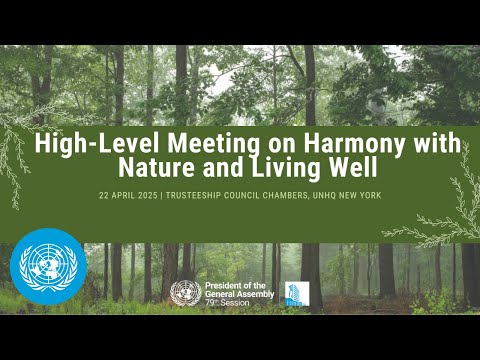
Delegates at a United Nations General Assembly high-level meeting on April 22, 2025, told member states that the world must urgently reorient development to live in harmony with nature, emphasizing stronger multilateral action, greater inclusion of indigenous peoples and stepped-up funding for biodiversity and climate measures.
The meeting, convened pursuant to Resolution 79/210 of Dec. 19, 2024, brought ministers, UN officials and observers who framed the challenge as immediate and systemic: speakers cited accelerating biodiversity loss, climate extremes and the need to integrate indigenous knowledge alongside science in governance and financing.
President of the General Assembly (title only) opened the meeting by saying it was “an opportunity for us to reflect on the state of our planet and rethink our relationship with nature and with ourselves,” and warned that “the time to act was years or decades ago.” The president also recalled the meeting’s mandate under Resolution 79/210 to discuss “holistic approaches based on diverse world views” and to promote sustainable lifestyles.
Li Junhua, Under-Secretary-General for Economic and Social Affairs, cited recent global trends to underline urgency: “2024 was the warmest year on record. Biodiversity is vanishing at an alarming rate. 1,000,000 species are now at the risk of extinction, many within decades,” and called for a “regenerative…approach that restores balance with nature.” He highlighted four priority areas: stronger environmental governance, inclusive decision-making that ensures indigenous peoples’ access to finance, promotion of sustainable consumption and production, and scaling effective local actions.
Representatives from intergovernmental and civil-society bodies reinforced the call for integrated action. Sophie Sandstrom Jaffe, permanent observer for the International Union for Conservation of Nature, speaking for IUCN, noted the role of multilateral agreements under way at the UN — including the High Seas Treaty preparatory process — and warned that transforming production and consumption will require political will and public demand.
Several delegations pointed to upcoming multilateral moments as opportunities to accelerate implementation, including the 2025 UN Ocean Conference, the 2026 UN Water Conference, COP17 (biodiversity) and other meetings where finance, scientific advice and capacity building can be scaled up.
The opening and plenary segments concluded ahead of a panel discussion scheduled for the afternoon; the meeting record shows the plenary adjourned and the panel entitled “Promoting sustainable lifestyles and holistic approaches to harmony with nature” was set to convene later the same day.