Get Full Government Meeting Transcripts, Videos, & Alerts Forever!
Get email alerts on the Community Preservation Plan topic
No spam. Unsubscribe anytime.
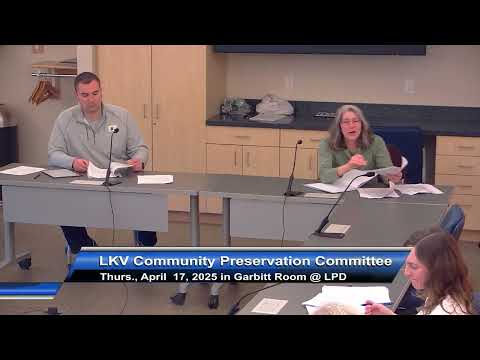
Lakeville CPC reviews redline edits to Community Preservation Plan, delays vote for more input
Summary
The Town of Lakeville Community Preservation Committee reviewed proposed edits to its Community Preservation Plan, including clarified allowable uses of CPA funds and a new evaluation checklist, but decided to defer approval pending additional input on housing data and parks.
The Town of Lakeville Community Preservation Committee reviewed a redlined draft of its Community Preservation Plan on April 2025 and agreed to postpone a final vote while members gather follow-up information on housing figures and parks input.
Robert Stefanian, member at large, said he and Susan Spieler, member at large, used the checklist the committee created at a prior meeting to compile edits and highlighted wording added in red. “We added that it must be a capital improvement expense,” Stefanian said, and described additional clarifications the committee placed under allowable and non-allowable uses of Community Preservation Act (CPA) funds.
The draft adds or tightens language in several places: definitions taken from a state coalition were pared to items applicable to Lakeville; the plan clarifies that CPA-funded projects must qualify as capital improvement expenses; it narrows what counts as indoor recreation (excluding removable structures); and it includes three new non-allowable bullets stating CPA funds cannot be used for general supplies, mailings or brochures, and cannot be used to “create” projects where the intent is not preservation. The draft also restates that capital CPA money should not be granted directly to individuals and instead should be submitted in the name of a board, committee or organization that can legally receive and regrant funds.
Committee members added an evaluation-criteria checklist to the Step 1 application appendix and discussed adding an explicit question on the application that asks applicants to circle which allowable spending purpose applies to their project to help the committee understand applicants’ intent. Stefanian noted the checklist will be added to the appendix and the front-page application will be adjusted to make the question more visible.
Members debated whether to keep specific housing statistics in the plan or to link to an external source. Michelle McEachern, planning board representative, and others pressed that housing and affordability numbers change frequently; the committee decided to point readers to up-to-date sources rather than update the plan annually. Stefanian recommended including both a town link (the five-year Housing Production Plan) and a state link for area median income and subsidized housing inventory (SHI) data.
The Lakeville Historical Commission had no substantive edits to propose, according to Nancy Lefebvre, who said the commission’s recommended language matched last year’s text. Parks and recreation input was still outstanding; the committee agreed to request Parks feedback before finalizing page dates and step-application timing. The group identified five outstanding items to resolve before a final draft: updated housing figures, Parks’ input, Nancy Yates’ updates for the financial chart, aligning meeting dates with application cycles, and the added Step 1 application question.
No formal vote was taken on the plan at the meeting. The committee put the item back on the agenda for the next scheduled meeting so members can incorporate feedback and produce a final formatted draft.