Get Full Government Meeting Transcripts, Videos, & Alerts Forever!
Get email alerts on the Water Allocation topic
No spam. Unsubscribe anytime.
Goodyear staff propose parcel-based water allocation policy to guide development
Summary
Barbara Chappell, the city's Water Services director, presented a draft water resource allocation policy at a Goodyear City Council work session, saying the proposal would assign a fixed "paper water" allocation to every undeveloped parcel inside the city's service area and set rules for large water users and annexations.
Barbara Chappell, the city's Water Services director, presented a draft water resource allocation policy at a Goodyear City Council work session, saying the proposal would assign a fixed "paper water" allocation to every undeveloped parcel inside the city's service area and set rules for large water users and annexations.
The proposal matters because the city is a designated provider with a 100-year assured water supply and has an active application to the State Department of Water Resources to add roughly 10,000 acre-feet per year to its portfolio, Chappell said. She warned the council that uncertainty on the Colorado River makes clearer internal rules important for growth management and for communicating expectations to the development community.
Under the draft policy, staff would use the city's integrated water master plan and the land-use layer to assign an allocation for each undeveloped parcel. Chappell gave a numeric example: a 100-acre parcel assigned single-family residential at four dwelling units per acre would receive water sufficient for roughly 400 homes — about 160,000 gallons per day — and developers would have to design projects to fit that water budget. "We would use historic consumption as their allocation" for already developed parcels, she said, citing utility-billing data as the basis for those allocations.
The draft spells out options for applicants who need more water than the parcel's allocation. Chappell told council that such applicants could (1) locate on a different parcel with a higher allocation, (2) purchase or lease water from another provider or rights holder, or (3) purchase additional resources from the city's available portfolio if any exist. "Market rate for us would be what the market's bearing today for that resource," she said, and emphasized that any water the city sells must qualify as a 100-year supply to meet the city's designation requirements.
Chappell said staff will discourage—and ultimately seek ordinance language to prohibit—private "self-service" groundwater pumping inside the city's service area. "We would strongly discourage and hopefully prohibit even self-service within the city's service area, and would definitely oppose anyone trying to drill a well within our service area," she said. She also described existing state-level permitting: to drill a well in Arizona, an applicant must obtain a permit from the Arizona Department of Water Resources (ADWR), and ADWR notifies the city when a permit is applied for so the city may participate in the public process.
To make allocations transparent and usable during due diligence, staff are building a GIS tool that will let development-services staff (and developers) click on a parcel to see its assigned allocation. Chappell said staff will implement council feedback in the draft, complete the GIS tool and staff training, and return the policy for formal adoption later this spring; she also said the ordinances needed to implement the policy with the development community would be brought forward in the fall.
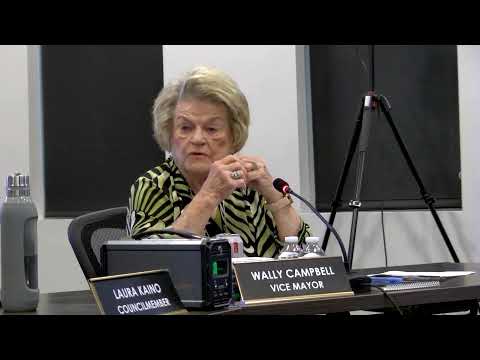
Council members voiced broad support for a written policy but asked for clearer decision pathways for exceptional cases. "Every case is different," said Councilwoman Kano, who thanked staff and urged a decision structure that could include development services, the water department and the city manager's office, and — when warranted — council consultation for high-impact proposals. Kano said the policy should remain flexible so the city can accept major economic-development users when appropriate.
Other councilmembers asked staff to strengthen the draft's language opposing private wells from "discouraged" to a more directive prohibition in the implementing ordinances, and to emphasize conservation as part of the broader strategic plan. Chappell replied that staff will work with the city attorney to craft ordinance language and that conservation and zoning updates will be tied to the strategic plan and future zoning changes.
No formal action or vote was taken; staff were directed to incorporate council feedback and return with revised policy language, the GIS tool and proposed ordinances for future consideration.