Get Full Government Meeting Transcripts, Videos, & Alerts Forever!
Get email alerts on the Property Assessment Budget topic
No spam. Unsubscribe anytime.
Cochise County assessor outlines budget pressures, staffing gaps and valuation trends
Summary
Cochise County Assessor Phil Leinbarger told supervisors his office’s budget is largely statutory, highlighted staffing vacancies and data-system costs, and presented countywide valuation and assessment-rate trends that affect local taxing jurisdictions.
Cochise County Assessor Phil Leinbarger told the Cochise County Board of Supervisors during a work session that about 98% of his office’s budget is driven by statutory duties and that the office needs modest increases for postage, printing and staffing to meet mandatory workloads.
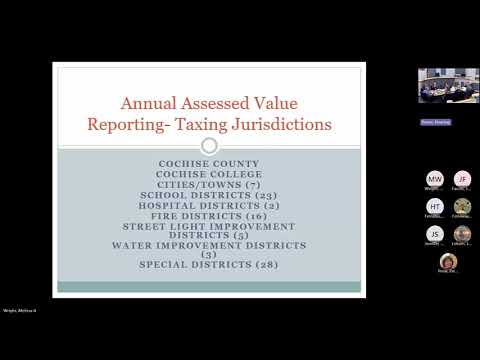
Leinbarger framed the request as narrowly focused but consequential: the assessor’s office prepares the annual property assessment roll used by the county and dozens of local taxing jurisdictions to set tax levies. He said staffing shortages, recurring data-system license costs and changes in how centrally valued properties are assessed are the primary operational pressures facing the office.
Leinbarger said his office employs 36 full-time positions and currently has eight vacancies—about 25% of the workforce—and that filling certified appraiser roles is a persistent challenge. “Basically, about 98 of my budget is mandated statutory functions,” Leinbarger said. He told supervisors the office uses aerial imagery, permit data and field inspections to identify new construction and escaped property, but limited staff constrains how much field reappraisal the office can perform.
On costs, Leinbarger called out two specific budget drivers: recurring operating leases for the assessor’s data-processing system and an unusual $60,000 charge this year after the county’s primary railwire provider moved from a fiscal-year billing cycle to a calendar-year cycle. He said postage and printing for notices of value and change are also significant line items.
Leinbarger reported the county’s full cash value at $13,527,000,000, an increase of roughly 6% from the prior year, and said the limited property value used for tax bills is about $10,921,000,000, also up nearly 6%. He provided sales-ratio measurements by nine market areas and said countywide ratios measured by the state Department of Revenue are roughly 77% for residential improvements and 76% for land; commercial ratios were shown at about 84% countywide.
The assessor raised concern about centrally valued property (utilities, mines and certain communications and transportation infrastructure), which is valued by the Arizona Department of Revenue under a statutory income-based methodology and reported to be handled confidentially. Leinbarger said the department’s limited staffing and statutory protections reduce local oversight of those valuations and that statewide assessment rates for centrally valued property have fallen over decades. He said, for example, centrally valued assessment rates have dropped significantly while commercial assessment rates have fallen about 41% in the last 45 years.
Leinbarger described several ongoing and planned projects: converting commercial property valuation to a new cost system, an extensive land reappraisal program, a planned change in how mobile homes are valued (moving from a statutory depreciation schedule toward a square-foot market-based approach) and continued focus on new-construction capture. He also said the assessor’s office has a small number of tax-court cases pending, including a multi-operator case covering more than 96 parcels in orchards and vineyards that is on appeal to the Court of Appeals; he said the outcome could have statewide implications.
On field access, Leinbarger described the office’s authority to enter property for assessment and the practice of leaving business cards and notifying owners when inspections occur. “We do. We have the authority to go on to the property to do the property assessment,” he said, adding that when owners deny access staff will make an estimated assessment and note that the estimate will be used unless changed through appeal.
Board members asked about options for limiting levy increases by other taxing jurisdictions (for example, community college governing boards) and about transparency of taxing-district rates; Leinbarger and supervisors discussed statutory limits and the county treasurer’s role in collecting levies that taxing districts set. No formal action or vote was taken during the work session.
Leinbarger asked for continued emphasis on salaries to retain certified appraisers and on hiring to reduce vacancies. He said the assessor’s office may request occasional funding for expert witnesses in big tax cases but has not historically used such funds often.
The presentation closed with supervisors scheduling follow-up budget discussions and a separate work session on related items, including public works and salary needs.