Get Full Government Meeting Transcripts, Videos, & Alerts Forever!
Get email alerts on the Childcare Accreditation Funding topic
No spam. Unsubscribe anytime.
Commission members warned of child‑care accreditation squeeze and potential Head Start cuts
Summary
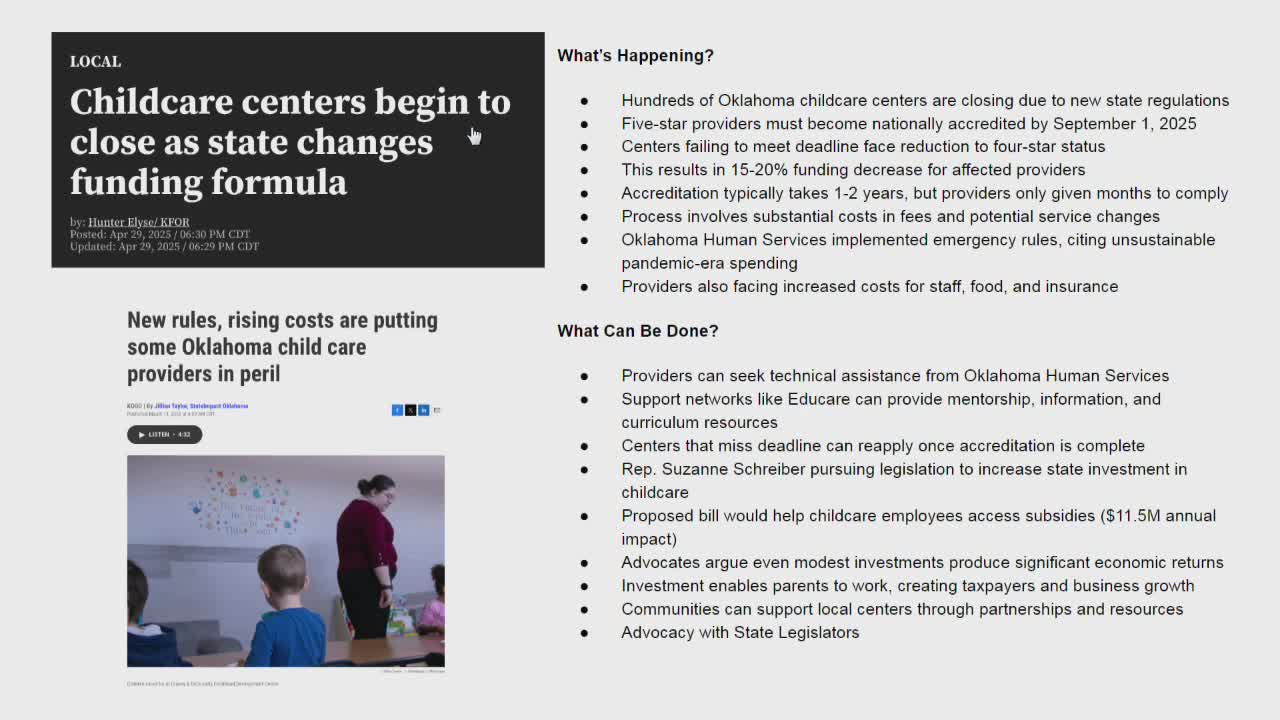
Commission discussion flagged state DHS changes to Oklahoma’s child‑care star accreditation and a compressed timeline for homes to gain required accreditation, concerns that local providers say are forcing closures and reducing provider pay. Members also urged awareness of proposed federal Head Start funding cuts.
Commissioners heard a sustained discussion about recent state policy moves and funding pressures affecting child‑care providers, with Maria Palacios, director of Early Learning Works by Tulsa Educare, summarizing local effects and next steps.
Palacios told the Tulsa Women’s Commission that Oklahoma Department of Human Services (DHS) issued many providers five‑star ratings, then later required those providers to obtain National Association for Family Child Care (NAFCC) accreditation to keep the rating. She said the agency set a much shorter timeline than typical accreditation processes, forcing many home‑based providers to scramble.
“DHS gave a bunch of childcare providers five stars here, and you have two years to show that you could be five stars. That would be requirements that are pretty high standard... The first accreditation that we did with the National Association of Family Child Care took us about three years. Now they want to do it in nine months,” Palacios said.
Commission members discussed possible downstream effects: providers that cannot meet the accreditation deadline may lose five‑star status, which Palacios said ties into DHS subsidy rates. She explained that losing a five‑star rating can reduce per‑child payments and create financial pressure that contributes to closures.
Members also raised concerns about national funding: speakers warned of proposed Head Start funding reductions that could exacerbate child‑care shortages and workforce strain. The commission chair said she would share slide resources and sample advocacy letters for members to use with legislators.
Two state house bills were mentioned by a commissioner as relevant to child care: House Bill 1849 and House Bill 1847; the commission member said the bills “have to do with child care” but did not detail provisions. Commissioners encouraged letters and mailed correspondence to legislators and noted that sample language could be provided for members to submit.
Palacios and other members suggested local steps to mitigate impacts: support for providers pursuing accreditation, expanded partnerships with funders, and outreach to policymakers about the practical timeline for home‑based provider accreditation. The commission did not take a formal vote on the items but resolved to distribute informational materials and sample letters for advocacy.