Get Full Government Meeting Transcripts, Videos, & Alerts Forever!
Get email alerts on the Reentry Trauma Informed Care topic
No spam. Unsubscribe anytime.
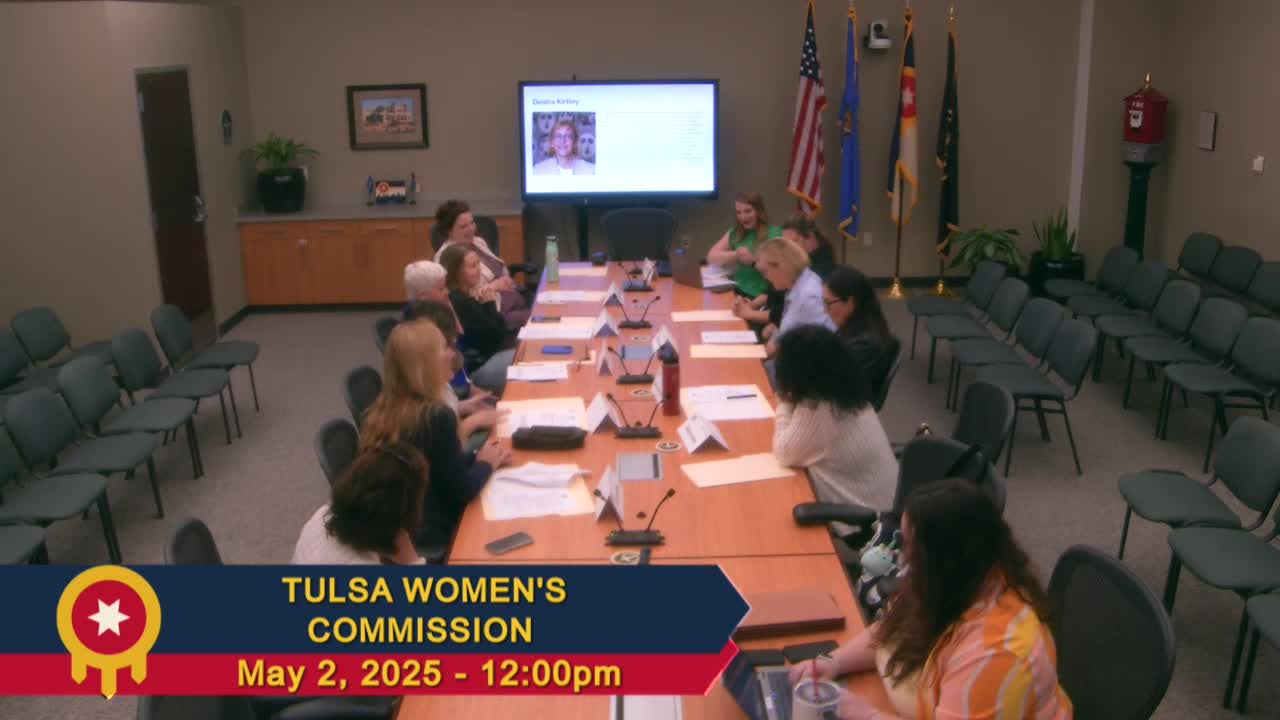
Speakers at Tulsa commission meeting describe trauma‑informed reentry work for women
Summary
At a Tulsa Women’s Commission meeting, Deidra Kirtley of Resonance Center for Women and Melissa Hoover of SheBrews described trauma‑informed treatment, transitional employment and housing programs for women leaving incarceration and how those services address high ACE scores and reduce recidivism.
Deidra Kirtley, executive director of the Resonance Center for Women, and Melissa Hoover, Claremore case manager for SheBrews, told the Tulsa Women’s Commission that trauma‑informed care is central to treating addiction and helping formerly incarcerated women reenter the community.
Kirtley opened the presentation by outlining types of trauma — acute, chronic and complex — and described how “complex trauma” (multiple, overlapping adversities) alters brain wiring in children and later contributes to substance use and criminal‑justice involvement. She said many women the Resonance Center served had very high Adverse Childhood Experiences (ACE) scores and that addiction and high ACEs were common threads among clients.
“Trauma‑informed care is probably the one way to be truly successful with addiction treatment. You can’t treat the addiction if you don’t treat the trauma,” Kirtley said.
Kirtley described Resonance’s approach while she led the nonprofit: a mix of court diversion and treatment, on‑site corrections contracts, transitional work and housing, and case management. She said the program included a transitional employment operation, Take 2 Cafe, and a year‑and‑a‑half to two‑year intensive outpatient model that kept participants out of incarceration while they received treatment.
Melissa Hoover, a program alum who now serves as a case manager, described SheBrews’ model of job training and transitional housing. SheBrews operates coffee houses used for barista and events roles and maintains transitional homes in Tulsa and Claremore. Hoover said she worked first as a barista and later as a house manager and events coordinator before moving into a case management role that currently serves about 22 clients.
Hoover recounted her own path: trauma in young adulthood, subsequent substance use and incarceration, and then participation in SheBrews’ residential and employment programs after release. She said the program combines therapy (including EMDR and cognitive behavioral approaches), faith‑based support where required by the program, and on‑the‑job training at the coffee houses.
Hoover credited SheBrews founder Rhonda Behr with saying that “safe housing and safe employment are the two biggest keys” to successful reentry; she described the organization’s 11 transitional homes and its practice of pairing case managers with clients to work monthly on goals across domains like employment, education, legal needs and health.
Both speakers and commission members highlighted barriers women face after release: background checks and hiring practices that block access to interviews, landlords who refuse to rent to people with felony records, and lifetime registration rules for some offenses. Kirtley and Hoover identified “Ban the Box”‑style hiring practices and relationships with second‑chance landlords as practical changes that help graduates secure housing and work.
Commission members asked about program outcomes and volunteer needs. Hoover said the organization has served hundreds of people over its history and highlighted results she described as generational: reuniting children with mothers and graduates moving into steady employment. SheBrews posts program and volunteer information at shebrews.org.
The discussion closed with commissioners noting that trauma‑informed services and post‑release case management — including housing, employment training and clinical therapy — were viewed by speakers as the most effective route to reduce reoffending and improve long‑term outcomes.