Get Full Government Meeting Transcripts, Videos, & Alerts Forever!
Get email alerts on the State Government Finance topic
No spam. Unsubscribe anytime.
Minnesota House passes DWI interlock changes, AED signage law and state government finance bill amid heated floor debate
Summary
The Minnesota House on May 2 approved measures that expand ignition‑interlock requirements for repeat DWI offenders, set a statewide sign for public AEDs and approved the chamber’s 2025 state government finance bill after extended debate on proxy voting, anti‑bribery language and attorney‑general funding.
The Minnesota House on May 2 passed several high-profile measures, including a bill that expands ignition-interlock requirements for repeat drunken-driving offenders, a bipartisan bill authorizing standardized roadside signage for publicly accessible automated external defibrillators (AEDs), and the chamber’s 2025 state government finance bill following extended debate and multiple amendments.
Representative Richard Kraft, the bill’s author, told the chamber the driving changes followed a deadly crash in Saint Louis Park and said the legislation “ramps the time repeat offenders are required to be on interlock much more aggressively” and extends the period for counting prior offenses in some cases. Kraft described the 09/01/2024 crash that killed a Park Tavern server and another person and left several injured; he noted the driver had multiple prior DWI convictions.
Why it matters: The DWI measure tightens penalties and expands ignition-interlock use in an effort to reduce repeat impaired-driving incidents. Supporters cited federal and public-health research showing interlocks cut repeat offenses while installed and argued the bill removes barriers that have discouraged eligible drivers from enrolling.
What the bills do (high-level): - DWI/interlock bill (House file discussed on the floor): increases interlock durations for repeat offenders, raises the look-back window for some prior offenses, reduces certain barriers to enrolling in interlock programs and classifies driving without a required interlock as a more serious offense in targeted situations. The author said the bill also clarifies cross‑state convictions and strengthens requirements that repeat offenders receive treatment.
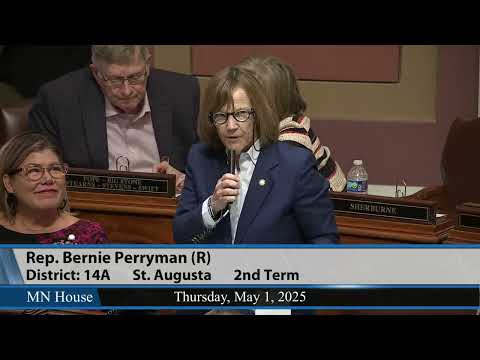
- AED signage (House File 1290): authorizes a statewide standardized roadside sign to identify publicly registered outdoor AED locations, allows MnDOT to integrate the sign into the Minnesota Manual on Uniform Traffic Control Devices beginning Sept. 1, and contains non‑mandating, locality‑driven placement and fee arrangements so participating entities cover sign costs.
- State government finance (Senate File 3045, as amended): funds the legislature, constitutional officers, multiple agencies and several policy priorities identified by the House Rules and Legislative Administration committee co‑chairs. The bill contains a mix of investments Republicans and Democrats said were the result of compromise, and it also includes anti‑fraud measures and funding increases for auditing and information‑technology functions.
Floor debate and amendments: The state government finance bill drew the longest debate. Co‑chairs Representative C. Cleburne and Representative Nash, who jointly carried the bill, framed it as a compromise that funds core services and nonpartisan staff. The measure faced multiple amendments and roll-call votes on several politically sensitive items.
- Proxy voting for deployed service members: Representative Paul Sexton offered an amendment to allow a deployed, active‑duty member to vote remotely or to have a proxy stand in. Sexton said the amendment was intended to give deployed legislators the option to preserve both military service and legislative representation. After floor discussion and a division vote, the amendment was adopted (division announced as 58 ayes, 52 nays).
- Anti‑bribery amendment (A18): Representative Greenman offered an amendment that would expressly prohibit offering inducements (including lotteries or chances to win cash or goods) to induce voter registration or voting during the absentee period; the amendment would exclude de minimis items up to $20. Greenman framed it as preemptive protection against large monetary inducements that have appeared in other states. The amendment failed on a roll call (the clerk announced 66 ayes and 67 nays).
- Attorney General budget and oversight debate: Multiple members debated funding and oversight for the Attorney General’s Office. Representative Davis offered an amendment to restrain operational and one‑time spending in the attorney general’s budget; supporters described it as fiscal prudence and critics said it would harm prosecutions and consumer protections. Debate on AG oversight and a referenced court case called “Energy Policy Advocates” featured extended back‑and‑forth over transparency and the office’s role in statewide investigations.
Votes at a glance (floor outcomes reported): - DWI/interlock bill (as amended): Passed — 123 ayes, 5 nays (clerk announcement on roll call during third reading). - AED signage (House File 1290): Passed — 133 ayes, 0 nays. - State government finance (Senate File 3045, as amended): Passed — 113 yays, 21 nays (final roll call reported on third reading). - State government policy (House File 1837): Passed — 131 yays, 1 nay. - Local government policy (House File 2098, as amended): Passed — 132 yays, 0 nays.
What’s next: The finance bill was passed as amended in the House and will go to conference with the Senate on provisions where the chambers disagree. Members named conference committee appointments and the House set additional conferees for other Senate files mentioned on the floor.
Who spoke: Dozens of representatives took the floor over the day; notable floor speakers in the debates included Representative Kraft (DWI bill sponsor), Representative Perryman (AED signage sponsor), committee co‑chairs Representative Cleburne and Representative Nash (state government finance), Representative Sexton (proxy voting amendment), and Representative Greenman (anti‑bribery amendment proponent). Representative Kraft described personal community impact from the Park Tavern crash and urged passage; Representative Perryman emphasized lifesaving value of AED visibility; Representative Cleburne and Nash framed the finance bill as a bipartisan compromise.
Limits of this report: The House transcript includes many interventions, withdrawn amendments and clerical calls; this report lists floor outcomes the clerk announced during roll calls and records spoken reasons given on the floor. It does not attempt to summarize every minor amendment or appropriation line in the finance bill.
Ending note: Lawmakers said they expect some contested provisions to go to conference committees; final state funding and policy choices will be resolved through those negotiations before the 2025 budget is finalized.