Get Full Government Meeting Transcripts, Videos, & Alerts Forever!
Get email alerts on the Hazardous Substance Regulation topic
No spam. Unsubscribe anytime.
Eugene holds public hearing on hazardous substance user fees; city staff, residents discuss toxics board staffing
Summary
The Eugene City Council held a public hearing April 21 on an ordinance setting annual hazardous substance user fees, including a recommended rate of $85.62 per full-time-equivalent employee; speakers and councilors questioned the toxics board’s staffing, reporting burdens on industry, and regulatory overlap with state agencies.
The Eugene City Council on April 21 opened a public hearing on an ordinance adopting annual hazardous substance user fees meant to support the city’s toxics reporting program.
City Manager said, “The fee of $85.62 per FTE was recommended by the toxics board and is the subject of tonight's public hearing,” noting the fee is based on numbers of employees, not numbers of chemicals.
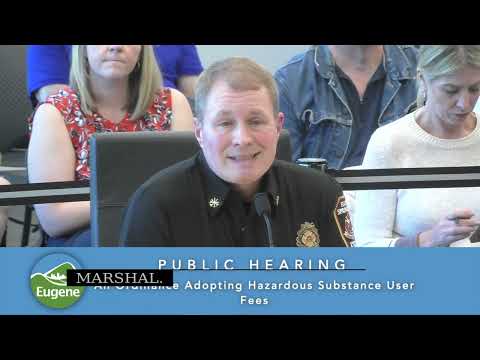
The hearing drew a member of the public who described attending an informational session led by the fire marshal and praised the program’s role for first responders. The commenter said the toxics board “has not been fully filled with people over the last few years,” and that the board has at times lacked the quorum needed to conduct business.
The presentation and subsequent council questions focused on three practical issues: what the toxics program provides to first responders, overlap between city and state reporting, and board recruitment. Fire Marshal explained the program “makes the environment safer for the community as a whole” and that annual reporting keeps safety issues “on the forefront” for industries and responders. The Fire Marshal also said the Oregon State Fire Marshal has primary responsibility for setting certain state-level reporting numbers and that the Department of Environmental Quality (DEQ) has a role for substances on federal lists.
Councilors pressed staff on whether the city and state reporting systems could be consolidated or automated to reduce duplicate industry reporting. A former fire chief on the council recalled repeated efforts to explore a single, automated form that could populate both city and state systems; staff confirmed that facilities currently must report separately to the city, the state, and in some cases to federal systems.
Several councilors and the public raised recruitment for the toxics board as a concern, with comments that the board has been difficult to fully staff and that vacancies limit the board’s ability to complete work.
No council action was taken at the hearing; the public hearing was opened and closed during the meeting and moved on to other agenda items.
The council recessed the hearing and proceeded with other business after questions and brief comments from council members.