Get Full Government Meeting Transcripts, Videos, & Alerts Forever!
Get email alerts on the Vessel Insurance topic
No spam. Unsubscribe anytime.
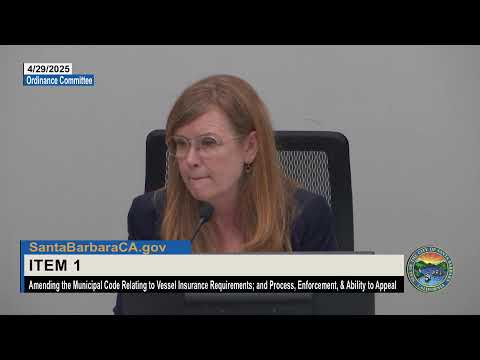
Ordinance committee forwards vessel-insurance requirement to City Council
Summary
The Santa Barbara City Council Ordinance Committee voted unanimously April 29 to send an ordinance to the full council that would require most vessels in city waters to carry liability insurance with a $300,000 minimum, take effect Jan. 1, 2026, and include enforcement and appeal provisions.
The Santa Barbara City Council Ordinance Committee voted 3-0 April 29 to forward to the full City Council a draft ordinance that would require most vessels in the Santa Barbara Harbor District to carry liability insurance and add administrative enforcement and appeal procedures to the municipal code.
Nathan Aldridge, the Waterfront’s harbor operations manager, told the committee that “Santa Barbara is one of only a few harbors throughout California that does not require insurance,” and that the proposed requirement is intended to protect the city and boaters from cleanup and infrastructure costs after accidents, sinks or fires.
The draft ordinance would add two sections to the Santa Barbara Municipal Code (proposed 17.12.0.2 and 17.12.0.21). Under the draft, effective Jan. 1, 2026, vessels that hold a slip permit or that moor or anchor in city waters generally must maintain general liability vessel insurance with a minimum policy limit of $300,000. The draft narrows some earlier proposals: staff removed a separate wreck/spill liability clause, reduced the minimum from $500,000 to $300,000, and made an “additional insured” endorsement a requirement only if the underwriter makes it available.
The ordinance would exempt launched vessels and human-powered craft, and skiffs under 15 feet. It would also exempt brief anchorings: the additional-insured requirement does not apply when a vessel moors or anchors for fewer than 90 days or when the waterfront director permits emergency anchoring. Vessel owners must notify the waterfront director within five business days if coverage is cancelled or if the city’s additional-insured status is removed. When proof of insurance is requested, permittees would have 60 calendar days to provide documentation; failure to comply may result in slip termination, denial of mooring permission for transient vessels, or impoundment per existing enforcement provisions (see municipal code section 17.20.005(j)).
Aldridge said the Waterfront Department surveyed roughly 400 members of the harbor community and found that more than 80% of respondents already carry vessel insurance and that the majority supported a requirement. He said the department has tracked industry standards across California and found that most marinas require insurance; as a result, staff concluded the requirement would bring the harbor in line with common practice.
City Attorney Duimos told the committee that waterfront staff and their designees will review submitted policies to confirm coverage levels and that the city can amend the ordinance language in future if the review shows gaps. As Duimos put it, “the waterfront director, their designees are gonna see these insurance policies to confirm that.” Aldridge and the committee emphasized that staff intends to use the first year to evaluate incoming policy documents and, if necessary, adjust language.
Commercial fishermen and other harbor stakeholders spoke during public comment. Chris Foss, president of the Commercial Fishermen of Santa Barbara, said he was not in “significant opposition” but warned that insurance markets can be volatile and that coverage costs for fishermen vary with annual gross receipts. Foss suggested the sector could consider a pooled approach to lower costs and asked whether the January 2026 effective date would allow time to explore that option; he said an insurance agent had agreed to discuss pooling with the fishing community.
Committee members pressed staff on several operational points. Committee member Jordan asked whether the survey captured anchored vessels off East Beach; Aldridge said the department’s outreach and survey capture permit holders and harbor slip users more reliably than some indefinite or abandoned anchored vessels. Jordan also sought clarification on pollution coverage; Aldridge and others told the committee they had consulted industry experts and believed pollution or fuel-spill coverage is typically included in standard liability policies, but staff said they will verify the coverage when they review individual policies.
Committee member Gutierrez moved, and committee member Jordan seconded, a motion that the ordinance committee forward the draft ordinance to City Council for introduction. The committee voted unanimously (Gutierrez: yes; Jordan: yes; Chair Sneddon: yes).
The Harbor Commission previously reviewed the proposal and, according to staff, unanimously recommended moving forward. Aldridge outlined a multiyear outreach timeline: the topic was first considered by the Harbor Commission in 2022, a draft policy was circulated through 2023 and 2024, and Harbor Commission action in March 2025 advanced the draft to the ordinance committee for review.
Next steps: the committee forwarded the draft to the full City Council for introduction; the City Council will consider the ordinance at a future hearing, where the public will have another opportunity to comment. Because the ordinance was forwarded for introduction rather than final adoption, additional amendments or delays remain possible.