Get Full Government Meeting Transcripts, Videos, & Alerts Forever!
Get email alerts on the Public Health Measles topic
No spam. Unsubscribe anytime.
Travis County reports second measles case; officials urge MMR vaccination
Summary
Austin Public Health and Travis County officials confirmed a second measles case in the county, saying the patient was fully vaccinated and experienced only mild symptoms. Health leaders posted exposure locations, advised monitoring through May 11 and urged vaccination and boosters for those uncertain of their immunity.
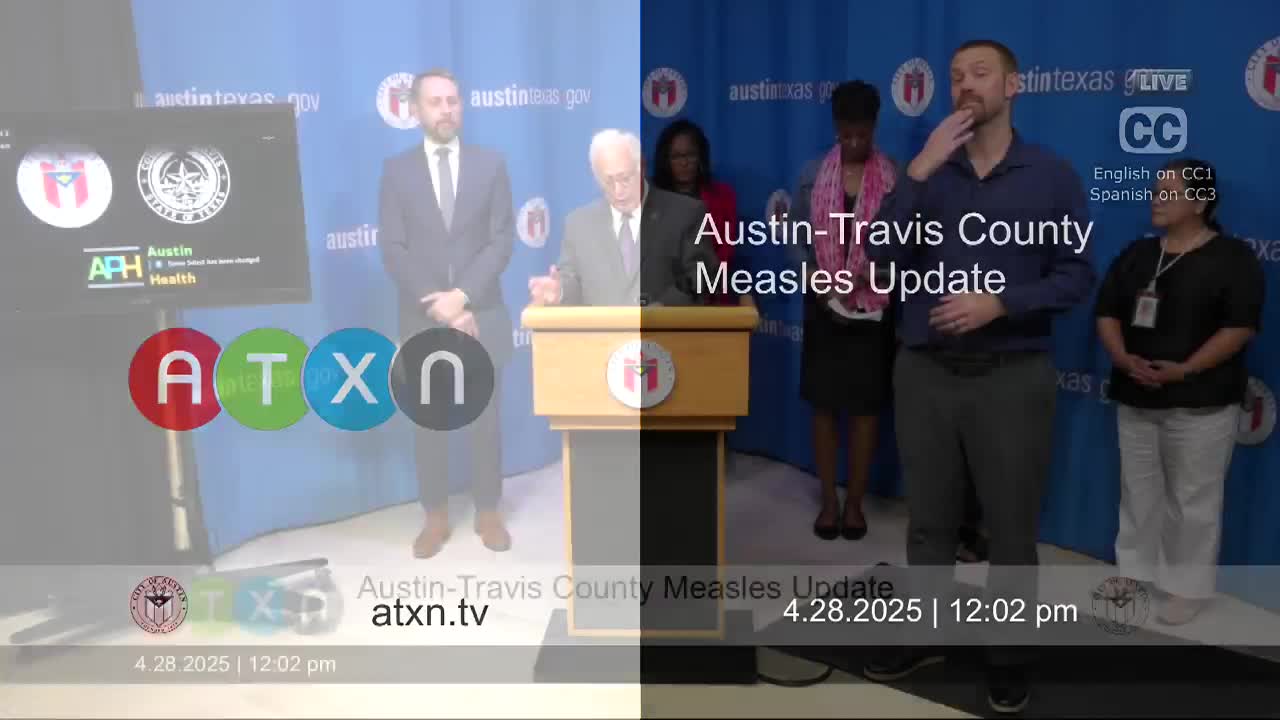
Travis County public health officials confirmed a second case of measles and urged Austin-area residents to verify MMR vaccination status and seek shots if they are unvaccinated or unsure.
Dr. Watts, an epidemiologist with Austin Public Health, said the newly confirmed case involved a fully vaccinated adult who developed only mild symptoms and is isolating at home. Officials said federal and state partners, including the Centers for Disease Control and Prevention, are assisting contact tracing and passenger notification related to travel exposures.
“This case shows that vaccines are our best defense,” an Austin Public Health spokesperson said in Spanish during the briefing. Officials told residents that exposure locations have been posted on the county’s public information channels and encouraged anyone who was at listed sites during the posted hours to contact their health care provider or Austin Public Health for guidance.
The county advised people who were at listed locations to monitor themselves for symptoms through May 11, the last date of potential public exposure, and to call Austin Public Health at 512-972-5555 for help finding care if they do not have a provider. Health staff said measles virus can linger in the air and on surfaces for roughly two hours after an infectious person leaves, so risk depends on timing and the infected person’s viral load.
Judge Andy Brown emphasized community vaccination coverage, citing CDC guidance about herd immunity thresholds. “The CDC says it is important for any community to maintain high vaccination rates; when that drops below 95 percent, transmission can occur,” he said in Spanish.
Officials repeated standard clinical guidance: two doses of MMR vaccine provide about 97 percent protection against measles for the average person; people unsure of their status can have immunity checked by a blood test or receive another MMR dose. Public clinics, many retail pharmacies such as CVS and Walgreens, and community providers including Lone Star Circle of Care and Austin Regional Clinic were listed as vaccine access points; the county also noted mobile clinics and programs to provide vaccines to uninsured residents.
Adrian Stairup, director of Austin Public Health, said the department has used federal public-health funding to support outreach and contact tracing and that the city and county will mobilize available resources to respond even as some federal COVID-era funding declines.
Officials urged parents to review school and child-care immunization records and to protect infants, pregnant people and immunocompromised residents who cannot be fully vaccinated. The briefing closed with a reminder that measles can cause pneumonia and encephalitis and can be fatal in young children and others at high risk.