Get email alerts on the Defense Community Partnerships topic
No spam. Unsubscribe anytime.
Offutt commander’s representative outlines base missions, growth plans and local concerns in Bellevue briefing
Summary
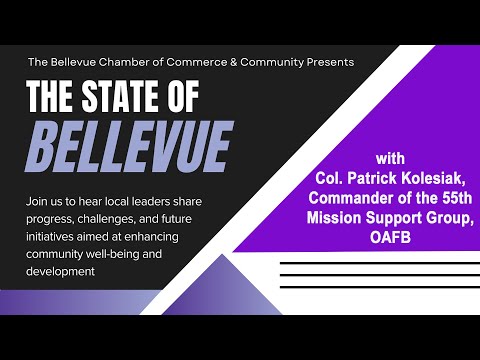
Colonel Patrick Kliesiak, mission support group at Offutt Air Force Base, told a Bellevue community gathering that the base’s unique mix of intelligence, command-and-control and recovery missions drives close ties with local schools and the city — but also creates pressure points around land use, power and outside investment.
Colonel Patrick Kliesiak, mission support group at Offutt Air Force Base, told a Bellevue community gathering that the base’s unique mix of intelligence, command-and-control and recovery missions drives close ties with local schools and the city — but also creates pressure points around land use, power and outside investment.
"I've spent 24 years in the military...but I've never been anywhere that I've seen that has a greater partnership between the base and the local community than what we have here at Bellevue," Kliesiak said, praising local schools and community partners.
The briefing summarized Offutt’s principal mission elements, noted the base’s economic linkages to the city and identified three main challenges for the installation: preventing incompatible development (encroachment), ensuring power resiliency for energy‑intensive operations, and monitoring foreign investment near the installation. Kliesiak said about 26% of the Bellevue School Corporation student population is military‑connected and that a drop in impact aid and tuition assistance — “right down under $3,000,000,” he said — has made support for those students more difficult for the district.
Kliesiak described Offutt’s major hosted missions and organizations, including the installation host wing, the weather wing that provides terrestrial and space weather forecasting across the Air Force, United States Strategic Command, and the Defense POW/MIA Accounting Agency lab located at the base. He also reviewed the range of specialized aircraft and roles tied to the installation’s intelligence and command missions, including reconnaissance platforms, aircraft that collect ballistic‑missile data and platforms used for post‑detonation sampling and airborne command and control.
On encroachment, Kliesiak said the base is seeking to preserve land around airfield operations and described recent property transactions that add buffer space: donations or proffers for parcels on the north and south sides of the base. He said those areas provide room for future mission growth and improve safety by keeping noncompatible uses at a distance.
"One of those things is encroachment," Kliesiak said. "It makes it safer for the base. It provides us a little bit of a standoff that we need to be able to make sure that we can fly safely, and provides us some area that we can go and expand into."
On foreign investment, Kliesiak described the Committee on Foreign Investment in the United States (CFIUS) process and increased federal scrutiny of foreign ownership near military installations. "It is a law that Congress has passed that basically says we have to be notified in the federal government if there is an organization that has a more than 5% ownership by foreign companies that are going to invest in land near the [installation]," he said, adding that the process does not necessarily block transactions but triggers review.
Power resiliency was another priority. Kliesiak said the base’s global command‑and‑control facilities and operations are energy intensive and that Omaha Public Power District (OPPD) has warned it may need to roughly double generation and distribution capacity in the metro area over the next decade to meet growth. He said the base works with OPPD to improve reliability.
Kliesiak also reviewed recent damage and reconstruction: he said a February event removed roughly one‑third of usable square footage on the base; reconstruction has reopened three of eight campuses, with two more due in the coming months and the remainder scheduled through early 2028. He said a large, largely classified processing campus will take substantial time to rebuild.
Looking ahead, Kliesiak outlined planning to preserve space for mission growth and to relocate non‑fence‑line facilities into the surrounding community — for example, moving some training and professional development facilities outside the wire and keeping a language learning center available while planning for possible future relocation. He said Offutt has been named a preferred location for the replacement National Airborne Operations Center (NAOC) and that, if selected and funded by Congress, the base would host a survivable air operations center and accompanying personnel, with significant local impact.
Kliesiak identified several aging base facilities slated for right‑sizing or renovation, including Building 500 (used by wing headquarters) and the Martin Bomber Building, which he said currently houses approximately 3,000 personnel in space not designed for that level of occupancy. He said renovation and new construction are prerequisites to removing older facilities.
The presentation closed with an appeal of thanks to local partners. Kliesiak praised Bellevue schools, Bellevue University, regional chambers of commerce and community support organizations. He noted Bellevue School District’s designation as Purple Star Schools systemwide and the region’s recognition by the Association of Defense Communities for advancing community‑base partnerships.
Kliesiak concluded by offering to take questions and thanked the community for its ongoing support.
AI generated
The text on this page is AI generated. Summaries, highlights, analysis, and video transcripts are all produced from the original source material.
AI can make mistakes, so if you spot one, and we will fix it for everyone.
Note: the source content is unaltered by us. Any content source we link to, be it a video, an audio recording, or a document, is presented exactly as its publisher released it. That publisher is usually a government body, sometimes an individual official or another organisation.