Get Full Government Meeting Transcripts, Videos, & Alerts Forever!
Get email alerts on the Water Quality topic
No spam. Unsubscribe anytime.
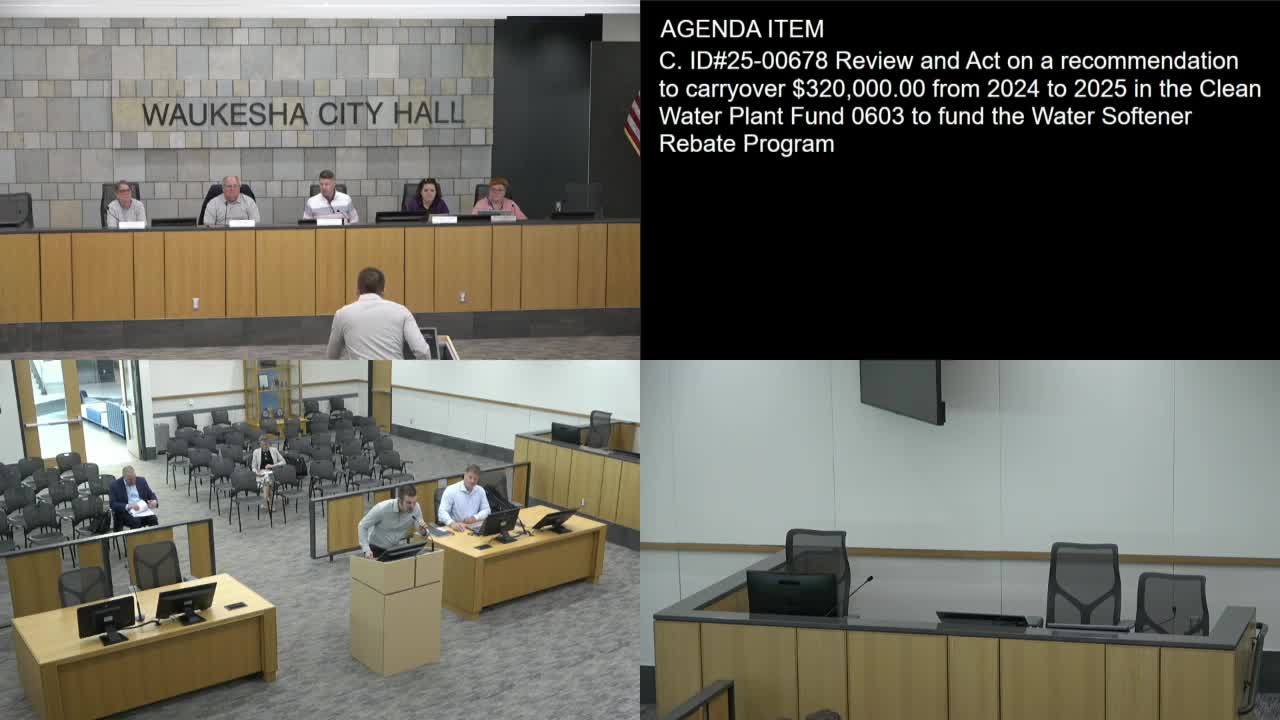
Waukesha finance committee approves $320,000 carryover for water softener rebate program
Summary
The Waukesha City Finance Committee approved carrying over $320,000 from 2024 to 2025 for a rebate program that pays residents $200 to remove water softeners. Staff said the program reduces chloride levels in the city—s water and receives about 10—20 applications weekly.
The Waukesha City Finance Committee voted to carry over $320,000 from 2024 into 2025 to keep the city—s water softener rebate program running.
Zack Eisner, plant manager at the Clean Water Plant, told the committee the program offers a $200 rebate to residents who remove qualifying water softeners. "We get about 10 to 20 new applicants a week," Eisner said, and staff receives "at least 1 or 2 calls a day about the rebate program." He said the program is using remaining 2024 money and the city asked the committee to move $320,000 forward to continue the effort.
The program was seeded in part from an account established during Waukesha—s Lake Michigan water diversion work, Eisner said. "So $100,000 of this rebate program is from that account. And then there is also some money from water utility that's assisting with this program," he said. Eisner also said $160,000 had been in the program account so far this year.
Eisner described measurable water-quality effects tied to the program and the utility's other changes: "Ever since we switched over from Lake Michigan water, we're seeing at least a hundred milligram per liter drop in chlorides. So that takes it from, upper 4 hundreds a lot of times to upper 3 hundreds milligrams per liter." He said the permit limit the city faces is 400 milligrams per liter and that seasonal road-salt spikes can push concentrations above that level in winter months.
When Alderman Lemke asked how many softeners would need removal to provide a safe buffer below permit thresholds, Eisner said the utility does not have an exact count of installed softeners and estimated instead by targeting a baseline chloride level reduction. "As far as the goal in mind for the chloride concentration, we're trying to see 100 milligrams per liter below the 400. So we're trying to see the 300 milligrams per liter," he said.
Alderman Lemke made the motion to approve carrying over the $320,000; the motion was seconded by Alderman Slaven and approved by voice vote.
Committee members asked how the program was performing and whether interest remained high; Eisner said interest comes in spurts tied to outreach and social-media notices. The committee did not set additional conditions for the carryover.
The carryover will allow staff to continue issuing $200 rebates to qualifying residents while the program continues to monitor chloride concentrations and permit compliance.