Get Full Government Meeting Transcripts, Videos, & Alerts Forever!
Get email alerts on the Land Use Housing topic
No spam. Unsubscribe anytime.
County delegation and consultants brief committee on land use, ADUs, appeals and Chesapeake critical-area changes
Summary
Presenters summarized multiple bills tracked for Prince George’s County in 2025: a new land-use task force, accessory dwelling unit requirements, Board of Appeals membership language, a Chesapeake critical-area tree-clearing lien measure (county opposed), and several housing bills that failed or were deferred.
A series of land use and housing measures that could reshape local planning and property liability drew attention in the General Assembly Committee briefing Tuesday.
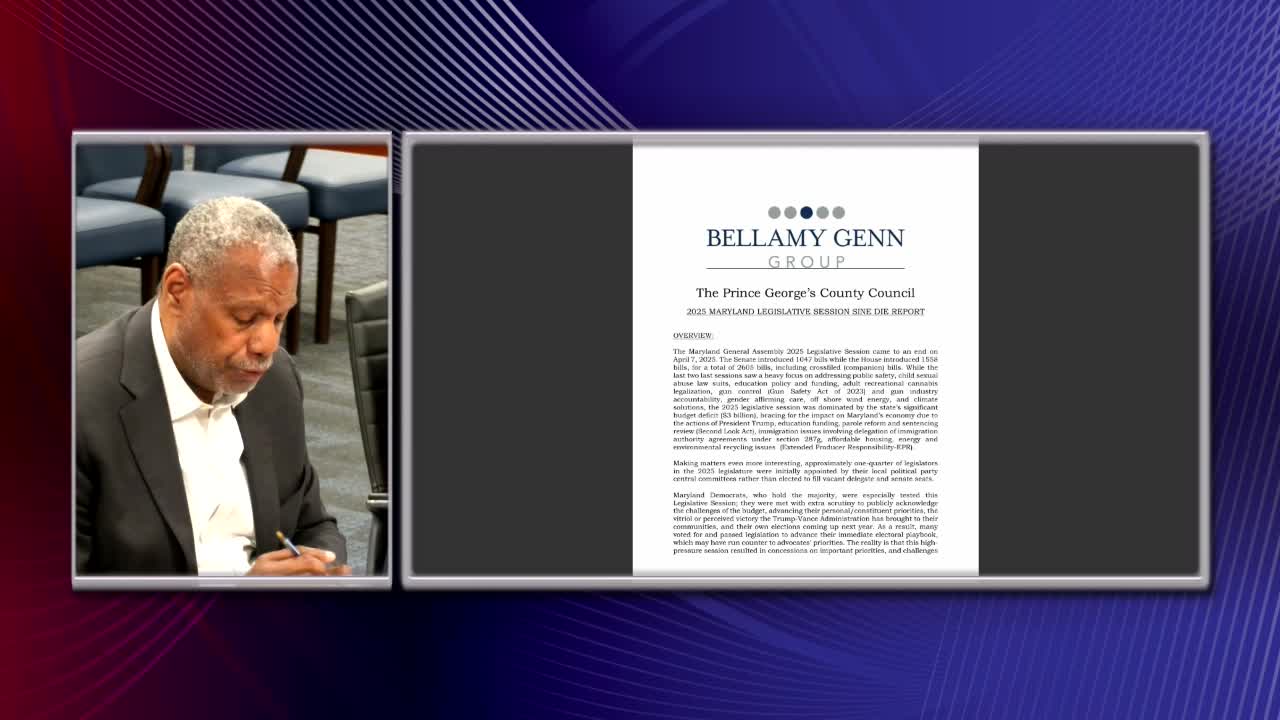
Lorenzo Bellamy of Bellamy Gen Group walked committee members through bills assigned to the county’s bi-county delegation and other local measures. He said House Bill 1266 establishes a task force to study Prince George’s County land-use issues; the Maryland Department of Planning will staff the task force, which must report findings by December 2026. Bellamy described the panel’s membership and noted the task force terminates Dec. 31, 2026.
Bellamy said House Bill 1065 on Board of Appeals membership passed both chambers and is headed to the governor. The bill clarifies appointment rules for Prince George’s County’s Board of Appeals and removes an amendment that would have changed appointment counts, according to the briefing.
On environmental property enforcement, Bellamy summarized HB1470 (Prince George’s County Chesapeake and Atlantic Coastal Bays Critical Area protection), a measure that requires the county Department of Environment, Planning and Infrastructure Enforcement (DEPIE) to record a lien within 90 days after issuing a notice of violation for unauthorized tree cutting on qualifying properties; the law applies to properties under five acres not zoned commercial and includes retroactive application to violations occurring on or before Nov. 7, 2018. Bellamy said Prince George’s County has taken an official opposing position on this bill and asked staff to transmit that position to the governor.
On housing, Bellamy noted that HB1466 / SB891, which promotes accessory dwelling units (ADUs), passed and requires local legislative bodies to authorize ADUs by Oct. 1, 2026 with certain mandatory and optional local standards; the bill includes safety, density and setback provisions and allows localities to impose off-street parking requirements if backed by a parking study and waiver process. Bellamy said a substantial administration housing bill (HB503) addressing housing-to-job ratios was amended and ultimately killed in the Senate Education and Energy Committee after county and municipal pushback. Bellamy also said HB709 / SB651 (a good-cause eviction bill) failed this year but could return in future sessions.
Committee members asked clarifying questions about liability, retroactivity and enforcement costs; Bellamy and staff said they had discussed the potential administrative impacts with the county executive’s office and that the county expects to supply a cover letter on its opposition where requested.
Presenters asked to follow up with members by sending the comprehensive list of assigned bond bills and a longer bill-tracking list for members’ review.