Get Full Government Meeting Transcripts, Videos, & Alerts Forever!
Get email alerts on the Economic Development Loan Process topic
No spam. Unsubscribe anytime.
City staff outlines South Dallas Fair Park economic-development loan process, underwriting, and board role
Summary
Office of Economic Development staff described the steps from initial contact through underwriting to approvals for economic-development loans, explained underwriting by Grow America (formerly National Development Council), administrative vs. City Council approval thresholds, and how the board fits into offer and approval steps.
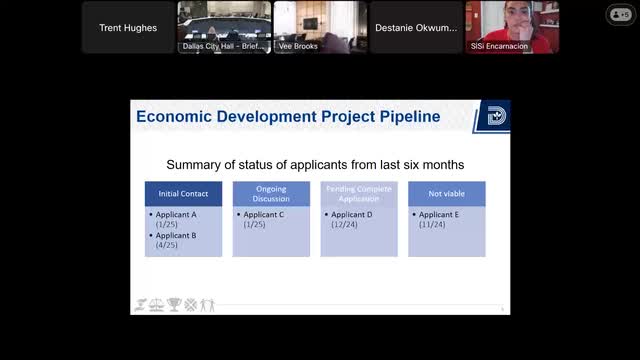
Office of Economic Development staff walked the South Dallas Fair Park Opportunity Fund Board through the economic-development loan pipeline process at the April 28 meeting, explaining how applications move from initial contact to underwriting, offer letters and final approvals.
Staff member Heather (Office of Economic Development) said the office begins with an initial meeting to assess project readiness, then works with applicants to submit a complete application. If a project best fits existing, formulaic programs such as the small-business assistance program or an "as-of-right" tax abatement, staff can approve administratively without sending the matter to underwriting. More complex real-estate projects that require deeper subsidy or a negotiated incentive are referred to an underwriter. "Our underwriter is Grow America, which is a national CDFI that does a lot of small-business lending and community development lending," Heather said, adding that Grow America is formally the National Development Council but has changed its name.
Heather outlined the typical workflow after underwriting: staff issue an offer letter that sets terms and conditions; the applicant may negotiate and countersign that offer; and only once terms are agreed will staff pursue the necessary approvals. She said administrative approvals are used for many projects in the target area: projects under $1 million located in a target area may be approved administratively by the city manager's office with legal review from the city attorney. For projects over $1 million, staff said City Council approval is required. Heather said that projects outside a target area have a lower Council threshold: $100,000.
Board members asked where the board fits in the timeline. Heather said the board's formal recommendation happens after an executed offer letter and before administrative or City Council approvals; she described the offer letter as "contingent" on subsequent approvals so that the board's action comes on projects for which staff and the applicant have agreement in principal. Board members may also move to send a project to Council for public consideration even if it otherwise qualifies for administrative approval; any such change requires a board vote.
Brady Flannery of the Dallas Attorney's Office told members that ethics questions — for example, whether a board member has a disqualifying financial interest in a project — can be routed to the Office of Inspector General for an advisory opinion. Heather confirmed staff can accept conflict-check questions routed through her office or members may contact the inspector general's office directly.
Staff also explained post-approval contracting and disbursement: contracts are disbursed on a reimbursement basis; staff and finance review draw packets (often requiring 2–3 weeks of internal review), then accounts payable processes payment (typically another 30 days). Heather said the overall reimbursement timeline is generally 30–45 days, and the office is moving to quarterly draws for NOFA grants to reduce repetitive review workload.
Why it matters: The presentation described where board review and voting fit in practical steps that determine whether and how projects receive city loans, the thresholds for administrative vs. council approval, and how the city manages underwriting, contracts and reimbursements.