Get Full Government Meeting Transcripts, Videos, & Alerts Forever!
Get email alerts on the Education Blueprint topic
No spam. Unsubscribe anytime.
Committee briefed on education changes: collaborative time delayed, local shares shift under Maryland blueprint
Summary
Presenters outlined how 2025 General Assembly actions adjusted the Blueprint for Maryland’s Future: collaborative teacher time implementation was delayed, funding phase-in shortened, and county shares for the blueprint will increase, prompting local fiscal impacts.
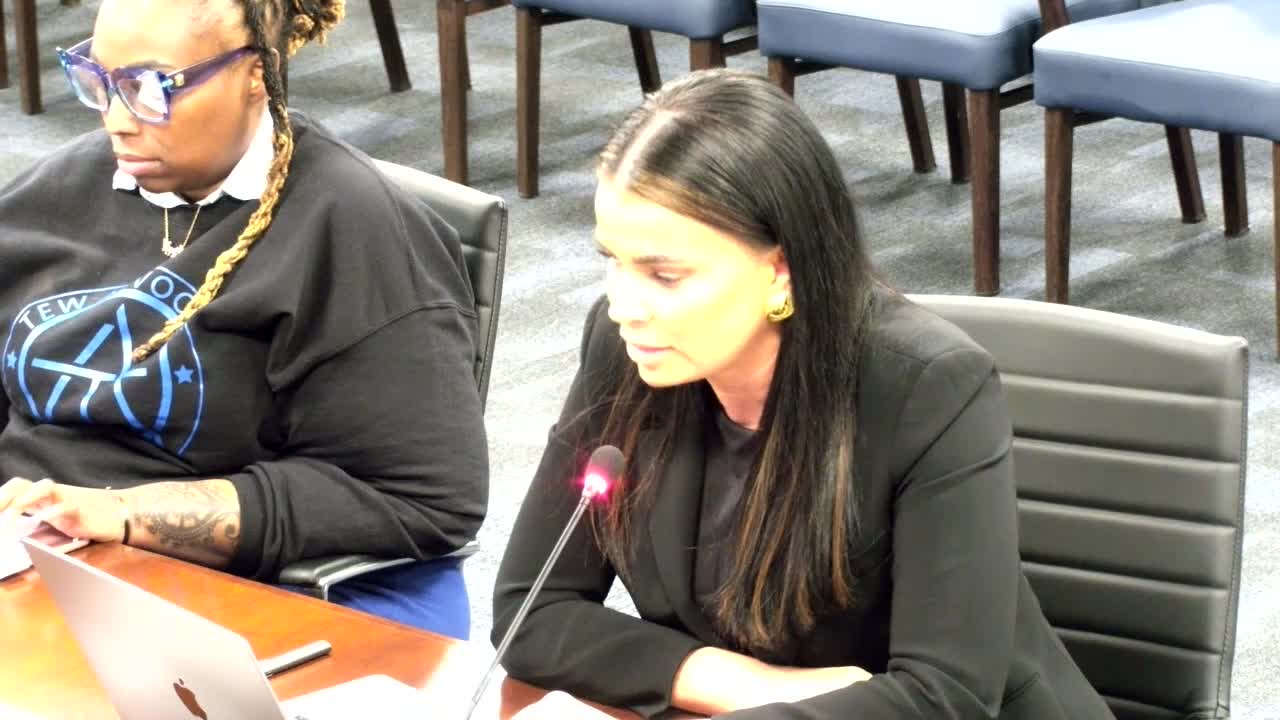
Prince George’s County General Assembly Committee received a briefing on education-related legislation passed by the Maryland General Assembly and how the changes are likely to affect local funding obligations.
Teresa Hessler, CEO of Ashlar Government Affairs, told the committee the legislature rejected proposed cuts and preserved full funding for community schools and other Blueprint programs while adjusting implementation timelines. Hessler said amendments delayed the requirement for collaborative (non-teaching) time and changed the implementation window from eight years to a seven-year phase-in, moving the start date to July 1, 2028. She also said the state “retains a portion of funding at a number of $1.63 per pupil” that had been originally designated for collaborative time.
Hessler described other changes enacted in the session: authorization for the Maryland State Department of Education to set community school implementation requirements and countywide plans; expansion of an academic excellence program and related special fund; adjustments to the Grow Your Own Educators grant program to emphasize experiential learning; and a $2,000 teacher relocation incentive for out-of-state licensed teachers who move to Maryland.
Daryl Barnes of Barnes International quantified statewide school support presented in the briefing: he said state support for public schools totals about $9.8 billion, with an increase of $594 million in direct aid to local schools (reported by presenters as a 7.3% year-over-year increase). Later in the meeting Barnes and other presenters noted the enacted changes shift roughly $45 million more in blueprint contribution responsibility onto counties, increasing the county share to a cited figure of $954 million (as stated in the briefing). Committee members pressed for clarity on whether that increase applies to the coming fiscal year; presenters said the $45 million increase is scheduled to take effect next year.
Presenters said the AGR team and county lobbyists will continue to refine county-specific fiscal projections and circulate updated per-pupil and county-level numbers as enrollment and local fiscal details are updated.
The committee asked follow-up questions about program timing and county obligations; staff and consultants pledged to supply more detailed county-level figures and to provide links to the full bill-tracking list.