Get Full Government Meeting Transcripts, Videos, & Alerts Forever!
White House reviews draft land-development code updates on streets, stormwater, lighting and parking
Summary
White House city officials and consultants held a study-session update on proposed land-development regulation changes that would consolidate zoning, site‑plan and engineering standards into a single unified development ordinance and revise street, stormwater and lighting requirements.
White House city officials and consultants held a study-session update on proposed land-development regulation changes that would consolidate zoning, site‑plan and engineering standards into a single unified development ordinance and revise street, stormwater and lighting requirements.
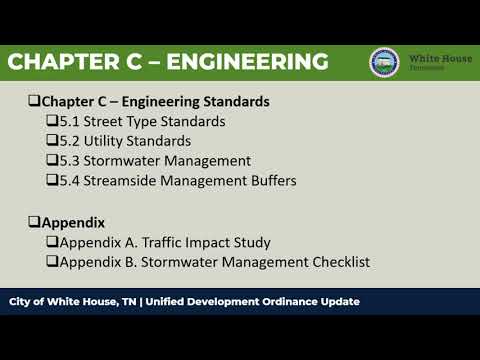
The update, presented by Kelly Pleper, a planning consultant with Kimley‑Horn, and Harrison Turner, a civil engineer with Kimley‑Horn, walked the Board through Chapter C (engineering standards) and how it will link to the municipal code’s Chapter 18 stormwater regulations, and discussed options for on‑street parking, guest/inset parking, lighting and proposed residential densities.
The new document would combine procedural material (Chapter A) with engineering requirements (Chapter C) so developers and staff consult one book for submittal and review requirements, presenters said. “You’re gonna have this nice book that’s going to be digital, so both hard copies as well as online versions, that identify everything from your procedures as far as how you do certain things as far as reviews, time frames, processes, who does what,” Kelly Pleper said.
Nut graf: The consultants and staff said the revisions are intended to streamline review, reflect current engineering practice and TDOT details, and give staff clearer tools to protect public infrastructure. The changes could affect subdivision street widths, placement of utilities, stormwater design and how developers supply parking and open space; the board asked for additional detail and a joint follow‑up session before moving to the Planning Commission.
Key proposals and technical details
- Street classifications and minimums: Presenters proposed a hierarchy of street types (minor arterial, major collector, minor collector, local urban and rural streets, and alleys) with matched design speeds and…
Already have an account? Log in
Subscribe to keep reading
Unlock the rest of this article — and every article on Citizen Portal.
- Unlimited articles
- AI-powered breakdowns of topics, speakers, decisions, and budgets
- Instant alerts when your location has a new meeting
- Follow topics and more locations
- 1,000 AI Insights / month, plus AI Chat