Get Full Government Meeting Transcripts, Videos, & Alerts Forever!
Get email alerts on the Education Finance topic
No spam. Unsubscribe anytime.
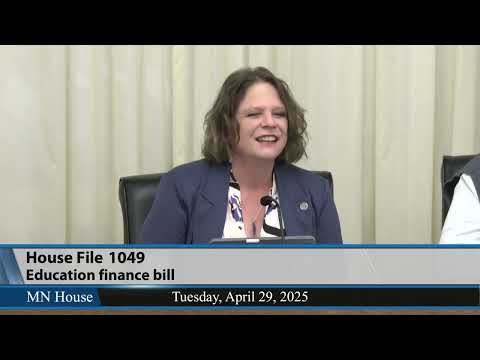
Minn. House Tax Committee lays over HF 1049 after divided debate over unemployment insurance for hourly school workers
Summary
Chair Joachim of the Minnesota House Tax Committee opened the hearing on House File 1049 and introduced a bipartisan education finance package that funds the Read Act and creates a flexible basic supplemental aid while retaining a leadership-directed provision to end extended UI eligibility for K–12 hourly school employees after the summer of 2028.
Chair Joachim of the Minnesota House Tax Committee opened the hearing on House File 1049 at the committee meeting and moved the bill in committee. HF 1049 combines education finance and limited policy changes, including provisions tied to the Read Act, creation of a basic supplemental aid, optional use of long-term facilities maintenance levies for roof repair, and a scheduled repeal in 2028 of the unemployment insurance (UI) eligibility that was extended to some K–12 hourly school employees in 2023.
Why it matters: HF 1049 would change how several K–12 funding streams interact with property tax levies and state aid, create a new flexible per-pupil basic supplemental aid, direct $40,000,000 toward the Read Act in the first biennium, and set a four-year runway that would end the UI eligibility for certain hourly school employees after the summer of 2028. The measures affect school budgets, district levy capacity, and benefits for education support professionals (ESPs) statewide.
The committee adopted the DE2 amendment by voice vote after the bill sponsors described both finance and policy components. "We had a target of $40,000,000 in the first biennium, dedicated to the Read Act," Representative Joachim said, and explained the bill included a mix of funding reallocations and new flexible uses districts had requested. Christina Perra of House Research summarized the primary policy changes in the bill, saying that the Read Act provisions modify several definitions, add "science of reading" to definitions such as "evidence-based" and "structured literacy," and shift some implementation responsibilities to the Department of Education.
On financing, House Fiscal staff described the bill's property tax interactions. A staff analyst identified two levy-related items: (1) renaming and restructuring the former local optional levy into a three-tier "basic supplemental revenue" and (2) allowing roof repair and replacement to be included in long-term facilities maintenance (LTFM) plans while increasing the equalizing factor from 123% to 127% and covering the resulting cost with state aid. The staff analysis shows the state aid covering roughly $9,600,000 in fiscal years 2028 and 2029 for that roof provision.
The bill also creates a flexible basic supplemental aid by reallocating existing categorical funds (including library funds and partial changes to transportation reimbursement) and slowing the planned growth of student support personnel aid. Sponsors said the changes were intended to give districts more flexible dollars while preserving core investments such as funding directed to student support personnel (counselors, nurses, psychologists and social workers).
The most contested element was the UI provision. Under HF 1049 as presented to the committee, the UI eligibility that had been extended to K–12 hourly employees in 2023 would expire after the summer of 2028. Supporters of maintaining the 2023 change argued hourly school workers (ESPs) provide essential services and that the UI eligibility filled longstanding gaps in worker protections. Representative Lee offered the A1 amendment to remove the 2028 repeal and preserve UI eligibility; Lee described personal family experience of an hourly school worker and said the amendment was offered "on behalf of all of her colleagues."
Representative Gomez urged support for the A1 amendment, saying ESPs are "the people who fill in all of the gaps, who are on the front lines, who make education possible in our buildings." Committee co-chairs and other sponsors described compromise steps in the bill and a belief that the bill's new basic supplemental aid and a four-year runway would give districts time to work with employees and find summer assignments that reduce reliance on UI. "What we have now with the basic supplemental aid... those dollars are 100% kept in the school district and used for students and other summertime programs," one sponsor said.
The A1 amendment was put to a roll-call vote. The roll call recorded 12 ayes and 12 nays; the amendment therefore failed. The recorded roll-call votes available in committee proceedings show these individual votes:
- Aye: Chair Gomez; Vice Chair Norris; Representative Elkins; Representative Freyberg; Representative Freiburg; Representative Hansen; Representative Herr; Representative Hewitt; Representative Kozlowski; Representative Lee; Representative Smith; Representative Stevenson; Representative Joaquin. (Note: committee summary gave the result as 12 ayes total.)
- Nay: Chair Davids; Vice Chair Joy; Representative Anderson; Representative Harder; Representative Johnson; Representative Roach; Representative Robbins; Representative Schwartz; Representative Swadinsky; Representative Werwas; Representative Weiner; Representative Witty. (Note: committee summary gave the result as 12 nays total.)
After the A1 vote, members discussed next steps. Sponsors said the version of HF 1049 before the committee followed parameters set by chamber leadership: a $40,000,000 Read Act target in the first biennium, a net-zero overall target, and a 2028 repeal of the UI extension. The committee laid HF 1049 over for possible further action and conference committee work.
What the record shows and does not: The committee record shows adoption of the DE2 amendment (voice vote), rejection of the A1 amendment (12-12 roll call), and the bill laid over. The transcript includes estimates and projections from nonpartisan staff about levy interactions, the stated $40,000,000 Read Act target, a $4,000,000 litigation funding figure retained in the bill (compared with a $6,000,000 request), and an estimated $9,600,000 state-aid cost for the LTFM roof change in FY28–29. The transcript attributes these numbers to committee sponsors and nonpartisan staff; it does not record final conference outcomes or enacted law.
Quotes used in this account are drawn from committee proceedings as recorded in the hearing transcript and attributed to the speakers who made them in committee.