Get Full Government Meeting Transcripts, Videos, & Alerts Forever!
Get email alerts on the Home Initiative topic
No spam. Unsubscribe anytime.
Council presses administration on HOME initiative spending, AMI changes and land bank readiness
Summary
Philadelphia City Council members pressed administration officials at a committee hearing over how the proposed FY2026 HOME plan would spend $134,000,000, protect low‑income homeowners as income limits change, and accelerate land bank and production programs.
Philadelphia City Council members pressed administration officials on how the proposed FY2026 HOME initiative would be spent, how changes to income-eligibility (AMI) would affect the most vulnerable homeowners and whether the city’s land bank and development programs are ready to deploy billions in new funding.
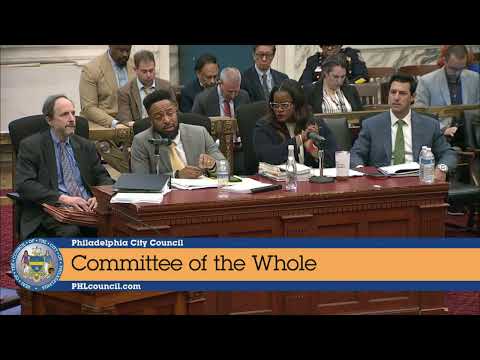
At a Committee of the Whole hearing, Council President Johnson opened discussion by asking city staff to explain plans to spend roughly $134,000,000 projected for FY 2026 under the HOME initiative and how the city will safeguard low‑income homeowners if programs shift income-eligibility limits. "We just wanna make sure that the most vulnerable population is also protected," Johnson said.
The administration said existing programs would spend broadly over the next two years and that new HOME-funded programs would begin in July 2026 and ramp up to normal spending levels within about a year. A city staff member said, "Existing programs will be spent evenly over the year over the next couple of years. And the new programs will start in July of 2026... and then they'll ramp up." The administration also committed to providing detailed data on applicants who were turned down under current income thresholds to justify expanding eligibility bands.
Why it matters: Council members repeatedly warned that expanding AMI bands for programs such as basic systems repair (BSRP) could leave already waitlisted homeowners behind unless staff can show how many people have been denied under existing thresholds and how resources will be increased to match expanded eligibility.
Basic systems repair and adaptive modifications Officials said BSRP served more than 3,000 households in FY 2025 and that the HOME plan would more than double the number served under the bond program for some components. The administration provided an FY 2026 BSRP funding breakdown during the hearing: $9,000,000 in HOME bond funding, $13,906,000 in CDBG, $551,000 from the housing trust fund and $16,000,000 in NPI, for a total of $35,457,000.
Councilwoman Jamie Gauthier noted long wait lists for related programs: "We have 7,000 homeowners already waiting in line," she said, urging the administration to ensure funding matches demand. On adaptive modifications — a separate program for accessibility and disability-related home changes — staff told councilmembers that last year’s $7,000,000 produced 382 completed homes but that a 1,400–1,700 person interest list remains and additional funding discussions are underway.
Land bank, acquisition and operational assessment Members pressed the administration about the city land bank’s capacity to support rapid acquisition and disposition if council approves a large bond. Several councilmembers said the land bank must be staffed and operational quickly. "I just don't personally think we have a year," one councilmember said of a planned operational assessment.
Administration officials responded that the assessment will not stop acquisition activity and that work will proceed in parallel: "The assessment doesn't mean that the work doesn't start until the assessment is done... The changes are gonna happen along the way," said a city staff member. The administration reported an RFP is active for a strategic plan and that a third‑party vendor was expected to be selected by July 1. Staff also said the acquisition fund language will be clarified to permit priority bids on sheriff sales and to allow purchases of privately offered vacant land.
TurnKey production, Accelerated Fund and preservation Councilmembers sought data on production programs. Angel Rodriguez of PHDC described outreach plans for the TurnKey program and said marketing will use community outreach and transit advertising. City staff reported a TurnKey mortgage allocation of $42,000,000, with $14,100,000 expended to date; they said an additional $18,000,000 would be needed to reach 802 currently approved properties and about $33,000,000 more would be required to reach an original goal of 1,000 units.
David Langley, introduced as executive director of the Philadelphia Accelerator Fund, presented program outcomes for an initial $10,000,000 investment: the first tranche was structured as forgivable loans and grant funding and leveraged about $15,000,000 in private capital. He said the fund has committed or deployed about $11,500,000, has a credible pipeline of roughly $20,000,000 and that 24 transactions have been closed or committed, covering about 78 units, 46 of which are deed-restricted affordable units. Of the 24 developers in the program, 22 are identified in his remarks as Black- or Brown-owned or nonprofit entities.
Shallow rent expansion and PHL Housing Plus The HOME plan proposes additional funding for the shallow rent subsidy program, which staff said is expected to serve roughly 1,000 households under the bond allocation and fund about 550 tenant-based vouchers when expanded. Councilmember Landau and others questioned extending eligibility up to 80% of AMI, saying the city must show how that expansion will serve the lowest‑income residents and not undercut existing pilots.
Councilmembers also asked about the PHL Housing Plus cash transfer pilot, which several members said has shown promising results. The administration said it is negotiating with philanthropic partners to extend the program beyond its current deadline and working with the Philadelphia Housing Authority and other partners to seek stable housing outcomes for pilot participants; staff said roughly 20% of pilot participants obtained vouchers during the study period.
Homelessness prevention, housing counseling and jobs Officials said homelessness prevention funds will be used for rent arrears, security deposits and diversion services. The administration reported housing counseling funding of roughly $10,000,000 in FY 2025 and an intended FY 2026 total closer to $13,000,000, adding about $2.8 million to compensate for pandemic-era CDBG-CV reductions.
Staff estimated approximately 41,500 full-time jobs would be supported over the life of the HOME initiative based on construction and preservation projections; officials acknowledged they will provide a breakdown of the types of jobs and prevailing-wage elements.
Council action The committee recessed by voice vote at the end of the hearing. Majority Leader Gilmore Richardson moved the motion to recess until the committee reconvenes in April 2025; the motion carried by voice vote.
What’s next Councilmembers asked for additional written materials before further action: (1) a written breakdown of how many applicants have been denied or placed on wait lists because they did not meet current AMI thresholds; (2) FY 2025 vs FY 2026 funding line-item comparisons for BSRP, adaptive modifications and housing counseling; (3) TurnKey pipeline and MPI remaining balances; and (4) the final scope and vendor timetable for the land bank operational assessment. Administration staff said they would provide the requested materials and that the land bank RFP is scheduled to close in early May with a vendor selection target of July 1.