Get Full Government Meeting Transcripts, Videos, & Alerts Forever!
Get email alerts on the Roads And Water topic
No spam. Unsubscribe anytime.
Council reviews pavement management plan and water projects, weighing tax increases, savings and loans
Summary
City staff outlined a multi-year pavement management plan and a parallel water project strategy that rely on a mix of budgeted road funds, state grants/loans and water account savings. Councilmembers discussed incremental tax changes versus drawing from reserves to avoid a larger future increase.
Woodland Hills City Council and staff spent the bulk of a budget workshop on a pavement management plan and how to pay for major road and water projects, including repairs to the Maple Canyon well.
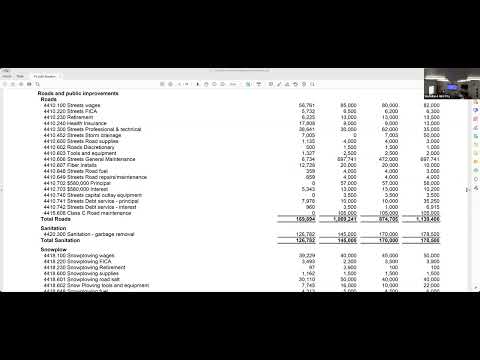
City staff said the pavement management plan started in 2024 and covers work through 2027. The first planned project for 2025 was described as a micro-seal package of projects costing a little over $500,000 (the speaker cited “roughly … five hundred and seventy or something like that”). Council staff reported the streets-maintenance line in the proposed budget at about $697,000, which would cover planned 2027 micro-seal projects and leave a smaller amount for potholing and repairs.
Nut graf: The council focused on how to fund a multi-million-dollar backlog that staff summarized as about $2.8 million of road work beyond 2027 and roughly $5 million of water-line work. Staff recommended coordinating road work with water projects where possible, using water grants or low-interest loans to fund combined water/road trenches so the road budget is not expected to shoulder the full cost.
City staff explained how tying road repaving to water-line replacement can reduce the road-dollar need: of the $2.8 million in major road rebuilds beyond 2027, staff estimated “probably over half of that would be done under a water project” if water funding can pay for combined work. That, they said, would reduce the standalone road requirement to about $1 million–$1.5 million beyond 2027 if water projects are successful.
Council members probed revenue options. Speakers noted the city receives roughly $100,000 annually in state Class C road funds and about $31,000 from a transportation tax shared with Utah County; staff also identified franchise tax receipts tied to utilities as a modest road revenue source. Several council members described a preference for smaller, incremental tax increases rather than deferring spending and facing a large “jump” later. One councilmember cited recent experience in which delaying maintenance led to difficult election-year conversations.
Staff recommended pursuing grant and loan programs for water work rather than funding multi-million-dollar water projects entirely from reserves. A staff speaker said they had submitted about $6.5 million in water-system needs into a state funding system and characterized cities’ conventional approach as combining a modest local match with state loans or grants to lock in construction costs at lower interest rates. As an example, staff recommended saving roughly $1 million as a local match and pursuing low-interest loans for the remainder.
Council asked about the Maple Canyon well specifically. Staff said the council’s proposed budget column included $650,000 to cover well repairs and the Maple Canyon well work; staff added that some work remains outstanding (casing orders and change orders) and the project schedule was tight for completion before June 30. A staff speaker warned that the $650,000 estimate could need adjusting if additional costs emerge.
Council discussion also covered how recently certified property-tax-rate mechanics can create public perception issues: one speaker noted that maintaining the certified rate can increase revenue because of county valuation changes, but residents often see the truth-in-taxation hearing as a tax increase. Several councilmembers and staff recommended clearer messaging and suggested offering residents “options” during truth-in-taxation outreach (for example, explaining the trade-off between holding the rate and delaying projects).
Ending: Council directed staff to refine the budget numbers and to return with more precise figures on the pavement plan, the Maple Canyon well timeline and the water-funding approach. Staff and council agreed to allow roughly 45 days to 60 days for additional analysis before final budget adoption, and staff said they would present a draft of the revised numbers at the next public hearing.