Get Full Government Meeting Transcripts, Videos, & Alerts Forever!
Get email alerts on the Climate Change topic
No spam. Unsubscribe anytime.
U.N. secretary-general urges ambitious national climate plans and $1.3 trillion a year for developing countries ahead of COP30
Summary
The United Nations secretary-general told reporters the global clean-energy transition must accelerate before COP30, called for stronger nationally determined contributions and for developed countries to scale up climate finance, including doubling adaptation funding and expanding loss-and-damage resources.
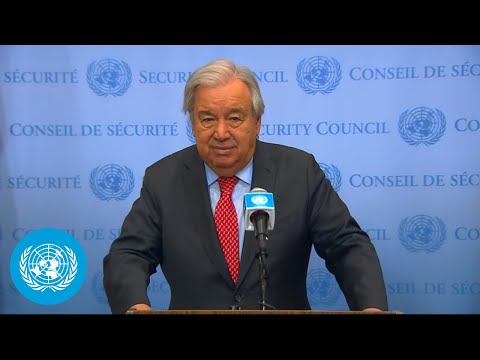
United Nations Secretary-General delivered remarks on international climate action and a just transition and urged leaders to submit stronger nationally determined contributions (NDCs) well ahead of COP30 and to mobilize large-scale finance for developing countries.
The secretary-general said the meeting he and Brazilian President Lula convened included 17 heads of state and government and representatives from major economies and climate-vulnerable groups, and that the gathering sent a clear signal to accelerate action before COP30. He called renewables “the economic opportunity of the century,” warned that climate change is deepening poverty and displacement, and urged developed countries to increase support for adaptation and loss-and-damage finance.
At a brief question-and-answer session, the secretary-general defended private-sector dynamics in the United States and pointed to subnational action there. He also said China had indicated its forthcoming NDCs would cover “all economic sectors and all greenhouse gases,” a clarification he described as important for global climate action.
The secretary-general said the Paris Agreement has already bent the projected warming curve but that the world must “go further and faster.” “We don't have a moment to lose,” he said, urging leaders to submit the strongest possible NDCs aligned with limiting warming to 1.5 degrees and to link national energy and development strategies with climate goals.
He pressed two main points for leaders ahead of COP30: first, to “step up efforts to submit the strongest possible national climate plans well ahead of COP30”; and second, to scale up support for developing countries. He put a figure on required mobilization that he described in his remarks as "1,300,000,000,000.0 US dollars a year for developing countries by 02/1935," and asked developed countries to honor their commitment to double adaptation finance to “at least 40,000,000,000 a year by this year.” The transcript contains those numeric formulations as stated.
On questions about whether specific countries could slow the clean-energy transition, the secretary-general said, “The United States is a market economy. It's not government that determines the volume that is produced by fossil fuels or that is produced by renewable energy.” He added that the private sector in the United States is “very dynamic,” and that governors and other subnational actors have committed to the same objectives, so analysts should consider the complexity of U.S. society rather than only the positions of national leaders.
Responding to a question about China, he said China was in the meeting and that President Xi had indicated China’s NDCs would cover all sectors and greenhouse gases — a clarification the secretary-general said was “extremely important for climate action.”
He closed by saying the U.N. and partners will continue pressure for action in the months ahead, including at a special event in September in the lead-up to COP30.
Details from the briefing were limited to the statements on the record; the transcript records the finance and date figures in the phrasing above.