Get Full Government Meeting Transcripts, Videos, & Alerts Forever!
Get email alerts on the Higher Education Funding topic
No spam. Unsubscribe anytime.
Five university leaders tell House panel sustained state funding, scholarships and research support are critical to workforce and enrollment goals
Summary
Presidents and student speakers from Northern Michigan, Michigan State, Saginaw Valley State, Oakland and Lake Superior State briefed the House Appropriations Subcommittee for Higher Education and Community Colleges on enrollment gains, workforce pipelines, and the impact of the Michigan Achievement Scholarship and federal research funding.
Lansing — Presidents and student representatives from five public universities told the Michigan House Appropriations Subcommittee for Higher Education and Community Colleges on April 23, 2025, that continued state support — especially for the Michigan Achievement Scholarship and operating increases — is essential to sustain enrollment growth, workforce training and university research capacity.
The testimony, delivered by Northern Michigan University, Michigan State University, Saginaw Valley State University, Oakland University and Lake Superior State University, emphasized how state and federal investments help recruit and retain students, support transfer pathways and place graduates into in-state jobs. Speakers also warned that federal proposals to cap indirect research costs could reduce research activity and its economic returns.
Northern Michigan University students and President Brock Tessman said state programs have directly expanded access and supported student retention. Bennett Klosner, a junior in NMU’s Mechanical Engineering Technology program, described a straightforward transfer experience and close faculty mentoring. “If I have a question in the middle of the night, it’s to the point where I can shoot them a text, and they’ll respond,” Klosner said. Tessman said the Michigan Achievement Scholarship supports about 500 Upper Peninsula students and 800 students from the Lower Peninsula and estimated the scholarship delivers roughly $2.5 million a year to NMU students. Tessman also highlighted NMU’s Grow Your Own teacher-preparation cohort — about 400 enrollees with roughly a 90% retention rate — and said Northern’s overall enrollment is rising for a third consecutive year.
Michigan State University’s president (name not provided in testimony) framed MSU as a major research engine and emphasized federally funded facilities and partnerships. He said MSU’s Facility for Rare Isotope Beams (FRIB) has attracted about $1.5 billion in federal investment since 2012, with about 79% of that spending retained in Michigan, and that MSU’s research expenditures are approaching $932 million annually. “We’re reliant on that funding,” he said, warning that proposed caps on indirect costs for NIH, DOE and NSF awards could reduce the university’s ability to support large-scale research.
Saginaw Valley State University President George Grant said SVSU enrolls about 7,000 students and aligns programs to the state’s high-demand (“hot 50”) occupations; he noted the university offers programs in 38 of those fields. Grant highlighted outcomes in health and education fields, including a 98.55% first-time pass rate in 2024 for nursing graduates on the National Council Licensure Examination.
Oakland University Executive Vice President and Provost Amy Thompson described Oakland as a regionally focused institution: she said about 92% of Oakland students come from Michigan and that the university’s preliminary economic-impact analysis found roughly $1.9 billion in net new economic activity and 6,485 jobs tied to the university in fiscal year 2024, generating about $316 million in state tax revenue. Marianne Brummer, Oakland’s student body vice president, urged full funding of the Michigan Achievement Scholarship, noting thousands of Oakland students currently receive the award.
Lake Superior State University President David Travis told the panel that Lake State is a small, rural-serving institution with a $14 million annual state appropriation and an estimated $155 million regional economic impact. He said about 88% of LSSU students come from Michigan and that many academic programs feed local employers. Travis also cited distinctive campus resources such as a student-run fish hatchery that supplies Great Lakes fisheries.
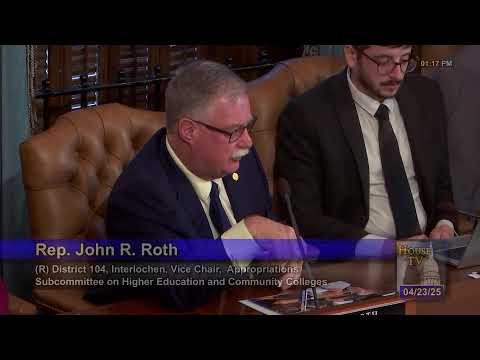
Chairman Markkanen convened the meeting and the subcommittee took two procedural actions at the start of the session: Representative Mueller moved to accept the April 22 minutes and the motion carried with no objection; Representative Roth moved to excuse absent members and that motion also carried with no objection.
Committee members asked presenters follow-up questions about in-state retention of graduates, how universities track workforce needs, partnerships with community colleges and the potential fiscal impacts of federal research-policy changes. Michigan State’s president said he would be meeting with congressional leaders to press for continued federal research support.
The testimony makes clear that university leaders view the Michigan Achievement Scholarship, operating appropriations and transfer/partnership programs as central levers for affordability, workforce pipelines and regional economic development. Several presidents formally asked the subcommittee to consider the budget office’s recommended operating increase for fiscal year 2026 and additional capital-outlay or program funding to sustain capacity and facilities. The subcommittee did not take further policy action at the meeting; presenters left materials and packet summaries for members to review.