Get Full Government Meeting Transcripts, Videos, & Alerts Forever!
Get email alerts on the Green Building Jurisdictional Amendments topic
No spam. Unsubscribe anytime.
Somerville seeks zoning edits to avoid conflicts with state building code and preserve green incentives
Summary
City planning staff proposed amendments to remove conflicts between Somerville’s zoning green-building standards and the state building code, shift some requirements into incentives (adding LEED Platinum certifiability to the density bonus), and reserve the local green-building section for future, legally vetted updates.
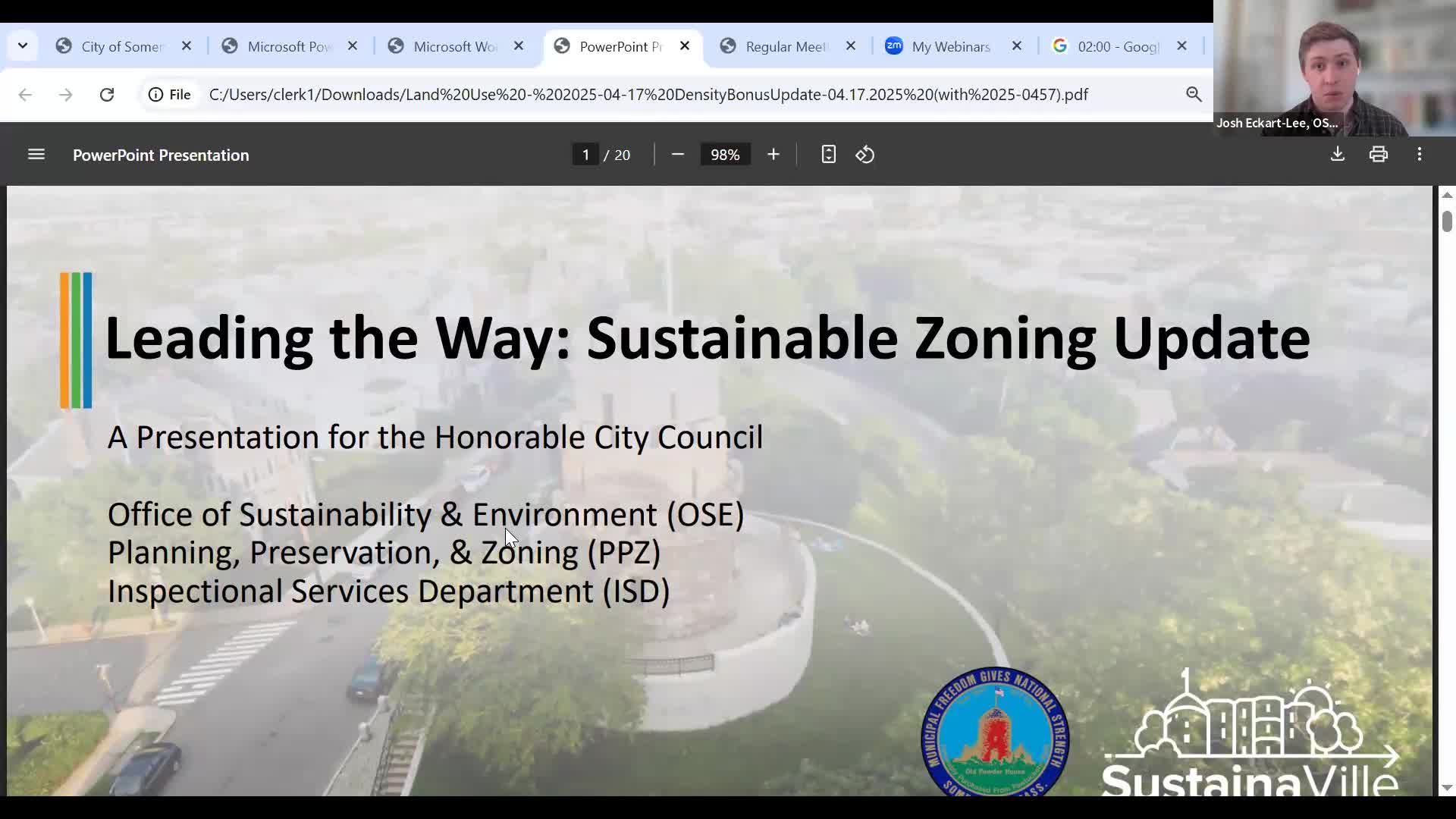
City sustainability and planning staff told the Somerville Land Use Committee and Planning Board that they are proposing jurisdictional amendments to remove overlaps between the city's zoning green-building standards and the state building code and to preserve meaningful local incentives for high-performance buildings.
"Where we can adopt and enforce new green building standards is through our incentive programs such as the Master Plan Development Overlay District and in the density bonus," said Josh Eckhart-Lee, sustainability planner in the Office of Sustainability and Environment. He said changes are needed because the state’s specialized energy code and decisions from the attorney general’s office have limited the city’s ability to require some material or efficiency standards in zoning.
The package presented would: remove a local definition of "net-zero ready" that conflicts with state definitions; add language to the density-bonus provisions across the zoning ordinance to require LEED Platinum certifiability for projects that seek the bonus; and delete the existing Green Buildings section from the zoning ordinance and reserve that section for future updates after further analysis.
Staff described three supporting studies and processes that will inform subsequent recommendations: a lead-gap analysis with the Metropolitan Area Planning Council (MAPC) expected near the end of the fiscal year; a fossil-fuel-free incentives study to design local incentives; and an electrical-capacity study to identify grid constraints. City staff said they will return to the planning board and council with detailed recommendations after those studies conclude.
Planning board members and councilors raised concerns about trade-offs between aspirational sustainability standards and housing affordability. Planning board member Lynn Richards said the draft appeared to make "LEED Platinum" an explicit pathway for density bonuses and asked whether that would conflict with other pathways such as Passive House; Richards added, "it seems as though we've got 2 conflicting goals" — ambitious sustainability standards and affordability. Staff replied that the LEED Platinum language is intended to remain an incentive (density bonus) rather than a baseline requirement, and that Passive House pathways remain possible in the specialized code and will be considered as part of the MAPC-led gap analysis.
Public commenters reiterated concerns and priorities about affordability and unit mix. Planning staff said the planning board will accept written testimony and that the land use committee will use the same public-comment channel; both bodies left the item in committee for further review.
Why it matters: The amendments seek to preserve local incentives for high-performance buildings while avoiding legal conflict with the state building code. The technical studies staff identified will determine whether new mandatory local standards are feasible and how incentives should be structured.
What’s next: The planning board and land use committee will accept written testimony and review final staff recommendations after the MAPC gap analysis, the fossil-fuel-free incentives study and the electrical-capacity study are complete.