Get Full Government Meeting Transcripts, Videos, & Alerts Forever!
Get email alerts on the Tenderloin Retail Hours topic
No spam. Unsubscribe anytime.
SFPD, DPH report early gains from Tenderloin retail‑hours pilot; committee continues hearing for follow‑up
Summary
The committee received a status update on the Tenderloin retail‑hours restriction pilot, heard SFPD and Department of Public Health data showing reduced overnight calls and fewer incidents in the pilot area, and voted to continue the hearing to the call of the chair for additional follow‑up and community input.
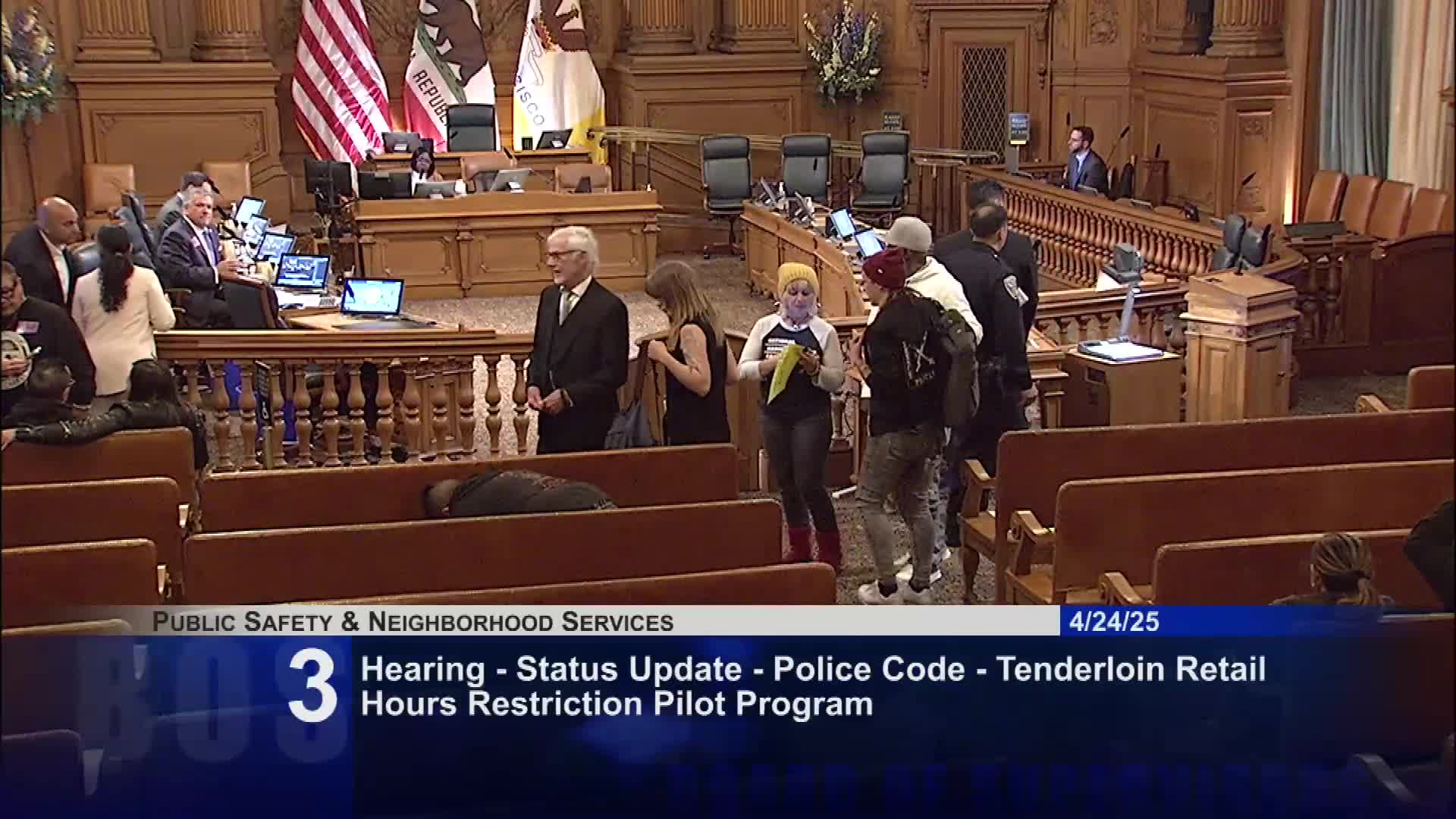
The Public Safety and Neighborhood Services Committee on Thursday received a status update on the Tenderloin retail‑hours restriction pilot program and heard police and public‑health data showing early reductions in late‑night calls and reported incidents within the program’s defined zone.
The pilot, enacted by ordinance and implemented through the Drug Market Agency Coordination Center (DMACC), prohibits specified retail outlets from operating between midnight and 5 a.m. within the Tenderloin Public Safety Zone (bounded by O’Farrell Street to the north, McAllister Street to the south, Jones Street to the east and Polk Street to the west). The ordinance authorizes the Department of Public Health to levy administrative fines—up to $1,000 per hour—for violations and sets a two‑year pilot term.
SFPD and DMACC commander Derek Liu presented maps and comparative photographs showing reduced nighttime crowding at several problem corners, and statistics the department characterized as evidence of early progress: within the Tenderloin Public Safety Zone, SFPD reported an overall decline in reported crime of roughly 14 percent during the midnight‑to‑5 a.m. interval and an 18 percent reduction in combined calls for service (dispatched calls plus officer‑initiated “on‑view” incidents). Officer‑initiated on‑view calls were down by about 43 percent in the zone during the same hours, the department said. Commander Liu described the initiative as a coordinated, multi‑agency effort that complements enforcement with public‑works and health interventions.
Department of Public Health assistant director Jen Kallawert reported eight total ordinance violations across five businesses since the pilot began. The department has held two director’s hearings resulting in assessed penalties totaling $2,650 and has referred two locations to the City Attorney; litigation related to repeat violations is currently active, she said.
The item drew substantial public comment. Dozens of residents, community‑based organizations, merchants, and workers testified in support of continuing the pilot, saying the restrictions have reduced noise, street crowding, litter, and safety threats to seniors, children and families living in the Tenderloin. Some speakers urged the city to expand similar restrictions to other problem corridors, including Sixth Street and West SoMa. Others raised questions about impacts on small business revenue and asked for additional data on economic effects and employment.
After public comment the committee voted to continue the hearing to the call of the chair to allow more time for follow‑up, additional data and further stakeholder engagement. The committee emphasized that no final decision about expansion or termination of the pilot was made at the meeting.