Get Full Government Meeting Transcripts, Videos, & Alerts Forever!
Get email alerts on the Cap And Trade Reauthorization topic
No spam. Unsubscribe anytime.
Assembly committee weighs reauthorization of cap-and-trade revenue, presses for spending priorities and oversight
Summary
A California State Assembly subcommittee heard expert analysis and public comment on reauthorizing the cap-and-trade program and the future of the Greenhouse Gas Reduction Fund (GGRF), focusing debate on revenue volatility, continuous appropriations, affordability measures and priority uses such as natural and working lands, housing and transit.
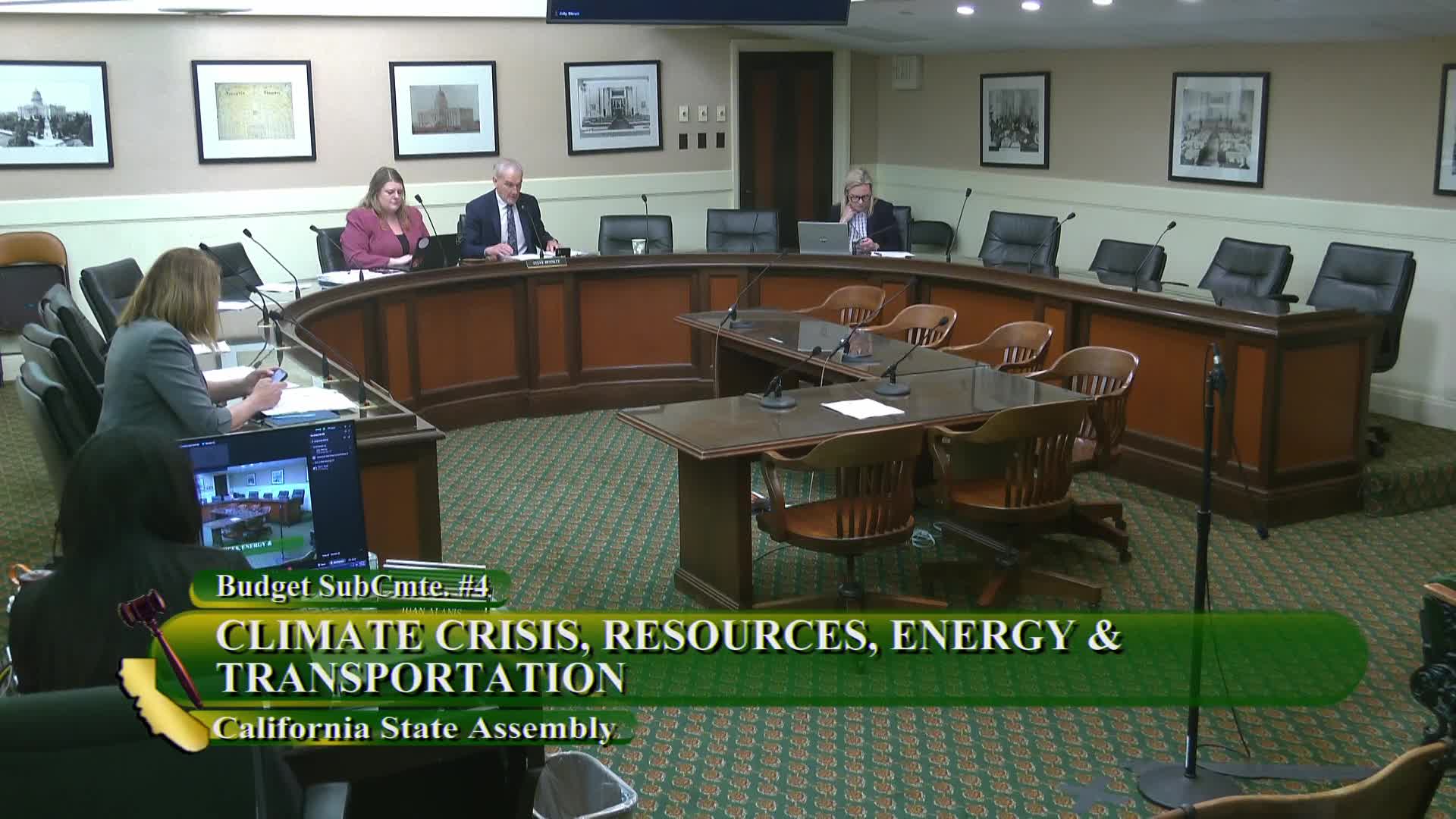
The California State Assembly Budget Subcommittee No. 4 held an extended hearing on reauthorization of the cap-and-trade program and how to allocate revenue deposited into the Greenhouse Gas Reduction Fund (GGRF), hearing presentations from the Legislative Analyst's Office, academic experts and the Air Resources Board and receiving extensive public comment.
The subcommittee chair, Chair Bennett, opened the session saying the hearing was an opportunity "once in a decade" to review GGRF expenditures and explore options for reauthorization, oversight and allocation of continuous appropriations.
Why it matters: GGRF is supported by auction proceeds from California’s cap-and-trade program and has funded programs ranging from high-speed rail and affordable housing to wildfire resilience and low-carbon transportation. Panelists and commenters told lawmakers the program’s revenue can be highly variable and that design choices for the cap-and-trade market will determine future funding levels and stability.
Key findings and expert testimony
- Revenue volatility and magnitude: Helen Kerstein of the Legislative Analyst’s Office said GGRF revenues “vary quite a bit,” with recent annual proceeds ranging roughly from $2 billion to $5 billion. The LAO noted allowance prices historically have been nearer the floor than the ceiling and that revenue depends on market design, supply and demand for allowances and policy uncertainty.
- Market design drives revenues and distribution: Danny Cullenward, a researcher and vice chair of the independent emissions market advisory committee, emphasized that decisions about market design (price limits, allowance supply) and how allowances are allocated materially determine how much value flows to GGRF versus utility customer benefits or free allocation to industry. Cullenward provided scenarios showing wide potential ranges of total allowance value in coming decades and warned that uncertainty in price and supply makes short-term revenue forecasts imprecise.
- Targeting spending where markets don’t: Kyle Meng, an associate professor at UC Santa Barbara, said auction revenues should be spent where the carbon market does not already incentivize reductions. He recommended prioritizing (1) investments to deploy nascent technologies that are currently too costly to scale (for example, direct air capture) and (2) affordability measures when energy prices are a headwind to electrification. Meng described analysis from his research group suggesting an approximately $1.2 billion annual allocation through the California Climate Credit could lower retail electricity bills 20%–35% for low-income households served by the three largest investor-owned utilities, or yield smaller but meaningful reductions if spread differently.
Discussion points for lawmakers
- Continuous appropriations vs. legislative oversight: The LAO recommended caution about broad continuous appropriations because they reduce annual legislative oversight and flexibility. Several advocates and local-government representatives asked for reliable, sustained funding for programs such as urban greening, nature-based solutions and affordable-housing/transit projects; committee members countered that statutory continuous appropriations have contributed to limited transparency about how quickly funds are spent.
- Affordability and electricity prices: Multiple panelists and members raised affordability as a top priority. Meng and others argued that some GGRF-directed approaches could lower energy burdens (for example through targeted electricity bill relief or restructuring the California Climate Credit). Panelists said the higher retail electricity prices in California are driven largely by distribution and wildfire mitigation costs, not the carbon allowance price itself.
- Cost-effectiveness metrics and accounting: Multiple witnesses—including LAO and outside researchers—warned that current published cost-effectiveness numbers for GGRF investments can be misleading when programs rely on other funding sources. The committee pressed for better, standardized metrics and clearer reporting on how much GGRF dollars are actually expended versus committed or contracted.
Public comment and sector priorities
Public and advocacy testimony reflected broad, and sometimes competing, priorities: nature-based and working-lands investments (including a call for a 25% continuous allocation by some groups), ongoing support for agricultural climate practices (requests for 15% set-asides), a push to maintain the Affordable Housing and Sustainable Communities (AHSC) continuous appropriation, and calls to restore or expand funding for food-waste and composting infrastructure. Several transit and public-power advocates urged continued or stronger support for transit and utility-related investments that enable electrification while keeping customer rates manageable.
What the committee did not decide
No formal budget votes or statutory reauthorization language were adopted during the hearing. Panelists and members discussed tradeoffs—revenue stability, legislative oversight, program longevity and desired outcomes—but the committee deferred final allocation decisions and statutory changes to subsequent budget and policy processes.
Clarifying context and next steps
Panelists recommended that the committee consider (1) clarifying which priorities should be continuously appropriated, (2) improving reporting so the legislature can see committed versus expended funds, (3) directing investments toward market failures (innovation, affordability, unconstrained sectors) and (4) reducing surplus allowances or adjusting market design to reduce price/revenue volatility. The Air Resources Board staff and LAO said publicly accessible project-level expenditure and award data already exist on California Climate Investments reporting pages, and Committee members requested follow-up materials on program-level spending rates and a written note from LAO on the methodological issues that make some cost-effectiveness numbers misleading.
Ending note
Committee members indicated continued interest in reconciling durable program funding for long-term projects with stronger legislative oversight and improved cost-effectiveness accounting. The subcommittee said it will continue to take written materials, follow-up submissions from CARB and the LAO, and additional testimony as members craft reauthorization and budget directions.