Get Full Government Meeting Transcripts, Videos, & Alerts Forever!
Get email alerts on the It Budget topic
No spam. Unsubscribe anytime.
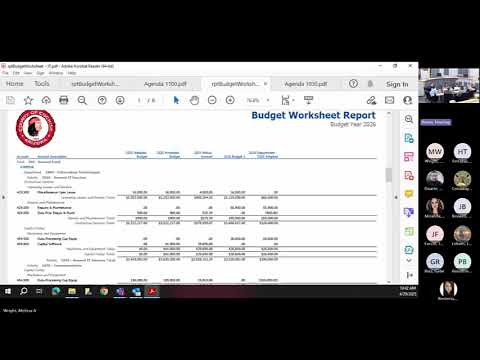
Cochise County IT presents FY25–26 budget; supervisors press on licensing, cybersecurity and overlapping charges
Summary
Cochise County interim IT director Alan Gordon presented the IT department's FY25'—26 budget request at a Board of Supervisors work session, citing rising hardware, software and cybersecurity costs. Supervisors asked for more detail on licensing counts, a Darktrace cybersecurity renewal and how IT costs are allocated across departments and funds.
Alan Gordon, interim IT director for Cochise County, presented the IT department's FY25'—26 budget request at a Board of Supervisors work session, saying the team "supports more than 25 departments and elected offices, managing over 2,000 computers, mobile devices, radios" and maintains "30 communication tower sites" used for public safety and emergency response.
Gordon told the board the department is asking to continue investments that maintain stability and replace aging equipment while protecting county services from cybersecurity risks. "We've extended the life of our equipment beyond industry standards, prepared devices in house to avoid costly outside service contracts," Gordon said, and noted inflation, global supply-chain pressures and higher manufacturing costs have raised prices for hardware and software licensing.
Why it matters: supervisors pressed for clearer accounting of who pays for what technology and how overlapping purchases are tracked. The work session focused on software licensing costs (Office 365 and specialized software such as Adobe), cloud services (Azure), a Darktrace cybersecurity monitoring renewal listed in the budget, and the county's use of a half-cent sales tax fund the presenters called the "4.5 fund" to cover capital IT replacements.
Key figures and systems: Gordon and IT staff described the department as supporting field employees and external public-safety partners under intergovernmental agreements (IGAs). The department currently lists about 25 staff positions under IT and referenced roughly $2,000,000 in salary costs tied to those positions. IT staff said they manage enterprise-wide software subscriptions (for example, Office 365 plans) and also negotiate multiyear agreements when possible to lock in pricing.
Board questions and gaps in the presentation: supervisors pressed for specific counts and allocations. When asked how many licenses a listed Freshworks IT ticketing purchase covered, staff said they would need to provide that figure later. A Darktrace maintenance renewal was discussed as a multiyear purchase and described as the county's cybersecurity monitoring service that "monitors all the traffic that's going in our network" and alerts on anomalous behavior; budget text and discussion indicated a significant multi-year cost but staff did not provide a single-line confirmed annual total during the session.
Funding and allocation: IT staff said some capital replacements are funded from a sales-tax-derived fund they referred to as the "4.5" half-cent sales tax fund and that the county apportions transaction privilege tax (TPT) receipts among multiple funds. Gordon said the 4.5 fund receives roughly $500,000 a year and is used for laptop replacements, servers, mobile data computers for the sheriff's office, radios and similar capital items. Staff also said two positions that sit with IT are funded through sheriff-related grants and that many department-specific software licenses remain the financial responsibility of the purchasing department.
Overlap and audit discussion: several supervisors raised concerns about overlapping services and the difficulty of tracing total technical costs charged to a given department when IT provides shared services. The board discussed the possibility of targeted reviews to surface inefficiencies or anomalous patterns in budgeting and transactions; one supervisor suggested engaging a consultant with experience identifying such patterns. Staff recalled a prior fraud-risk review that identified process weaknesses and described recent steps to change systems and add manual checks in payroll and other areas.
Public access and records: staff directed supervisors to the county's public document portal (OnBase) for resolutions and public records, providing the URL shown in the session transcript as publicaccess.cog.ad.gov/publicaccess. IT staff said the clerk of the board has performed cleanup work in the records system to make documents more discoverable.
Next steps: no formal action or vote was taken during the work session. Supervisors asked IT staff to provide additional detail on license counts, multiyear contract terms, and the allocation of IT costs across departments and funds; staff said they could produce those breakdowns but that compiling the full analysis would take time. The board adjourned the work session and moved to a scheduled meeting with risk managers immediately after.
Ending: The session closed with supervisors noting the presentation was informative and requesting follow-up information on licensing counts, specific contract totals, and an analysis of department-level overhead that reflects IT's shared services.