Get Full Government Meeting Transcripts, Videos, & Alerts Forever!
Get email alerts on the Residential Roofing And Solar topic
No spam. Unsubscribe anytime.
Board keeps roofing permit for 378 Collingwood Street but removes “in kind” wording to allow alternative roofing material
Summary
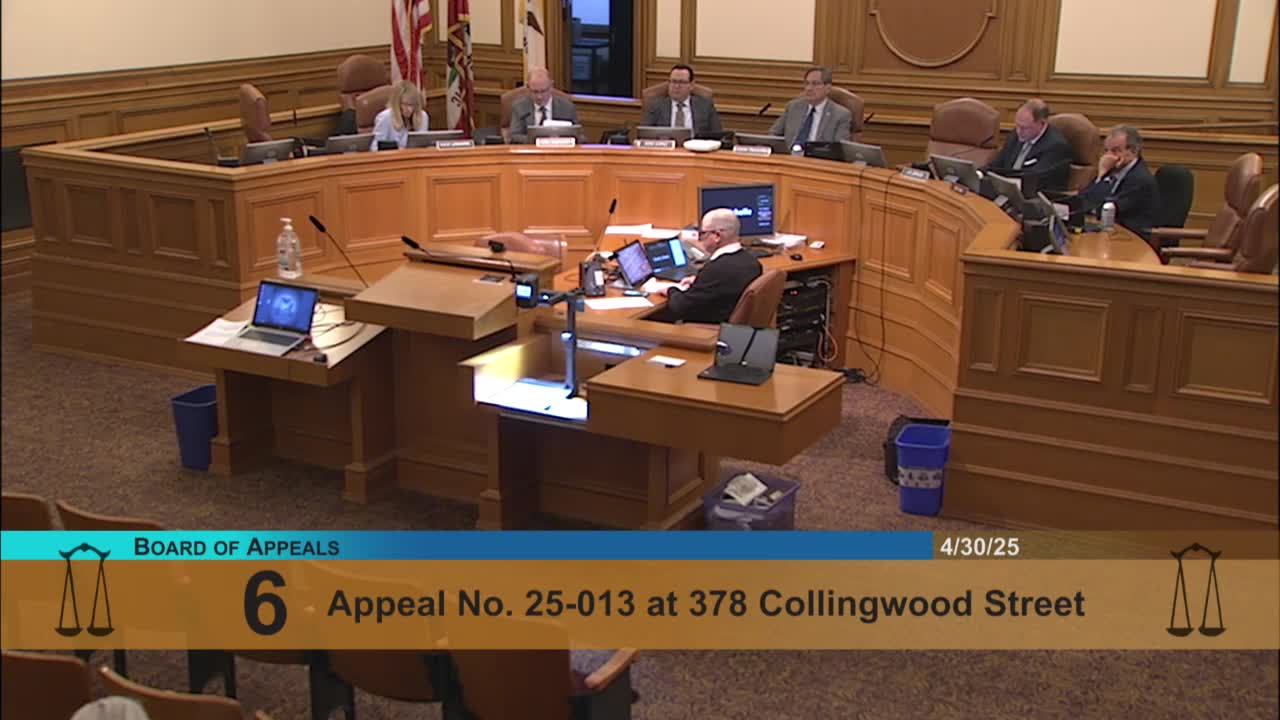
On April 30, 2025, the San Francisco Board of Appeals denied an appeal by a neighbor of a DBI roofing permit for 378 Collingwood Street, voting 4‑0 to uphold the permit while directing that the phrase “in kind” be removed from the permit text.
On April 30, 2025, the San Francisco Board of Appeals denied an appeal by a neighbor of a Department of Building Inspection permit to reroof 378 Collingwood Street, voting 4‑0 to uphold the permit but ordering that the permit’s reference to “in kind” roofing material be removed so the permit holder may specify the material to be used.
The appellant, identified in the agenda as Radu Roman, raised three concerns: alleged previous unpermitted unit mergers at the property, safety issues on the roof (including loose grounding wires and an electrical PG&E connection), and whether the replacement roof would be “in kind” (i.e., match the existing tar‑and‑gravel surface). The permit holders’ counsel, Jeremy Paul, and DBI and Planning staff told the board the issued permit is a standard roofing permit and DBI’s rules allow minor repairs without a permit when they affect less than 25% of the roof surface.
The appellant asked the board to require an in‑kind replacement and to use the permitting process to address safety and wiring concerns. “If the re roofing will not include gravel on flat roof, I will kindly ask DBI to issue notices of violation,” the appellant said. Jeremy Paul, counsel for the permit holder, said the project seeks a durable surface suitable for solar equipment and roof access and that upgrades will be permitted as required.
DBI staff explained that minor roof repairs under San Francisco code that affect less than 25% of the roof surface do not require a permit; the permit before the board covers the reroofing work as applied for. Planning staff clarified that the property is a legal single‑family dwelling (a dwelling unit merger for this lot was finaled years earlier) and therefore the merger claims were not a basis to deny the roofing permit.
Commissioners discussed options to avoid future disputes over material and appearance. DBI staff recommended that the permit holder file a revision to specify the chosen material (roofing contractors sometimes list “in kind” online, which may not capture intended modern membranes). The roofing contractor indicated it intends to install a TPO (thermoplastic polyolefin) membrane—an accepted modern roofing material often used on roofs that are frequently accessed for equipment.
Commissioner Lopez moved that the board deny the appeal and uphold the permit but remove the words “in kind” from the permit text so the permit holder may pursue a code‑compliant roofing membrane; the motion carried 4‑0. Commissioners and staff said DBI should ensure the final permit and the permit record specify the roofing material or require a revision permit so neighbors know what will be installed.
The board did not rule on unrelated allegations about alleged earlier unit mergers or the PG&E connection; commissioners advised the appellant that those claims can be pursued through DBI’s complaint system and other appropriate channels.