Get Full Government Meeting Transcripts, Videos, & Alerts Forever!
Get email alerts on the Commercial Landscaping Enforcement topic
No spam. Unsubscribe anytime.
Highland Village staff outlines stepped plan to inspect and enforce commercial landscaping
Summary
City staff presented a plan to inventory approved landscape plans, use a contracted arborist for condition assessments, and route likely violations to code enforcement; staff said enforcement is limited by historic approvals and available code-enforcement resources.
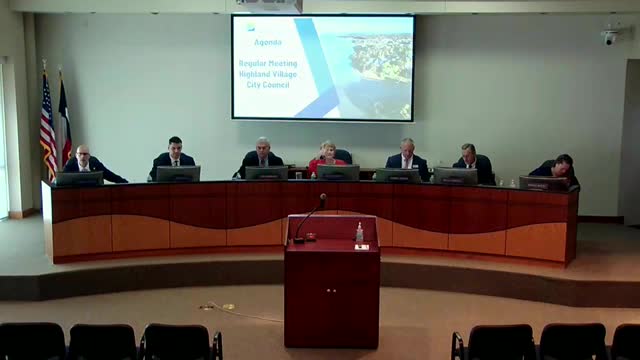
City staff told the Highland Village City Council on April during an early work session that they have begun a program to review and enforce commercial landscaping requirements across the city.
Christen, a city staff member, said the city has mobilized a licensed arborist to compare existing site conditions against approved landscape plans and produce assessment reports that code enforcement will use to open cases if violations are found. “We only have 1 field code enforcement officer, and that's a large task,” Christen said, adding that the arborist’s reports will direct enforcement decisions.
City staff described the steps they are taking: compile known Planned Development (PD) landscape plans, assign one property at a time to the contracted arborist for a condition assessment, document discrepancies with photos, and then have code open a case and provide notice if the officer determines a violation exists. Staff said they plan to implement annual inspections once properties are brought into compliance, and to rely on the approved landscape plan for each development when it was built or last permitted.
Why it matters: older commercial developments in Highland Village frequently lack current plantings because trees and shrubs have died or been removed and not replaced. Staff warned that the city’s legal ability to require retroactive landscape upgrades is constrained by what rules applied when a site received its certificate of occupancy or was built; new ordinances typically apply only when a property is remodeled, expands or undergoes other permitting that triggers current standards.
Christen and staff cited numbers and current caseloads: the city’s research identified about 131 commercial water meters (some meters may be for irrigation), roughly 80 platted commercial lots and about six active commercial landscape management code cases (staff said one of the cases is closed after voluntary compliance). Staff said commercial landscape cases represent roughly 15% of the city’s open code enforcement caseload.
Staff used Walmart and Highland Village Plaza as examples, showing approved plan sheets, current site photos and the arborist’s side-by-side notes. The arborist’s work product, staff said, lists what the approved plan required, what is actually present and proposed corrective steps; that report becomes the basis for a code case if the code officer verifies discrepancies.
Council members and staff noted practical limits on timelines and remedies. Christenen and others said planting windows matter in Texas (fall is the best season, plants installed in hot summer months often fail), so the city does not intend to apply a rigid 30-day restore notice in all seasons. Christen said the city can abate in some circumstances, place liens for abatement costs and pursue civil remedies or fines under the code, but that courts frequently reduce or dismiss multiple daily citations: “We issued 5 citations for this one address. The judge dismissed 4 of those citations,” Christen said.
Council discussion also covered policy changes the city is already budgeting: staff said funding is in this year’s budget to compile PD plans into a single document and to update the city’s zoning and building code references to current versions. Staff said the city is seeking a consultant to update the zoning ordinance and related sections (landscape, property maintenance) and will explore thresholds — for example, whether an ordinance could require a sitewide landscape update when a property modifies an identified percentage of its site.
Staff and council discussed nonregulatory options as well: Councilmember Rhonda suggested partnering with volunteer groups (she referenced a local volunteer tree/beautification group) and with property owners to offer assistance or guidance rather than immediate penalty. Staff responded that in some redevelopment cases (for example, where parking or the building footprint changes) the city can require updated landscape compliance as part of permitting.
Ending: Staff asked for direction while they continue to locate historical PD plans, complete the arborist assessments and implement an inspection cadence. They said ordinance revisions are budgeted and a consultant selection will be brought to council for approval.