Get Full Government Meeting Transcripts, Videos, & Alerts Forever!
Get email alerts on the Public Safety Dwi topic
No spam. Unsubscribe anytime.
House passes bill lengthening interlock and revocation rules for repeat DWI offenders
Summary
The Minnesota House on a 123-5 vote passed House File 2130, which increases required ignition-interlock durations for repeat DWI offenders, extends the look-back period for prior offenses in some cases, raises penalties for driving without an interlock and adds or clarifies treatment requirements.
The Minnesota House of Representatives passed House File 2130 on a 123-5 roll-call vote Monday, advancing legislation that increases ignition‑interlock requirements and other penalties for repeat drivers convicted of driving while impaired.
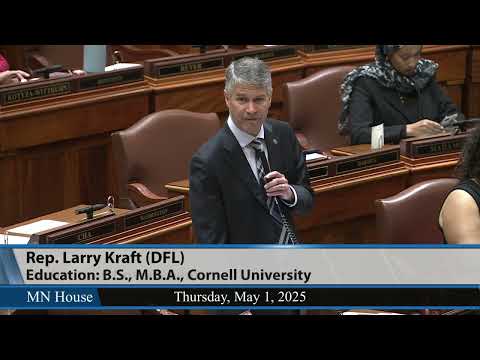
Rep. Kraft, the bill's author, told the chamber the measure was prompted by a fatal crash in St. Louis Park on Sept. 1, 2024. "On the night of 09/01/2024, Stephen Bailey got behind the wheel of his car with a blood alcohol level of 0.325, more than 4 times the legal limit," Kraft said, recounting that the driver struck the outdoor patio at Park Tavern, killing a server and a hospital unit coordinator and injuring others. Kraft said the bill aims to reduce repeat offenses and noted studies showing ignition‑interlock devices dramatically lower reoffending while installed.
The bill changes Minnesota's interlock scheme from a largely linear set of time periods to a steeper escalation for repeat offenders, increases the look‑back period for counting certain prior offenses from 10 to 20 years in some situations, and upgrades the offense of driving without a required interlock from a misdemeanor to a gross misdemeanor. The bill also removes the requirement that a person pay a significant license reinstatement fee before being placed on interlock, while still requiring the fee before the overall reinstatement process is complete, a change intended to increase program participation.
Rep. Witte, who worked with Kraft on the proposal, said, "Driving in Minnesota is a privilege. It's not a right," and argued longer interlock periods would give law enforcement and the public greater confidence that people with multiple offenses are not driving impaired. Rep. Rarick asked whether the bill changes treatment requirements for repeat offenders; Kraft replied that the bill adds or clarifies treatment in one provision where it had previously been absent.
An amendment at the desk (codified as A4) that made technical clarifications — including on out‑of‑state convictions, criminal vehicular homicide, contesting interlock extensions for administrative violations, and the gross‑misdemeanor language for driving without an interlock — was offered by Kraft and adopted by voice vote before final passage.
There was public and legislative recognition of the families and community affected by the Park Tavern crash; Kraft thanked Park Nicollet, Methodist staff and local officials who advocated for the bill. The clerk announced the final tally after a roll call of members participating remotely: the clerk reported 123 ayes and 5 nays and stated the bill, as amended, passed and its title was agreed to.
Votes at a glance House File 2130 (as amended) — Passed 123–5. Motion to pass as amended moved by Representative Kraft; second not specified in the transcript. Amendment A4 (technical clarifications) — Adopted by voice vote; mover Representative Kraft.
What the bill would do (as described on the floor) - Increase required ignition‑interlock durations for repeat DWI offenders, escalating more aggressively than the prior linear schedule. - Extend the look‑back period for counting some prior offenses from 10 to 20 years in certain circumstances. - Change driving without a required interlock from a misdemeanor to a gross misdemeanor. - Require treatment for repeat offenders in a provision that previously lacked an explicit treatment requirement. - Reduce a pre‑interlock financial barrier by delaying the requirement to pay a significant reinstatement fee until completion of interlock participation.
Background and context Kraft cited federal and state research about repeat DWI offending and the effectiveness of ignition‑interlock devices; he summarized findings that interlocks reduce repeat offenses by about 70% while installed and said many convicted drivers continue to drive on suspended licenses when interlock is not required or enforced. The author said roughly 5,000 driving without a license offenses occur annually in Minnesota, a figure he used to justify stronger enforcement and program participation measures.
Next steps The transcript records passage in the House; the bill will proceed according to legislative procedures (transmission to the Senate or conference actions as required). The bill text and any fiscal notes, as well as final engrossed language, would be needed to detail implementation dates, enforcement mechanisms and administrative responsibilities.