Get Full Government Meeting Transcripts, Videos, & Alerts Forever!
Get email alerts on the Native Hawaiian Health topic
No spam. Unsubscribe anytime.
JABSOM officials tell OHA federal grant losses threaten Native Hawaiian health programs and student pipeline
Summary
Leaders from the University of Hawaiʻi John A. Burns School of Medicine told the Office of Hawaiian Affairs board on May 1 that federal grant cuts and program sunsets are disrupting research, behavioral-health training and student supports that serve Native Hawaiian communities statewide.
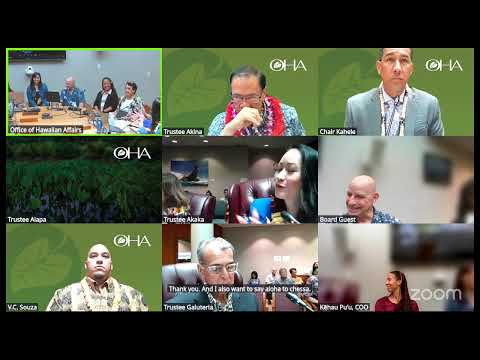
HONOLULU — Officials from the John A. Burns School of Medicine (JABSOM) told the Office of Hawaiian Affairs (OHA) board of trustees on May 1 that recent federal grant losses and policy changes are threatening Native Hawaiian–focused medical education, research and community-based health programs.
Dr. Kiawai Moku Kahulakula, who spoke on behalf of JABSOM’s Department of Native Hawaiian Health, told trustees the department generated roughly $7 million in extramural funding last year and that several existing awards have been lost or are at risk. He said about $5.4 million in funding is currently at risk and another roughly $6.9 million is pending review at the Health Resources and Services Administration (HRSA). No formal action was taken by the board at the meeting.
Why it matters: The department’s programs provide a pipeline for Native Hawaiian students into health careers, support community-based research and fund behavioral-health training that places clinicians on neighbor islands. Trustees and community partners said those programs help address persistent health disparities in Native Hawaiian communities and sustain long-term community research capacity.
Kahulakula described the department’s four core areas — medical education, research, clinical services and administration — and said JABSOM’s pathway programs have helped hundreds of students pursue medical careers. He said the Imi Ho‘ola post-baccalaureate program and other pipeline efforts reach K–12 students statewide and that the department currently supports students at multiple levels. Kahulakula told trustees there are about 52 medical students and about 47 premedical students engaged with the department’s programs; he said the Imi Ho‘ola program directly serves 12 students per year.
The department also supports community-based research and said it re-invests a large share of federal grant dollars back to partner organizations. Kahulakula pointed to a cultural intervention — using hula to reduce cardiovascular risk — that he said received international attention and was implemented in community settings. He said roughly 40% of some NIH awards go to community subawards and subcontracts because “the work actually happens in the communities.”
Behavioral-health training was a focal point in the discussion. Kahulakula and Dr. Robin Miyamoto described a HRSA proposal (submitted in January) intended to fund multiyear training for social work and psychology trainees so they could become licensed providers serving Native Hawaiian communities, including on Maui. Miyamoto said the HRSA proposal would have supported six trainees per year over four years (24 licensed providers) and that losing that funding removes a concrete opportunity to increase the number of licensed behavioral‑health providers for Hawaiian communities.
Community partners testified to longstanding collaboration. Dr. Adrienne Dillard, who works with Papakōlea and other homestead communities, described multi‑decade partnerships and said local groups have been trained to conduct surveys and community health work, contract with the university and retain local control over data and projects.
Trustees asked how OHA might respond. Kahulakula and his team suggested several immediate, tangible forms of support OHA could consider during its upcoming biennium budget deliberations: scholarships or tuition support for medical students, stipends or $5,000-per-student supports at the undergraduate/premed level, test-preparation assistance for the MCAT, and consideration of service-payback or rural-placement incentives. Department staff said Imi Ho‘ola costs run about $18,000–$19,000 per student per year and that historically students have received modest stipends (about $1,500–$1,600) to participate; the department described that level of support as insufficient if federal funding declines.
Board discussion did not produce a formal motion; Chair Kahele and several trustees indicated the suggestions could inform OHA’s budget priorities. Kahulakula and his colleagues stressed the risk of losing research infrastructure and community capacity built over decades if grants are discontinued.
The presentation and Q&A included discussion of outreach to neighbor islands (including Moloka‘i and Kaua‘i), programs that train students on Kaua‘i and other islands, and an institutional effort to broaden medical-school admissions criteria to identify applicants with attributes beyond GPA and MCAT scores. Kahulakula said the department is building a database to better track graduates and their practice locations but that the data are not yet complete.
No formal votes, budget commitments or board directives were recorded at the meeting. Trustees closed the session by thanking the JABSOM team and indicating staff would consider the program support ideas as OHA develops its budget recommendations.