Get Full Government Meeting Transcripts, Videos, & Alerts Forever!
Get email alerts on the Public Safety Millage topic
No spam. Unsubscribe anytime.
Unions, residents urge voters to back Eaton County public-safety millage; animal control flagged as at-risk if it fails
Summary
Union representatives and residents told the Public Safety Committee they support the May 6 public-safety millage, warning that failing to pass it could eliminate road patrol and animal control and harm public safety.
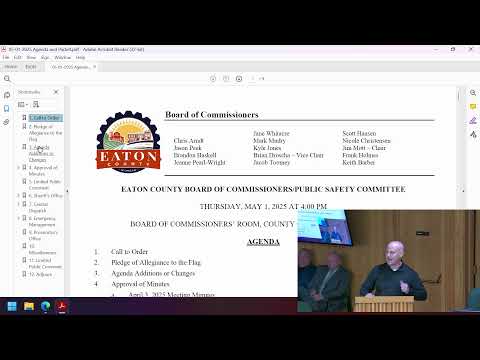
Union leaders and residents urged Eaton County officials on May 1 to support a proposed public-safety millage and warned the committee that failure of the measure could force cuts to road patrol, animal control and other services.
Greg Allgaier, a business agent for the Police Officers Association of Michigan, said he and colleagues represent deputies, correction officers and clerks and asked the public to "support this millage." He credited training provided by the sheriff's administration and said the work of deputies "protects" both officers and the public.
Brad Richmond, executive director of the Capital City Labor Program, which represents county animal control officers, told the committee that animal control "is not a luxury." He said animal control officers respond to aggressive and stray animals, investigate cruelty and hoarding, and help prevent disease spread. "Eliminating animal control officers means their work falls on someone else. But who?" Richmond asked, noting that local police and state police cannot be relied on to absorb those duties.
Eaton County resident Chris Coleman said he feared the loss of road patrol and animal control if the millage fails. "If this millage fails, many will suffer from all walks of life," Coleman told the committee, calling the warning a statement of "truth" rather than a scare tactic.
Why it matters: Speakers tied the millage to core public-safety functions—road patrol, animal control, responses to overdoses, child-abuse investigations and traffic crashes—and urged voters to approve the May 6 measure the commenters referenced. Richmond described the presentation as premature if the millage were speculative but said the perception that cuts are already contemplated has increased anxiety among employees and the public.
No committee action on the millage occurred during the meeting; the remarks were part of limited public comment.