Get Full Government Meeting Transcripts, Videos, & Alerts Forever!
Get email alerts on the Liquor Control Discount And Lookback topic
No spam. Unsubscribe anytime.
Committee hears testimony on bills to raise retailer liquor discount and limit MLCC look-back; Liquor Control Commission opposes over $90 million revenue loss
Summary
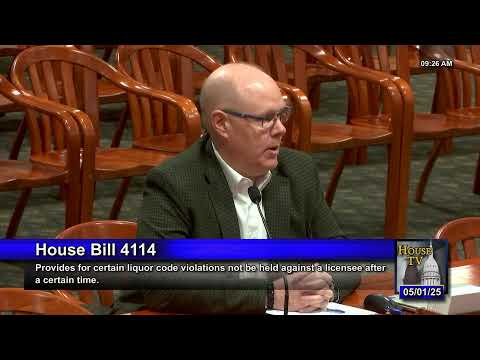
The Michigan House Committee on Regulatory Reform heard testimony on House Bills 4113 and 4114, which would increase the retailer discount on liquor purchased from the Michigan Liquor Control Commission and limit the commission's ability to consider certain past violations.
The Michigan House Committee on Regulatory Reform heard testimony on House Bills 4113 and 4114, measures that would change how the Michigan Liquor Control Commission (MLCC) sets retailer discounts and how far back the MLCC may consider prior violations when reviewing license status.
Representative Steckloff, the sponsor of HB 4113, told the committee the bills "amend the Michigan liquor control code to increase the amount that on premise licenses can deduct from the price of alcoholic liquor bought from the state and prohibit the MLCC from considering a qualified violation order within 2 years when making decisions regarding changing the status of a license." Steckloff said the change is intended to help small, neighborhood retailers compete with larger chains; she said the retailer discount would increase from 17 percent to 23 percent.
Jerry Griffin, vice president of government affairs for the Midwest Independent Retailers Association, testified in support of both bills and said the discount "creates the margin by which [members] can pay the cost of operating their stores." Griffin said the bills would bring uniformity to how violation history is considered when applications and renewals are reviewed.
David (Dave) Martin, representing the Michigan Liquor Control Commission, told the committee the commission "is opposed, officially on both of these bills." Martin said the commission estimates a reduction in general-fund revenue of about $90 million to $100 million annually if the retailer discount were increased as proposed. He described those figures as a running average based on the past three years and said the total revenues tied to spirits sales, fees and fines in fiscal 2024 were "close to $600,000,000," with the amount returned to the general fund at "just a little north of $400,000,000." Martin said the 65 percent markup that forms the minimum shelf price is set in statute and that retailers currently receive a 17 percent discount off the shelf price under the existing system; under the bills that discount would become 23 percent.
Martin also discussed operational details of the current distribution model. He said Michigan does not operate retail liquor stores; the state purchases spirits from producers, marks them up under statute, and pays independent distribution agents (ADAs) a per-case delivery fee (currently $12.50 per full case) to warehouse and deliver product on the state's behalf. Martin said the commission can and does consider prior violations when reviewing applications and that a longer look-back period (he mentioned a 10-year window as an example) would better address some commission concerns about "bad actors." He said the commission rarely upholds denials after appeals and that the commission currently exercises discretion to weigh recent serious violations more heavily.
Members asked questions about fiscal mechanics. Representative Wozniak asked where the increased discount money would come from; witnesses explained the state currently retains a markup (described in testimony as 65 percent) and that increasing the retailer discount would reduce the state's share of that margin. Representative Jamie Thompson asked for the profit totals; Martin provided the fiscal-year figures noted above. Committee leadership said additional testimony is expected next week and that a vote is planned for a future meeting.
Several organizations submitted support or neutral cards including the Michigan Retailers Association, Midwest Independent Retailers Association, Michigan Petroleum Association, Distilled Spirits Council of the United States (neutral), Michigan Licensed Beverage Association (support), and the Michigan Spirits Association (neutral). No committee vote on HB 4113 or HB 4114 was recorded at the hearing.
The committee did not adopt amendments during this hearing; sponsors indicated they plan to return with additional witnesses and potentially amendment language at a subsequent meeting.