Get Full Government Meeting Transcripts, Videos, & Alerts Forever!
Get email alerts on the Criminal Justice Resentencing topic
No spam. Unsubscribe anytime.
Eaton County prosecutor warns resentencing of juvenile lifers after Michigan Supreme Court ruling
Summary
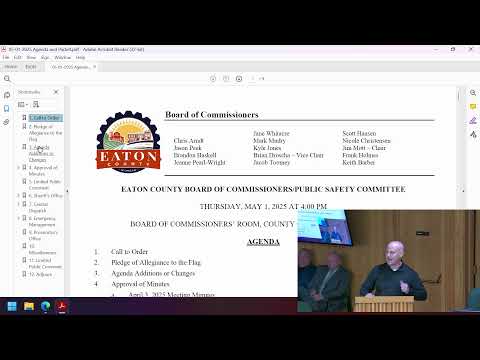
Eaton County Prosecutor Doug Lloyd told the Public Safety Committee on May 1 that recent Michigan Supreme Court rulings expanding resentencing eligibility for young adults will require the county to reopen long-closed murder sentences and impose fiscal and emotional costs.
Eaton County Prosecutor Doug Lloyd told the county Public Safety Committee on May 1 that a Michigan Supreme Court decision expanding resentencing eligibility for offenders who were 18–20 at the time of their crime will force the county to reopen long-closed murder sentences and require additional budgeted resources.
Lloyd said the county already has multiple cases affected by the 2022 People v. Parks opinion and a 2025 Michigan Supreme Court decision he identified as People v. Sarnisky, and that the rulings extend resentencing review to a broader age group. "I would expect that it would take about $25,000 per case," Lloyd said when explaining the anticipated fiscal impact of pursuing resentencing or defending life-without-parole sentences at new hearings.
The prosecutor framed the change as a legal development that will require him to notify victims’ families and bring defendants back to court. "I've ripped the band aid of trauma off of them," Lloyd said, describing the burden placed on victims who must again confront defendants in resentencing proceedings.
Why it matters: Lloyd said the county faces both emotional and financial costs—he cited an expectation that the prosecutor's office will incur additional case-processing and victim-notification expenses—and urged commissioners to understand a pending controller budget request tied to those costs. He told the committee that county staff asked the controller for additional funds (he referenced a request of $200,000 as an explanation for related budget activity) and said prosecutors will "be taking a strong look at arguing to the courts that life without parole is appropriate" where the facts support it.
Details Lloyd provided included workload statistics for his office in the prior month: 309 new cases, 777 hearings attended, 6,739 open cases, 274 victim interactions, and 41 subpoenas issued for 33 cases. He explained the legal background by citing the U.S. Supreme Court decision Miller v. Alabama and the state opinions he named, which have expanded the courts' requirement for individualized sentencing review for young adults.
Lloyd said the local impact includes three cases currently identified as under the earlier 18-and-younger guidance and three more cases falling into the newly covered 19–20 age bracket. He also provided a statewide figure he attributed to the ruling: "579 defendants" in the 18–20 age range whose sentences are implicated, and said thousands of victims statewide could be affected.
The committee did not take formal action on the prosecutor's report during the meeting. Lloyd answered one procedural question from the committee about appellate options, saying nationwide Supreme Court review was unlikely to alter the state ruling.
Looking ahead: Lloyd said his office will participate in resentencing hearings and seek to prove in individual cases that life without parole remains warranted. He framed the budget request as driven by the need to notify victims and litigate those hearings rather than by prosecutorial policy change alone.