Get Full Government Meeting Transcripts, Videos, & Alerts Forever!
Get email alerts on the Labor Unions topic
No spam. Unsubscribe anytime.
Senate labor committee adopts technical amendment and hears bill to let rideshare drivers organize
Summary
The Minnesota Senate Labor Committee on May 1 adopted a technical A1 amendment to Senate File 3229 and held an informational hearing on a bill that would let rideshare drivers choose to organize and collectively bargain with transportation network companies (TNCs) such as Uber and Lyft.
The Minnesota Senate Labor Committee on May 1 adopted a technical A1 amendment to Senate File 3229 and held an informational hearing on a bill that would let rideshare drivers choose to organize and collectively bargain with transportation network companies (TNCs) such as Uber and Lyft.
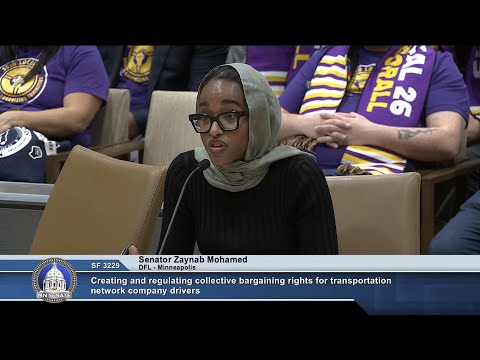
Senator Mohammed, the bill—s sponsor, told the committee the measure —gives rideshare drivers the right, if they choose so, to organize, to negotiate, and to vote on the terms of their work.— He said the framework is modeled partly on efforts in other states and tailored to Minnesota to ensure "fairness and enforceability." The bill would allow drivers to form or join a driver organization and petition to become the exclusive representative for industry-wide collective bargaining; any agreement would be ratified by a majority of active drivers through a statewide vote, according to the sponsor.
The committee first adopted the A1 amendment, described by the sponsor as technical language requested by the Bureau of Mediation Services to "clean up the bill on who can be at the negotiation table." Senator Kupak moved adoption; the chair called the voice vote and the amendment was approved.
Multiple current and former rideshare drivers testified in support of the bill, describing unpredictable pay, delayed or frozen earnings, and account deactivations without adequate review. Trey Bolton, a rideshare driver since 2018 and a union leader at Fairview Riverside Hospital, said he lost four months of income after a platform incorrectly associated his account with another vehicle and that resolving the error required contacting many representatives. "I lost 4 months of income," Bolton said, adding that drivers have "no protections, no transparency, and no way to advocate for ourselves when something goes wrong."
Driver David Casa described repeated deactivations based on rider claims and urged the committee to create a union so drivers would have "the ability to negotiate fairly and protect our rights through proper representation." Other drivers told the committee of delayed payouts (one speaker said waits of up to 19 days), frozen earnings after alleged fraud totaling $149.73, and slow, inconsistent communications from platforms.
Joel Carlson, who represents Uber Technology and described himself as owner of a legal research and government affairs business, said Uber had not taken a formal position but raised concerns about the bill—s thresholds and scope. Carlson noted the 2024 law requiring minimum compensation, occupational accident insurance and an appeals process for deactivations and said a driver resource center contracted with Somali Community Services has been in operation to handle account and pay problems. He also cited a wage study, saying "Twin City drivers earn $52.94 an hour while they have a passenger in the car," and warned that a low threshold for representation could allow a small percentage of drivers to set conditions for many who work part time.
Brad Leto, secretary-treasurer of the Minnesota AFL-CIO, and other labor supporters urged passage, saying collective bargaining would give drivers who are often immigrants and people of color a stronger voice and regular protections.
Senators voiced support and invited further conversations; Senator Murphur Batin said the bill levels the playing field for drivers who do not have the ability to negotiate standard contracts, and the chair, Jen McGovern, reiterated that collective bargaining is a basic workers' right. The committee held only an informational hearing and took no final vote on the bill itself during this meeting.
Action taken at the hearing was limited to adoption of the A1 amendment; no committee vote on final passage of Senate File 3229 occurred at this session. The bill sponsor and multiple members expressed interest in follow-up meetings with stakeholders and TNC representatives to refine the proposal.