Get Full Government Meeting Transcripts, Videos, & Alerts Forever!
Get email alerts on the Outdoor Dining topic
No spam. Unsubscribe anytime.
Manhattan CB2 reviews 36 outdoor‑dining applications, issues dozens of advisory rulings; enforcement, FDNY waivers highlighted
Summary
Manhattan Community Board 2 on April 23 reviewed 36 sidewalk and roadway dining applications in a single meeting. The volunteer committee issued advisory recommendations — mostly conditional approvals or denials — and repeatedly flagged referral errors from DOT, unanswered FDNY waiver questions and neighborhood enforcement gaps.
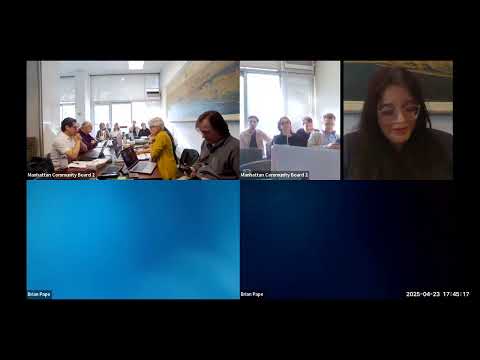
Valerie Dela Rosa, chair of the Manhattan Community Board 2 Outdoor Dining Working Group, called the meeting to order at 5:38 p.m. and told attendees the panel had 36 applications to review and would aim for short public comment and focused business-session votes.
Members said they wanted to avoid delaying businesses while also enforcing public‑safety and pedestrian‑access rules. “I cannot emphasize that enough… our decision is just one piece of the entire process,” Chair Valerie Dela Rosa said. The board emphasized that its recommendations are advisory and that applicants must still satisfy DOT, FDNY and the State Liquor Authority where applicable.
Why it matters: Community Board 2 manages a heavy share of Manhattan outdoor‑dining reviews and its advisory rulings steer whether applicants can avoid costly DOT public hearings or must revise plans. This meeting underscored three recurring threads: (1) errors and missing materials in DOT referral packages that delay local review, (2) requests for FDNY waivers for the 15‑foot emergency lane on narrow streets, and (3) escalating neighborhood complaints about operators who repeatedly violated rules or left structures in place after deadlines.
What the committee did - The working group heard public testimony and applicant comments on dozens of sidewalk and roadway café plans that covered most of the West Village and Greenwich Village/SoHo commercial corridors. Members said many DOT referrals they received had incorrect or incomplete site plans. - The committee discussed FDNY review and the city’s requirement that, on narrow roadways, a 15‑foot emergency travel lane be preserved unless FDNY issues a letter of no objection. Committee members repeatedly asked whether FDNY had issued formal letters for locations that were seeking waivers. - Neighbors and block‑associations repeatedly told the panel they have filed 311 and other complaints about a small number of operators who, they said, repeatedly exceeded permitted setups, left furniture out overnight, or generated noise late into the night.
Votes at a glance (advisory recommendations to agencies) — selected, representative results - Automatic Slims (Bank St.): recommended denial (roadway and sidewalk). Public testimony and submitted 311 records were cited by neighbors as a reason for denial. - Judy Z’s / 17 Seventh Ave S (sidewalk/roadway): recommended denial; neighbors documented longstanding non‑compliant sheds and late‑night noise problems. - Bisou (1126 Avenue, sidewalk): committee recommended conditional denial with requested modifications after residents described persistent noise, smoking and late‑night problems; applicants said they would work with neighbors and police. - Broom Street Bar (West Broadway): committee asked applicant to resubmit clearer, measured site plans and confirmed that barriers/perimeter and table sizes must be shown before the working group will clear the application. - Bar Six (Bar6, Mulberry/West Village): the committee accepted a proposal to add a removable perimeter and to ensure the clear pedestrian path and ADA access; recommendation issued with modifications. - Several applications were approved with conditions or asked to resubmit clearer perimeter drawings where a manhole, transformer vault or fire‑escape clearance was unclear on the plan.
Key concerns raised by the board and the public - DOT referral quality: Committee members said many DOT packets lack complete site plans (missing frontage drawings, incorrect corridor classification or omitted manhole/transformer markings). The board asked DOT to provide complete referral packets before community review so the volunteer committee can reach a timely consensus. - FDNY waivers: Several roadway cafés requested waivers of the 15‑foot emergency lane. Committee members pressed staff to confirm whether FDNY had issued letters of no objection or letters of deficiency; the committee reiterated that FDNY’s letters must be on the record before the board’s recommendation can be treated as sufficient for subsequent licensing steps. - Enforcement history: multiple residents and block associations submitted photographs, 311 records and testimony documenting repeated problems with a small number of operators (late‑night noise, standing patrons, furniture left overnight, and previously installed enclosed structures). Committee members stressed the difference between an application and the subsequent enforcement that must come from DOT, TLC, SLA, FDNY, or DOHMH as applicable.
What applicants were asked to fix most often - Add or darken the perimeter line on site plans and show how servers will access tables from inside the perimeter, not by serving across the clear path. - Show clear, measured distances to building entrances and tree pits, and certify 5‑foot access to building entrances and 10‑foot clear pedestrian path where required by corridor rules. - Mark utility vaults/manholes, transformer vaults and Siamese connections and show the required clearances around them. - Remove or relocate furniture that blocks required clearances, and remove lighting/temporary structures that would become winter enclosures unless permitted.
Board context and next steps - The working group emphasized that its rulings are advisory; DOT, FDNY and the SLA make final determinations for roadway cafés, fire/lane waivers and alcohol service changes. The board asked applicants to return with corrected drawings when DOT referrals were incomplete. - Several applicants said they would revise drawings and return (Bar6, Broom Street Bar, a number of sidewalk cafés). Others were recommended for denial because of safety or neighborhood‑impact concerns combined with a history of violations (notably applications discussed that had extensive 311 and oath summons records).
Ending note: Chair Valerie Dela Rosa closed the meeting noting volunteers’ limited time and the board’s role as an advisory reviewer. Members repeatedly asked DOT, FDNY and applicants to improve documentation and to focus on compliance so that the district’s outdoor dining — which the board said had been a community economic lifeline — can operate in a way that protects pedestrian access and neighborhood quality of life.
Votes recorded in the board’s business session were advisory recommendations to DOT/FDNY/SLA: the committee issued a mix of conditional approvals, conditional denials and straightforward denials; where applicants were asked to resubmit, the board requested corrected, measured site plans and clearer marking of utilities and clear paths.