Get Full Government Meeting Transcripts, Videos, & Alerts Forever!
Get email alerts on the Transportation Tax Policy topic
No spam. Unsubscribe anytime.
Taxes committee advances transportation omnibus after debate over EV fee, transit cuts and Washington Avenue bridge funding
Summary
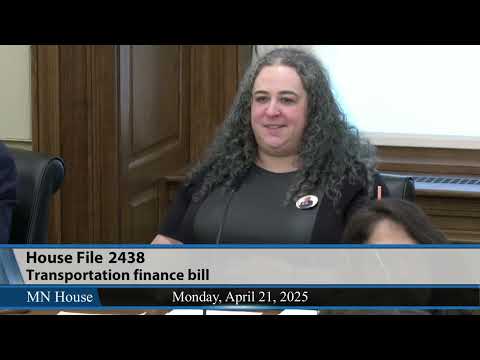
The Minnesota House Taxes Committee on Monday re‑referred House File 2,438, the transportation omnibus, to the Ways and Means Committee after public testimony and a contested amendment over funding for the Washington Avenue Bridge.
ST. PAUL, Minn. — The Minnesota House Taxes Committee on Monday re‑referred House File 2,438, the transportation omnibus, to the Ways and Means Committee after public testimony and a contested amendment over funding for the Washington Avenue Bridge.
The omnibus includes tax and surcharge provisions that committee members and public witnesses said would change transportation funding across the state, including a proposed increase in the electric vehicle (EV) registration surcharge from $75 to $200, cuts to some transit funding, and a change to the timing of state greenhouse‑gas requirements. An amendment (A20) that would have shifted bridge funding to the Met Council’s active transportation fund failed on a roll call, 11 ayes to 12 nays with one member excused.
Why it matters: The bill bundles tax and transportation policy changes that supporters say are part of a negotiated statewide transportation package and opponents say would undercut transit, burden lower‑income EV drivers and delay climate protections. The Washington Avenue Bridge — a high‑use bicycle and pedestrian crossing near the University of Minnesota — drew separate debate over whether locally raised Hennepin County sales tax money should be used or whether regional Met Council funds are the appropriate source.
Chair and sponsor remarks
Representative Kosnick, who described the measure as the omnibus transportation bill, told the committee the package contains “a couple of provisions dealing with taxes or surcharge” and said two technical clarifications were intended to exclude construction materials and heating fuels from a retail delivery fee. He also described an adjustment to “the electric vehicle surcharge in lieu of a regular registration tax or in addition to that.” Kosnick urged members to treat the bill as a negotiated product with provisions from members of both parties.
Public testimony
Anjali Banes, lead of the transportation team at Fresh Energy, said Minnesota’s Highway User Tax Distribution Fund — which draws on the gas tax, the motor vehicle sales tax and tab fees — is not adequately funded and that the proposed EV surcharge increase “does not fix the gas tax problem or the bigger issue of funding our transportation system.” She said Fresh Energy opposed the EV fee increase, a three‑year delay to a transportation greenhouse‑gas impact assessment and transit funding cuts.
Sarah Wolfe, strategic policy director with Minnesota Interfaith Power & Light, said the bill would “undercut our state’s progress” by cutting Metro Transit funding, including proposed reductions of $40 million in FY2026‑27 and $64 million in FY2028‑29 that she said would eliminate general‑fund support for Metro Transit. She called the reductions and a delay of climate provisions “grave concerns” and asked the committee to reject those changes.
Jukka Kupkone, who said he has driven EVs since 2012, told the committee that analysis by the Great Plains Institute and Minnesota Department of Transportation shows EV drivers already contribute more to the highway fund than comparable gas‑vehicle drivers. “I don’t think that it’s fair for us to increase the existing … $75 annual EV tax to $200,” he said, arguing an indexed approach tied to the gas tax would be fairer.
Other individual witnesses, including Philip Adam, William Watkins and Dan Widel, described personal and economic reasons to oppose the $200 surcharge. Kathleen Schueller, state policy director with Health Professionals for Healthy Climate, warned delaying greenhouse‑gas measures would increase air‑pollution health harms and opposed cuts to active‑transport projects such as Safe Routes to School.
Washington Avenue Bridge amendment and roll call
Representative Freyberg moved the A20 amendment to retain bridge funding in the bill but change the funding source to the Met Council’s active transportation fund. “The Washington Avenue bridge is the most used bike and pedestrian infrastructure in the entire state and it’s a regional asset,” Freyberg said, arguing the project connects University of Minnesota campuses and should be paid from a regional fund.
Representative Kosnick and others opposed the amendment, saying the bill as written already provides funding. Kosnick noted the transportation committee had approved language addressing the bridge by a 15‑0 vote and said the bill requests up to $15 million to address the bridge, funded from locally raised transportation sales tax accounts. Kosnick said there is currently about $240 million in a related account. The amendment failed on a roll call: 11 ayes, 12 nays, 1 excused.
The committee’s clerk recorded named votes during the roll call. Members recorded as voting aye included Chair Gomez, Representative Elkins, Representative Freiberg, Representative Hansen, Representative Her, Representative Hewitt, Representative Kozlowski, Representative Lee, Representative Stevenson and Representative Joaquin; members recorded as voting no included Chair Davids, Vice Chair Joy, Representative Anderson, Representative Harder, Representative Johnson, Representative Roach, Representative Robbins, Representative Schwartz, Representative Swazinski, Representative Witty and others. The clerk reported a final tally of 11 ayes and 12 nays with one excused.
Committee action
After public testimony and member discussion — including disagreement about whether the greenhouse‑gas implementation delay is 12 months or three years — Chair Davids renewed a motion that House File 2,438, first engrossment, be referred to the Ways and Means Committee. The committee approved that motion and the bill was re‑referred to Ways and Means.
What remains unresolved
Committee members and witnesses disagreed on several points that may shape floor debate and conference negotiations: the appropriate level and structure of any EV surcharge; the size and sources of transit cuts; whether the bill improperly delays greenhouse‑gas rules; and whether the Washington Avenue Bridge funding should come from regional Met Council active‑transportation funds or Hennepin County’s locally raised sales tax account. Several speakers urged alternatives such as indexing the current EV fee to the gas tax or restoring transit funding.
Next steps
House File 2,438 will move to the House Ways and Means Committee for further consideration. The Taxes Committee noted its next scheduled meeting is April 23.