Get Full Government Meeting Transcripts, Videos, & Alerts Forever!
Get email alerts on the Board Governance topic
No spam. Unsubscribe anytime.
Board reopens minutes, faces public outcry over records and alleged misconduct; seeks outside legal review
Summary
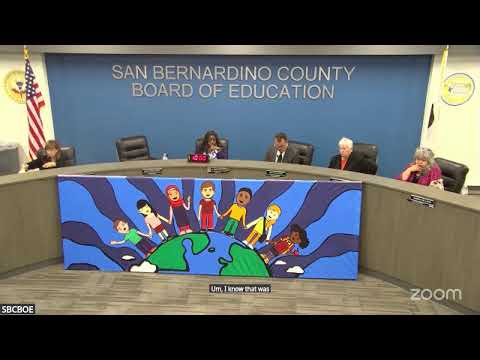
At its Oct. 13 meeting the San Bernardino County Board of Education reopened and rescinded prior approval of the Sept. minutes after extended public comment alleging inaccuracies and failures to disclose records; the board also directed staff to solicit proposals from two outside law firms to conduct a limited independent review.
San Bernardino — The San Bernardino County Board of Education spent much of its Oct. 13 meeting responding to sustained public comment alleging inaccurate minutes, improper handling of public‑records requests and failures of oversight. After a long public comment period, the board reopened its approval of the Sept. minutes, allowed additional public comment, rescinded the earlier approval and then reapproved the minutes; it also voted to authorize staff to solicit proposals from outside law firms to conduct an independent review of a county deputy counsel communication.
Public concerns and what commentators asked for Many members of the public used the meeting’s public‑comment period to press the board on several interrelated issues: alleged inaccuracies in draft minutes of prior meetings, whether public‑records requests (CPRA) have been handled transparently, and allegations involving personnel and student safety in other districts. Speakers called for immediate disclosure of documents and for independent review. Several speakers referenced the Brown Act and the California Public Records Act while urging the board to release material they said the public still had not seen.
Janice Haloka, a K–12 educational consultant, summarized the legal point that several speakers raised. “Under the Brown Act… when documents are distributed to the majority of the board and relate to an item being discussed in open session, those documents must be made available to the public without delay,” she told the board. That line of argument framed multiple public comments requesting release of a deputy‑counsel email mentioned at earlier meetings.
Other public commenters described alleged misconduct in other local school districts and asked the county board to act as an oversight body; those statements were made during public comment and were not the subject of any formal board findings or votes at the meeting.
Board action on minutes and agenda After first approving the Sept. minutes earlier in the meeting, the board agreed to recall item 5.1 so additional public comment could be heard. Following testimony the board rescinded its prior approval of the minutes and then voted again, after public comment and discussion, to approve the minutes. The transcript records the board’s procedural votes as voice votes (“All in favor? Aye… Motion carried”), but it does not include a roll‑call tally in the public record.
Selection of outside counsel The board also took steps to secure an independent legal review of a deputy county counsel communication dated Aug. 22 that members of the public and the board had previously discussed at prior meetings. Rather than select a single firm at the hearing, the board directed staff to solicit short proposals and capability statements from two firms named during the meeting — Liebert Cassidy Whitmore and Young, Minney & Corr (as listed in the meeting record) — and to return with a written summary for the board to consider. The board asked staff to include information about each firm’s experience with county offices of education and for a short scope of work limited to an independent review and analysis of the Aug. 22 communication.
Why it matters Speakers at the meeting repeatedly tied public‑records access, accurate minutes and independent review to public trust in the board’s oversight role. Several public commenters also referenced recent or pending filings with the Fair Political Practices Commission (FPPC) and asked for public disclosure of related documents and any legal fees paid with public funds. Board members and staff acknowledged the volume of requests and committed to clarifying protocols for how communications to the board are received and handled.
Board response and next steps Board members asked county counsel and staff to draft clear communication protocols and to return with those procedures for board review. The board’s direction on outside counsel also requires staff to bring back a short list of firm responses and an explanation of next steps; that material will be used to select a reviewer and define the review’s public release parameters. Board members emphasized that any documents distributed to a majority of the board and used for public decision‑making should be made available to the public in line with state law.
Ending The board concluded the meeting after approving the minutes again, approving the consent calendar and taking the action to solicit proposals from outside counsel. Several speakers told the board they will continue to monitor records disclosures and oversight, and the board asked staff and counsel to return with protocols and the outside counsel summaries at a future meeting.