Get Full Government Meeting Transcripts, Videos, & Alerts Forever!
Get email alerts on the Education Policy topic
No spam. Unsubscribe anytime.
Rules committee advances conference report covering K‑12 and higher‑education technical and policy provisions
Summary
House Bill 15‑15, a broad higher‑education and K‑12 package, advanced after the Rules Committee reviewed a conference report that restores some Senate amendments, adds pilot programs, clarifies collective bargaining, and requires new reporting and planning steps for virtual programs and sudden cardiac arrest response.
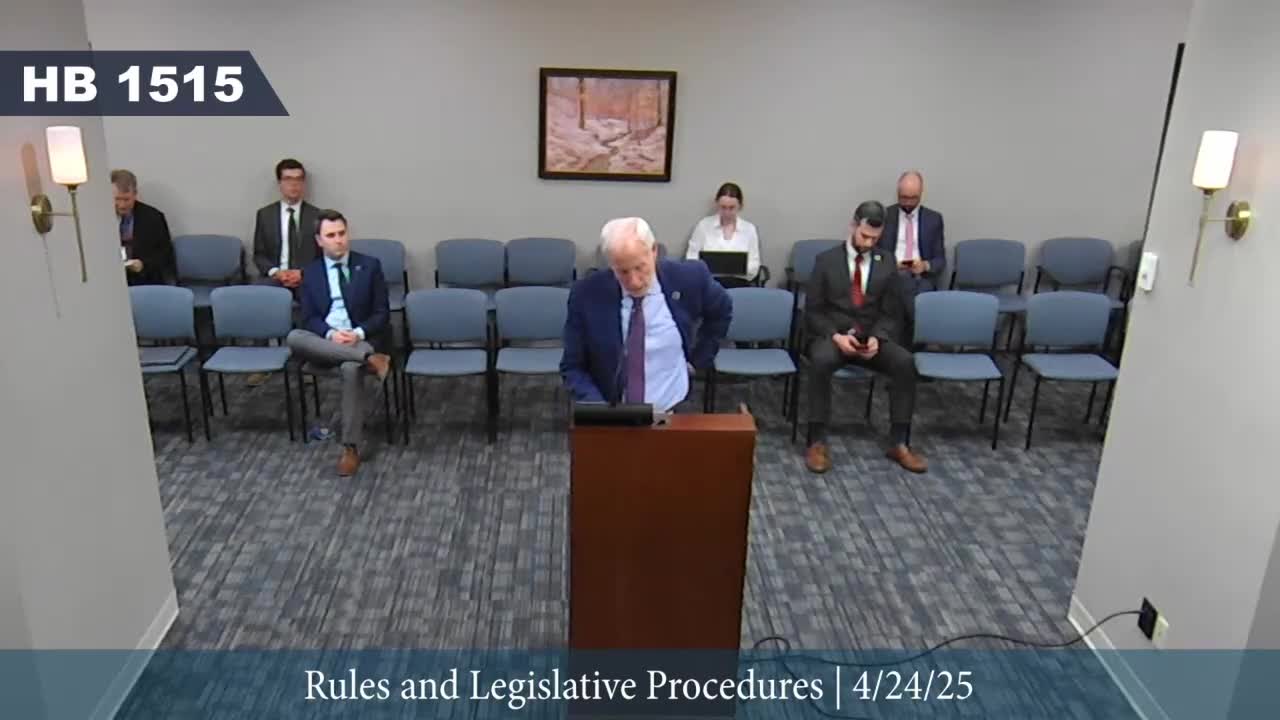
Representative Behning told the committee that the conference report for House Bill 15‑15 covers higher‑education and K‑12 matters and is his final presentation to the committee. He summarized key insertions and restorations: the Senate restored language permitting non‑accredited nonpublic schools to form police departments; language from House Bill 10‑49 embedding a county deputy public defender scholarship fund (restricted to private philanthropy and not general‑assembly appropriations); and language from other bills creating pilot programs for centralized school facilities and student transportation (each limited to three participating local boards).
The conference report also changed the mastery‑based education assessment approach by removing a requirement to seek a U.S. Department of Education waiver and requiring a comparative analysis with the state summative test. Collective bargaining language that had been optional was stricken so collective bargaining remains. The bill includes an Indianapolis Local Education Alliance with mayoral involvement and clarifies the Alliance’s open‑door meeting status; at the mayor’s request the report clarifies the Alliance is not subject to the state open‑door law but must hold its final meeting in public before taking a vote.
Other provisions added from Senate bills include standardized admission‑test requirements for certain health programs and a requirement that public schools provide written notice within 14 days to certain employees or parents regarding unsubstantiated or dismissed allegations. The bill also requires a Department of Education report on academic readiness of students enrolled in virtual programs and directs state boards to adopt rules by Dec. 31, 1926 (as stated in the conference report) for financial reporting and oversight for schools and vendors operating dedicated virtual education schools.
The Rules Committee voted to suspend rules and allow consideration after April 15; the motion passed 7–3.
Action: - Motion to suspend rules and allow distribution/30‑minute hold for conference report on House Bill 15‑15 — Passed, 7–3.
Sources and procedural notes: Representative Behning summarized the report’s components and noted items restored or added from other bills; the committee advanced the report for further consideration.